
 E-Paper



Startup Mantra: One stop solution for healthcare providers
Digital platform integrates with electronic health records allowing customers to use software tools to automate tasks


The healthcare landscape in the US and many other countries, including India, is dominated by the conventional fee-for-service model, driving healthcare providers to focus on quantity rather than quality. The approach has inadvertently led to inflated healthcare costs and subpar patient outcomes. The relentless pursuit of filling beds and performing high-tech procedures often overlooks the genuine needs of patients, casting a shadow on the very essence of healthcare. Healthcare startup Fold Health is fundamentally altering this incentive structure with the new value-based care approach under which the patient welfare is the paramount goal.
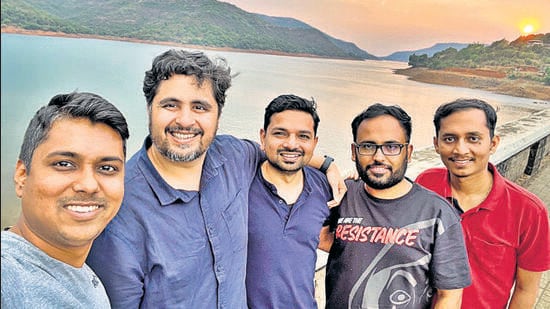
Instead of merely racking up procedures, value-based care emphasises positive patient outcomes. Reimbursement becomes intricately tied to these outcomes, prompting healthcare providers to reorient their strategies toward patient-centred care. The startup founded by serial entrepreneurs Abhijit Gupta, Ram Sahasranam and Dr SV Mahadevan along with Kaustubh Kabra, Akshay Ransing, Varun Wadhwa and Bhavesh Patel is enabling healthcare ecosystem transition to value-based payment models through its “operating system” designed for enabling collaborative care teams to operate at the top of their licence through powerful clinical and operational automation so that they can deepen and extend their ability to deliver proactive, person-centred, preventative care to radically improve outcomes.
Pursuit for healthcare
Born in Lonavla, Abhi did his higher education from Fergusson College and MIT College of Engineering of Pune. After his computer science engineering, Abhi joined a startup Codito (later acquired by Azingo Inc) which had created an end-to-end mobile operating system back in 2004-05 or the pre-Android days. However, after Android disrupted the mobile OS business model, Motorola Mobility acquired Azingo in 2010 and Abhi moved out to start his own healthcare company Praxify.
Abhi said, “In 2009, my mother went through a bad medical condition as I had pushed her to take medications of two renowned doctors from Pune who never bothered to check each other’s prescription, and which later caused her drug-induced diabetes for life. That incident triggered me to meet a lot of doctors from India, US, Middle East, Singapore, etc to understand their decision-making process. I realised that patients are not equipped to provide relevant information to doctors in a correct and consumable manner due to paucity of time, doctors must grasp loads of information in just few minutes which affects their decision making. My team and I got a chance to shadow around 1,800 doctors in 10 years and noticed that doctors are fast decision-makers and thinkers but were getting slowed down by administrative tasks and paperwork.”
Praxify days
Abhi said, “Our first startup Praxify Technologies was born to declutter this whole thing and help doctors give instructions to an underlying electronic medical record (EMR) instead of their resident or junior doctors. We had developed an intelligent voice assistant feature, along with bringing clinical insights at point of care, which was ahead of its time. In India we got good traction but only with corporate hospitals. The revenues to effort did not make sense so we pivoted to the US in the end of 2014. We showcased our products and onboarded some top hospital groups from Miami, US. Our pilot run proved that doctors could save 44 per cent of their time and later we scaled up quickly.”
“During one of the healthcare events, I met with Jonathan Bush who was founder and CEO of athenahealth company. A publicly listed company, Athenahealth later went private and offered to acquire us for ₹410 crore in June 2017. Post-acquisition, activist investors came on board and our product was rebranded. It was one of the largest mobile electronic health records (EHR) deployment in the world. The acquisition was smooth, and Ram and I ran the business line there and scaled it up. It was a good experience for us to witness how private equity (PE)-backed companies work,” Abhi said.
Golden visa
The artificial intelligence, digital economy and remote work applications office of UAE offered a golden visa to Abhi in 2020 and since he found it convenient from US-connectivity perspective, he relocated to Dubai. However, after the coronavirus pandemic hit the globe, Abhi and Ram also decided to take a break.
Abhi recalls, “I had spent a lot of years into healthcare and wanted to explore other domains. I started working with a lot of early-stage founders from agri-tech, ed-tech, fin-tech and invested in several startups. It was a fulfilling journey for me.”
Fold Health
Abhi and the team had started working on the concept of Fold Health in 2021. Explaining the idea behind Fold Health, Kaustubh said, “Due to Praxify, we had got a good amount of exposure to the US healthcare ecosystem. The amount of money put in healthcare in the US is the highest in the world. When we started Praxify it was $1.6 trillion and now it has grown to $4.6 trillion spent per year. Even though the expenditure on healthcare has tripled, the patient outcome has not improved. For comparison, the US spends almost equal amount than the combined spend of rest of world countries. This expenditure is expected to increase up to $9 trillion by 2030 and could be one of the biggest reasons for bankruptcy in the US if it continues. Hence, the US government and other stakeholders started looking at alternative business models. We were seeing this change coming, but the pandemic accelerated this.”
Problem statement
The conventional model of fee-for-service is not sustainable, said Akshay. “In this legacy model, a doctor must see more patients to earn more fees or money. If the patient-outcome must increase without burdening the doctors, then they will have to be provided with several tools. We started our research before launching Fold Health in November 2021 creating a blueprint and spoke with different stakeholders in the healthcare ecosystem like the insurance players, new-age digital health companies, health system CIOs (chief information officers), etc to validate our concept,” Akshay said.
“Our research suggested that early adopters of technology-powered solutions were using point solutions applications which were not designed specifically for the healthcare industry but for the parallel universe. Such point solutions were being ‘retrofitted’ but healthcare providers were finding it difficult to implement while scaling it up. Workflows not designed for healthcare, patient identity not flowing seamlessly from one application to another and more workforce required to manage these tools, were some of the key issues affecting the tech-adoption. Also, healthcare providers were not software companies to use so many point solutions,” Bhavesh said.
Solution, a platform approach
There was a clear white space for a platform that is built grounds-up for solving this need. Explaining the platform approach, Varun said, “The fee-for-service model is poised to undergo a radical change. The entire medicare model will now move to value-based-care by 2030 and has a potential of $2.5 trillion business. Early adopters have started looking for relationship management software, communication engines and task. As several countries have started to adopt this new model, it will come to India soon. Fold Health came into picture while solving for such healthcare-specific tools with a holistic platform approach.”
Team building
Abhi identified a group of 20 people that they would need from day one to kickstart these 14 engines entirely ground up. The group included Fold Health’s now co-founders and ex-Praxify employees – Kaustubh Kabra, Bhavesh Patel, Akshay Ransing and Varun Wadhwa.
Kaustubh spearheads the R&D initiatives and holds a degree in software engineering from Pune Institute of Computer Technology (PICT). He said, “I had joined ‘Praxify’ as a founding engineer and got an opportunity to lead the mobility team. After Praxify’s acquisition, Bhavesh and I founded Phygito in 2020, a company that emphasised cloud and mobile scalability as its core offerings. Eventually, Phygito was acquired by Fold Health. I take care of intelligence studio in which there is an automation engine. We have a forward-looking thought process and plan to include language learning models in near future.”
Bhavesh had co-founded ‘Phygito’ as chief technology officer (CTO) and co-founder. Taking the same vision of growth and patient (customer) engagement in healthcare to the US market with same team, Bhavesh and Kaustubh merged to form Fold Health. Bhavesh now takes care of the business studio in which he manages the omnichannel communication engine, patient engagement, reporting, analytics, etc.
An alumnus of PICT, Varun oversees product and engineering for clinical operations on the platform through the clinical studio. He has pioneered numerous NLP/ML powered workflows infusing assistive intelligence directly into provider’s workflow. He also developed a voice-driven AI assistant enabling physicians to seamlessly execute critical tasks vocally.
A computer science graduate from Savitribai Phule Pune University, and now as VP of engineering at the company, Akshay looks after the data studio and is creating a data warehouse based on multiple types of data collection. He had spearheaded the design of scalable systems, particularly architecting the backend technology stack for Praxify which emphasised microservices-based architecture and the utilisation of cloud native tools. Akshay was the first one to quit his job and join Abhi to research on technologies to develop for Fold Health.
Product-market fit
Abhijit, Ram, and their team decided to achieve the product-market fit (PMF) in the shortest possible time span. Ram got 10 customers (healthcare providers who were early adopters) from the US in just 4 months. In April 2022, Fold Health team started co-building the product with 10 thousand lives from these customers.
Abhi said, “Working with several other founders, I had realised earlier that founders and the teams that were closest to their customers on day zero were the winning horses. Usually, startups and founders do market research, MVP, scout for pilot, work hard to make that pilot a success, do some marketing, run another pilot, show return on investment, and then start scaling up. This takes anywhere between 24-36 months efforts if everything falls in line. We did not want ourselves to get trapped in this cycle. We wanted to achieve our PMF fast and hence we offered discounted price to the first 10 customers. All of them are now our paying customers and three of them have invested in us in our current funding round.”
Next moves
Abhijit wants Fold Health to become a US-focussed story built from India for the world. “Pune is our R&D hub. I personally have strong connection and feeling for Pune city and I believe that the things we need in a talent pool for a platform company like Fold Health is available in Pune. Kaustubh, Bhavesh, Akshay, and Varun are making this successful from our Pune R&D centre. At present, we have nine team members in the US and 45 in India. We are now getting into the enterprise segment and expect our revenue growth and active lives to increase 10x in the next six months. We will also start pitching to insurance companies who will be the most benefited stakeholder within the healthcare ecosystem. The downstream healthcare utilisation cost of insurers will reduce as the patient outcome improves.”


