
 E-Paper



IISER scientists develop ultra-thin electronic devices using novel 2D semiconductor
IISER Pune researchers developed ultra-thin electronic devices using Bismuth Oxyselenide, advancing flexible electronics for smartphones and wearables.

 Prefer HTon Google


Researchers at the Indian Institute of Science Education and Research (IISER) Pune have developed ultra-thin electronic devices using a novel, two-dimensional semiconductor, Bismuth Oxyselenide (Bi₂O₂Se), potentially advancing the future of flexible smartphones, wearable health monitors, smart fabrics, and foldable electronic systems.
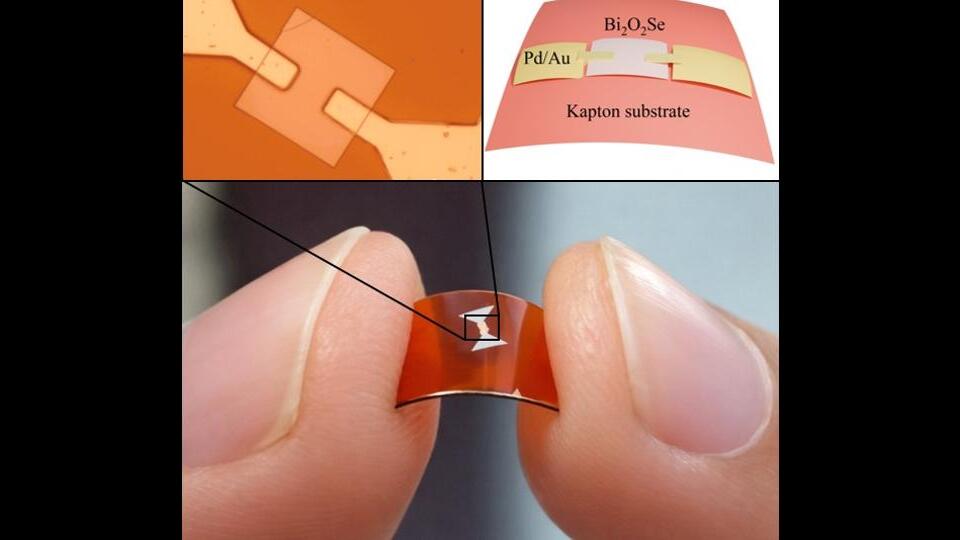
The findings, published on February 3, 2026 in the journal Small, describe a scalable method to grow large-area, atomically thin Bi₂O₂Se nanosheets while maintaining high structural stability and mechanical strength - challenges that have restricted the practical adoption of many 2D materials so far.
As electronic devices continue to shrink while demanding higher performance, traditional semiconductor materials are approaching their physical limits. This has prompted scientists to explore two-dimensional (2D) materials crystalline sheets only a few atoms thick as next-generation alternatives.
Bi₂O₂Se is one such promising material. Measuring only a few billionths of a metre in thickness (far thinner than a human hair), it offers the potential for faster charge transport, improved optoelectronic response, and mechanical flexibility. However, producing large, stable, and mechanically robust sheets suitable for device fabrication has remained a significant hurdle.
The IISER Pune team, led by professor Atikur Rahman from the department of physics, addressed these limitations by developing a simplified synthesis technique to grow large-area Bi₂O₂Se nanosheets just a few atomic layers thick.
According to Rahman, the breakthrough was achieved through careful optimisation of key growth parameters, including temperature, gas flow rate, precursor ratio, and reaction time. Fine-tuning these factors enabled the team to produce nanosheets that are both ultra-thin and structurally stable, an achievement considered technically challenging in the field of 2D materials research.
Using the synthesised nanosheets, the researchers fabricated microscopic electronic devices approximately one-thousandth the diameter of a human hair. The devices were constructed on a flexible Kapton substrate - a durable, plastic-like material commonly used in flexible electronics.
To evaluate mechanical reliability, the devices were repeatedly bent and folded thousands of times. Remarkably, even after extensive mechanical cycling, the devices showed no measurable degradation in electrical performance or light-sensing capability.
Rahman said, “This level of durability is crucial for future technologies such as smartwatches, foldable displays, and wearable medical sensors, where electronic components must remain reliable despite constant movement and strain.”
The research was supported by a grant from the department of science and technology science and engineering research board (DST-SERB). The study represents a significant step towards practical, durable, and high-performance flexible electronics built from atom-thin materials.
Photo caption: Photograph of a working flexible device is shown in the lower panel. Optical microscope images of the device and a schematic are shown in the upper-left and right panels, respectively.


