
 E-Paper



IUCAA-led global team measures universe’s expansion with record 1% precision
The study, conducted by the Ho Distance Network (H0DN) Collaboration, reports the Hubble constant as: Ho = 73.50 ± 0.81 kilometres per second per megaparsec

 Prefer HTon Google


An international team of at least 45 astronomers, including researchers from Inter-University Centre for Astronomy and Astrophysics (IUCAA), has achieved the most precise direct measurement yet of the Universe’s expansion rate, offering new insight into one of modern cosmology’s biggest puzzles, the “Hubble tension.”
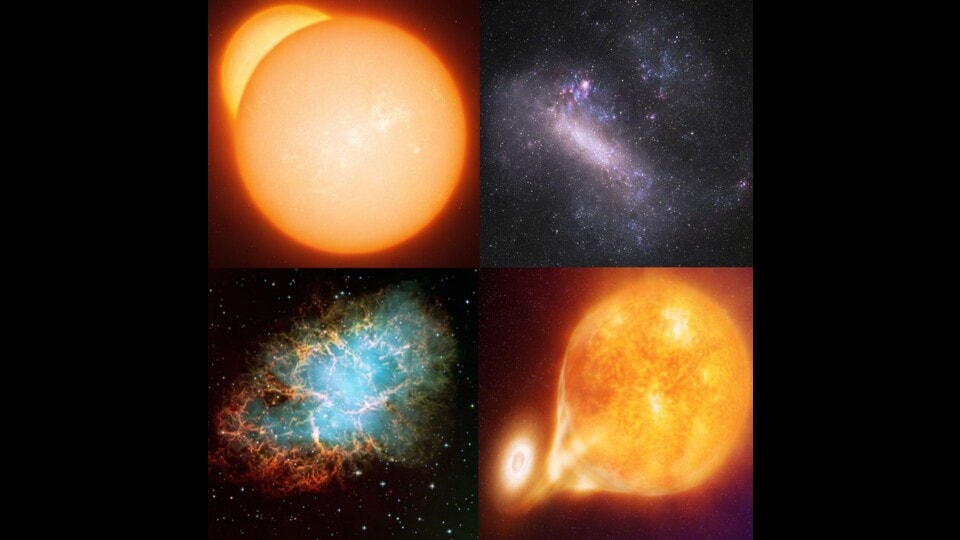
The Hubble tension is the disagreement between the Universe’s expansion rate measured in the nearby Universe and the value predicted from observations of the early Universe.
The study, conducted by the Ho Distance Network (H0DN) Collaboration, reports the Hubble constant as: Ho = 73.50 ± 0.81 kilometres per second per megaparsec.
A megaparsec equals about 3.26 million light-years. The result indicates that for every megaparsec of distance, galaxies are receding about 73.5 km per second due to cosmic expansion.
The work, soon to be published in Astronomy & Astrophysics, achieves just over 1% precision, making it the most accurate direct measurement of the Universe’s current expansion rate to date. The findings also help refine understanding of the Universe’s age, structure, evolution, and the role of dark energy, the mysterious force driving accelerated expansion.
For nearly a century, astronomers have relied on the traditional “distance ladder” method, where cosmic distances are measured step-by-step using interconnected rungs. While successful, this approach is vulnerable to hidden errors propagating through the chain.
To overcome this limitation, the H0DN Collaboration developed a local distance network, which links multiple independent measurement techniques simultaneously rather than relying on a single chain.
The network combines several cosmic distance indicators, including Cepheid and Mira variable stars, Tip of the Red Giant Branch (TRGB) stars, Type Ia and Type II supernovae, geometric megamaser distances, surface brightness fluctuations, the Tully–Fisher relation, and the Fundamental Plane relation.
Researchers describe the system as similar to a subway map, where multiple routes independently connect to the same destination. The collaboration reports that even when major methods are removed or replaced, the final value of the Hubble constant remains largely stable.
The new result strengthens the long-standing Hubble tension, where local measurements of cosmic expansion differ significantly from values inferred from the early Universe under the standard ΛCDM (Lambda-Cold Dark Matter) model.
The H0DN value is nearly 10% higher than 7 standard deviations of estimates based on observations of the cosmic microwave background. Scientists say the agreement across multiple independent techniques makes it increasingly unlikely that the discrepancy is due to a single measurement error.
Researchers suggest that the tension may point to new physics beyond the standard cosmological model, rather than observational bias alone. “If the tension is real as the growing body of evidence suggests, it may point to new physics beyond the standard cosmological model,” the authors noted.
Explaining the significance of the work, Prof Anupam Bhardwaj of Inter-University Centre for Astronomy and Astrophysics (IUCAA) said that stars like Cepheids and Miras are crucial links in the cosmic distance chain.
He said, “ Stars such as Cepheids and Miras play a vital role in connecting different steps of the Distance Network. At IUCAA, we are working on determining accurate luminosity scales of all types of stars that are used as distance indicators. These stellar luminosity scales are central to the local distance network, leading to a per cent-level precise Hubble constant value.”
He also highlighted that IUCAA contributes to the international ISSI “EXPANDING Universe” project, which aims to independently refine measurements of the Universe’s expansion rate.


