
 E-Paper



Khadakwasla Complex’s water storage reaches 91%; authorities begin releasing water
The four dams/reservoirs in the Khadakwasla Complex now collectively hold 26.54 TMC of water, which is 91.03% of their total storage capacity

 Prefer HTon Google


Due to heavy rain over the past two to three days in the ghat regions, the collective water storage in the Khadakwasla Complex comprising Khadakwasla, Panshet, Warasgaon and Temghar dams/reservoirs, reached 91.3% on July 27 prompting the irrigation authorities to begin releasing water from the reservoirs. According to the irrigation department, the Khadakwasla dam began releasing water at the rate of 18,482 cusecs on July 27 around 6 pm. Additionally, water is being discharged from the Panshet and Warasgaon dams at the rate of 3,608 cusecs and 9,074 cusecs, respectively.
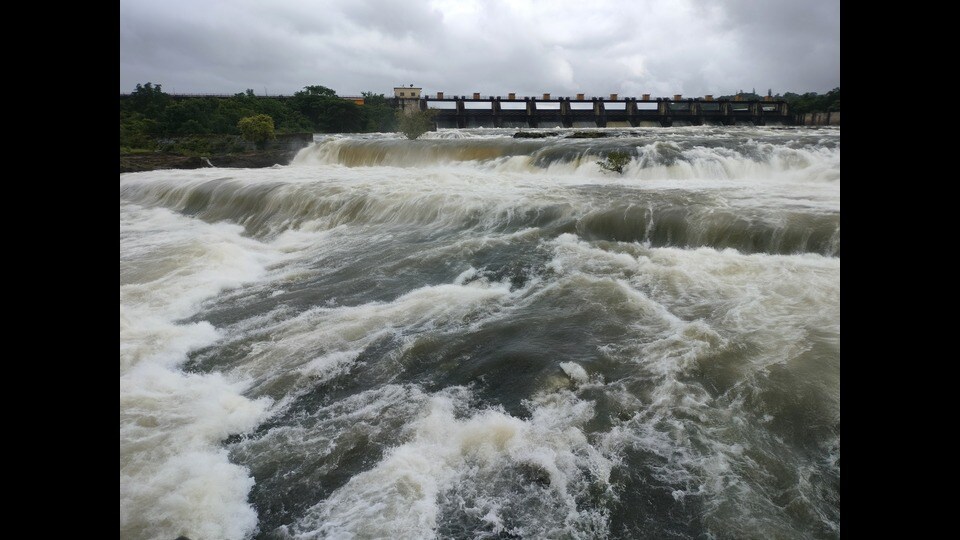
The four dams/reservoirs in the Khadakwasla Complex now collectively hold 26.54 TMC of water, which is 91.03% of their total storage capacity. This is significantly higher than 23.48 TMC or 80.57% of their total storage capacity during the corresponding period last year. The total inflow across all four dams stands at 395 million cubic feet (mcft) while Khadakwasla dam alone has released 5.57 TMC of water over the spillway so far.
Mohan Bhadane, sub-divisional engineer, irrigation department, said that the release of water from the Khadakwasla dam was entirely stopped on July 19. However due to fresh inflows, the release was resumed on July 26 with an initial outflow of under 2,000 cusecs which was gradually increased to over 18,000 cusecs by 6 pm on July 27. The dam is expected to continue releasing water for some time, considering the forecast of ongoing rainfall. Bhadane also emphasised that water is being released from the Panshet and Warasgaon dams as well as part of the standard flood control measures, and the situation remains completely under control.
Meanwhile, water is being released from the Ujani dam as well. According to official data, Ujani dam currently holds 52.4 TMC of water, amounting to 97.13% of its capacity. Presently, water is being released from the dam at the rate of 51,600 cusecs. Raosaheb More, executive engineer, Ujani dam project, said that the dam receives inflow from about 18 upstream dams. The current outflow may increase to 60,000 cusecs but there will be no significant impact on downstream villages unless the discharge crosses 120,000 cusecs. He assured that the situation is well under control.
Active monsoon conditions have brought intense rainfall to several parts of Maharashtra over the past few days, especially in the Konkan region and the ghat areas of Pune, Satara, and Kolhapur districts. Data from the India Meteorological Department (IMD) shows that in Pune district, locations such as Tamhini and Davadi in Mulshi tehsil have received over 200 mm of rainfall in the last three days. Other areas, including Lonavala, Walwan, Shirgaon and Dongrewadi have seen more than 150 mm of rainfall during the same period. Earlier this month, rainfall in these regions remained in double digits or was completely absent. The IMD’s latest forecast indicates continued heavy rainfall in the ghat areas of Pune for the next 24 hours, after which the intensity is expected to reduce.
In addition to the Pune and Solapur districts, Jayakwadi dam in Chhatrapati Sambhajinagar has also recorded substantial water levels. The latest data shows Jayakwadi dam at 82.76% capacity. Given the current inflow scenario, authorities may initiate water release from Jayakwadi soon.
Box:
Rainfall activity expected to subside across Maha
The recent active monsoon conditions have brought much-needed rainfall to several parts of Maharashtra, notably benefiting Marathwada, which had been facing a major rainfall deficit since the beginning of this monsoon season. With the recent showers, Marathwada has now reached ‘normal’ rainfall category.
However, according to the latest forecast from the India Meteorological Department (IMD), rainfall activity is expected to subside across most parts of the state. The color-coded weather map indicates that significant rainfall is likely to persist only in select regions—specifically, the ghat areas of Pune, Satara, and Kolhapur, along with the entire Raigad and Ratnagiri districts.
In contrast, the rest of Maharashtra is unlikely to see any major rainfall in the coming days. Light to moderate showers are expected in the Vidarbha region over the next three to four days, and a yellow alert has been issued accordingly. No weather warnings have been issued for other parts of the state as no significant rainfall activity is forecasted there.


