
 E-Paper



Noise beyond permissible limits across city but MPCB misses key locations during immersion procession
On the morning of September 18, Holkar Chowk recorded its highest noise level at 112.5 decibels followed by Khandoji Baba Chowk at 110 decibels and Belbag Chowk at 109.2 decibels

 Prefer HTon Google


The initial data regarding noise levels this Anant Chaturdashi provided by the Maharashtra Pollution Control Board (MPCB) revealed that the pollution watchdog missed key locations on the immersion procession route. Whereas noise recorded in the Mandai area by the MPCB was 94 decibels which too is beyond the Central Pollution Control Board’s (CPCB’s) permissible limit. On the other hand, noise level data shared by the College of Engineering Pune (CoEP) Technological University highlighted that the average noise level at Lakshmi Road was much higher than the standard limit and Belbaug- and Holkar- Chowk recorded the highest noise levels at 118 decibels. The CoEP noise data also highlighted that the daytime noise level at Lakshmi Road was less compared to that at night.
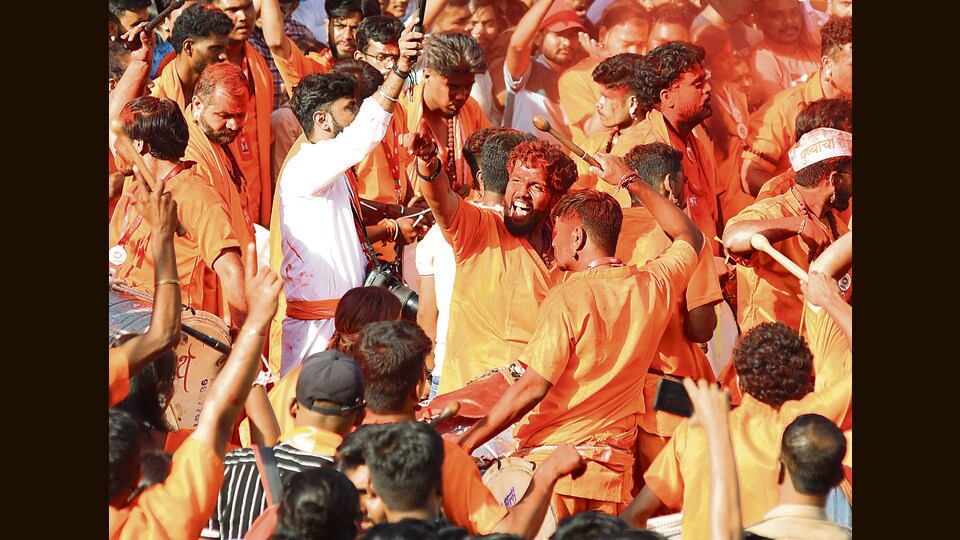
On the morning of September 18, Holkar Chowk recorded its highest noise level at 112.5 decibels followed by Khandoji Baba Chowk at 110 decibels and Belbag Chowk at 109.2 decibels. The average noise level during the immersion procession on September 17 was recorded as 94.8 decibels while the lowest noise level was recorded as 50.1 decibels at Khadoji Baba Chowk at 4 am on September 18.
The CoEP through its department of applied sciences and humanities has been conducting the noise monitoring exercise for the last 24 years. This year too, the university conducted noise monitoring at 10 locations on Lakshmi Road along which the immersion procession passes. Mahesh Shindikar, head of the department, said, “The noise monitoring is being conducted through spatio-temporal and scientific methods. Noise levels are being recorded for 24 hours at 10 different locations on Lakshmi Road and it is not about the source of noise but the intensity of noise that is heard by the common people standing at the location to witness the grand procession. The monitoring is mainly conducted for study, research and awareness purposes. Nearly 20 students participated in this initiative and it has been planned by Ira Kulkarni and Mehar Raghatate, who are also students of the department.’’
While the National Green Tribunal (NGT) has issued very clear guidelines about noise- monitoring and control by the MPCB and police, many dhol-tasha pathaks and Ganesh mandals were seen flouting norms with impunity during the immersion procession even as police officials failed to keep a check on the use of DJ systems during the procession.
While the MPCB carried out noise level monitoring at 11 locations across Pune and Pimpri-Chinchwad, key locations such as Lakshmi Road, Tilak Road, Kumthekar Road and Kelkar Road were seen to be missed out by the pollution watchdog. J Salunkhe, regional officer, MPCB, said, “The locations were decided by us as per the guidelines and hence, the monitoring was conducted accordingly.”
He also said that the initial noise level data on the immersion day shared by the MPCB is an average data of both day and night time monitoring across all locations. The one-day data highlighted that the noise levels at all 11 locations were beyond the CPCB’s permissible limit. However, noise levels were marginally lower at several locations as compared to last year.
Marginal increase in noise levels on first five days of Ganesh festival
As per the NGT order issued on August 30, noise level monitoring was carried out by the MPCB on the first five days at 21 different locations in Pune and Pimpri-Chinchwad. Of the 21 locations, 18 were in Pune city and three in Pimpri-Chinchwad. The data revealed a marginal increase in noise levels at several locations in both Pune and Pimpri-Chinchwad. On the first day of the festival, the Mahatma Phule Mandai area recorded the highest noise level at 90 decibels. Last year, the highest noise level recorded in the same area was 92.96 decibels. At the same time, areas like Shivajinagar, Satara Road, Karve Road, Swargate and Khadki recorded an increase in noise levels by two to four decibels as compared to last year.
Ananad Saraf, who studies noise levels during the Ganesh festival, said, “The noise pollution during the Ganesh festival has become a serious concern. The main reason for ineffectiveness of the existing law is the dual policy of the government. While plastic and thermocol bans proved effective during the Ganesh festival, the ban on excessive noise has not been effective. The government should ban the manufacture of equipment that generates excessive noise but due to vested interests, no government is willing to take strict action against this. If not addressed soon, the issue will certainly have an adverse impact on the Ganesh festival in the coming years.’’


