
 E-Paper



Pune dist needs to step up Covid testing, say experts
In the Pune district, between April 1 and April 7 as many as 1,50,365 tests were conducted, while from April 8- April 14 as many as 1,96,778 tests were conducted, according to the district administration


With the Covid tally rising, health experts have pointed out the need to increase testing. Many labs and hospitals are delaying test reports, claim patients.
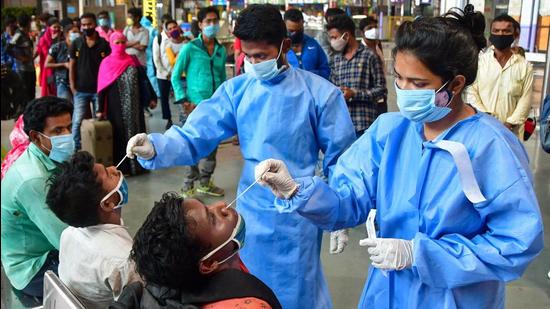
Gajanan More, a resident of Kothrud said that on Thursday, he went to several labs for testing, but all of them said that the reports will come late. “I went to private hospitals for testing and they said that the reports will come in four days. After which I went to a private lab, they said that the kits are over and they can send a person to take a sample by the next day,” said More.
In the Pune district, between April 1 and April 7 as many as 1,50,365 tests were conducted, while from April 8- April 14 as many as 1,96,778 tests were conducted, according to the district administration. In Pune Municipal Corporation (PMC) limits, meanwhile, between April 1 and April 7 at least 1,40,823 tests were conducted and from April 8- April 14, at least 1,66,815 tests were conducted.
Ayush Prasad, chief executive officer (CEO) of Zilla Parishad said, 35,000 antigen kits would be given to 234 hotspots in rural Pune for mass testing in the next three days (from April 15).
“We are hoping to get more people tested in Pune rural to ensure that good medical care is given to them and there is no further spread. Till April 17, we will be mass testing every person of each household who frequently goes out for work. This will help isolate and treat various patients at the early stage avoiding complications and further reducing death rate,” he said.
Dr Vichar Nigam, Internal Medicine, consultant physician and diabetes specialist, Columbia Asia hospital, said that at a 40 per cent positivity rate, this is certainly one of the worst Covid waves the city has ever seen, owing to unregulated gatherings, and complete disregard of Covid safety norms.
“We did not learn any lessons from the spike in cases that happened after festive celebrations last year. Few things are different this time. So far, the death rate is lower than last time. More deaths are reported in people above 60 years of age and with comorbidities. Approximately one-third of the infected patients are in their 20s and 30s which is more than last time,” said Dr Nigam.
He added that instead of individuals, we are seeing entire families getting infected, which possibly indicates that the virus or its mutant strain that is causing the infection is less virulent, but more transmissible.
“There is an urgent need to check the increasing number of infections to ensure that the healthcare providers can offer services to the more critical patients. Besides, every step must be taken to continue the current pace of vaccination, and try to speed it up so that more people are covered within a shorter period. Besides, public campaigns must be planned to increase awareness about the importance of Covid protocols and vaccine hesitancy,” said Dr Nigam.


