
 E-Paper



SPPU’s Marathi Bhasha Bhavan Remains Inactive
The Marathi Bhasha Bhavan, inaugurated in May 2024, remains inactive, raising concerns about mismanagement and hindering Marathi language promotion at SPPU.


Around one-and-a-half years after its inauguration on May 1, 2024 by the Savitribai Phule Pune University (SPPU); and nearly 10 years after it was first envisioned in 2016 as a centre of international standards for the promotion of Marathi and other languages, providing resources for students, professors, writers and researchers – the Marathi Bhasha Bhavan – remains completely inactive, raising serious concerns about administrative efficiency, resource management, and the future of language preservation at premier universities.
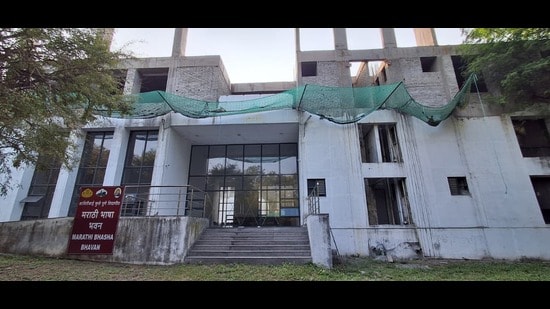
The Bhavan has seen no official activity since its grand inauguration last year. There is no faculty appointed, no administrative authority and no academic programmes at the Bhavan. Conceived with the aim of fostering Marathi language learning, cultural preservation and research, the Bhavan was to host 20-22 classrooms; a large library; reading halls; and modern facilities for workshops, seminars, and translation projects between Marathi and other languages. Committees appointed by the SPPU including senior scholars had proposed up to 15-16 sub-departments, ranging from textbook development, translation, and teacher training to folklore studies, linguistic research, and language certification. However, these initiatives remain dormant while the building itself stands incomplete. The Bhavan exists today only on paper.
On his part, Prabhakar Desai, committee head for the project, said, “The upper slabs are under construction. Once completed, internal leaks will be fixed. Central approval for the project has been obtained, and minor internal and external works reportedly remain. These will be completed by this year, and it will be functional from next year.”
Vice-chancellor (VC), SPPU, Suresh Gosavi, had earlier said that the university is committed to making the Marathi language centre a facility of international standards and that steps are being taken to speed up construction.
When contacted, Tukaram Rongate, current head of the Marathi department, SPPU, said, “The work is still ongoing. The building lacks electricity, fans, and basic facilities. While our department was ready to shift, construction was incomplete and unsafe. Minor delays in construction and financial constraints have held up progress.”
The SPPU’s failure to make the Marathi Bhasha Bhavan operational not only undermines the promotion of Marathi but also reflects poorly on the university’s accountability and planning. The inaction is worrying in light of the SPPU’s ₹650 crore annual budget. A substantial portion of the budget has already been spent on the Bhavan but there is no tangible output. Allegations of administrative mismanagement, substandard work and wasteful expenditure have further intensified the scrutiny. For instance, ₹2.5 crore was reportedly spent on illegal installation of lights and ₹4.5 crore on fibre optic cables, but neither the lights nor cables are functional or visible. A few months ago, the Yuva Sena (Uddhav Balasaheb Thackeray) had highlighted severe infrastructural deficiencies such as leaks and torn plaster; and a lack of basic amenities such as chairs, tables, water supply, lighting and toilets.
With the project remaining in limbo nearly 10 years after inception, it is feared that the vision of a vibrant, international-standard language hub may remain unrealised unless urgent corrective measures are taken. So much so that activists and scholars are now questioning the rationale behind inaugurating a half-finished building in a high-profile ceremony, with some alleging that it was aimed at projecting achievement.
Rahul Sasane, president, University Students’ Struggle Action Committee, said, “The Marathi Bhasha Bhavan was inaugurated last year. However, no kind of work is actually taking place there. No appointments have been made at the Bhavan. Marathi has been given the status of a classical language, but everyone is waiting to see what strategic decisions will be taken in future. Immediate appointments should be made and work should commence.”
For now, the Bhavan represents both promise and neglect. Conceived as a beacon for language learning and cultural preservation, it has instead become a symbol of delay, poor planning, and unfulfilled potential. There is need for concrete action to transform the existing dormant structure into the thriving language hub it was intended to be.


