
 E-Paper



Startup Mantra: 360-degree flexible shoes for children
Getting a shoe with the right size and comfort for your toddler or teens can be a real challenge for parents


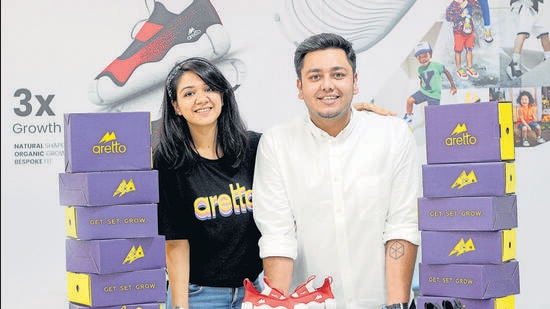
Getting a shoe with the right size and comfort for your toddler or teens can be a real challenge for parents. Children’s feet outgrow the shoe size within months. On one hand, parents don’t want to buy cheap products which may hamper the natural growth of their child while on the other hand, they don’t see ‘value for money’ in purchasing branded footwear which is a shrunk version of the for-adult products. Realising this very common problem across geographies and socio-economic sections of society, Satyajit Mittal and Krutika Lal founded Aretto (Sanosyzo Private Limited), a footwear technology startup company, based out of Pune. Building a go-to children-focused footwear brand deep-rooted in technology, superior quality and trendy styles at affordable price points driving maximum value, the duo wishes to unlock the ultimate comfort for growing children with 360-degree flexible shoes which grow up to 3 sizes.
In the beginning…
Mittal is an innovator turned entrepreneur with over 23 patents, six designs and three trademarks. An MIT product design alumni and second-time founder, Mittal launched his first product ‘SquatEase’ in 2018. SquatEase was awarded the best innovative product in Swachh Bharat Mission 2019. Co-founder Lal is Mittal’s school friend, who is an advertising and marketing professional and has worked with multinational corporations (MNCs) and thriving startups.
Says Mittal, ‘SquatEase’ has been licensed out in India in 2020. But when I travelled for that product design, I met a lot of people and came across all walks of life. I used to see a lot of children without any footwear, especially in tier 2 or 3 cities. Even in tier 1 or cosmopolitan cities, most children were wearing the wrong shoe size.”
“I started reading about the importance of footwear for children and how big a challenge children’s footwear has been in terms of sizing and fitting etc. I was curious why nobody has solved this obvious problem. There existed a few solutions like adjustable straps, but that required human intervention. I thought about building a concept that will not require any human intervention and still the footwear will organically grow as the child’s feet grow,” he added.
Findings
Mittal and his team researched for about six months during the lockdown in 2020. Bringing a non-footwear perspective to a footwear company, the team developed interesting insights. Sharing those insights, Satyajit says, “There are 1.4 billion kids in the world between 0 to 14 years of age and India is the third country with the largest population of kids (first is China). The largest footwear producer globally is China and the second is India. But the largest footwear consumption happens in the USA followed by China and then India. In India, the average footwear per person is 1.8 (one person has an average of 2 pairs) while in the USA it is 4.6. Also, 1 out of 3 children is wearing the wrong shoe size at any given time hampering their natural growth.”
“We observed that in India, the footwear consumption is growing 27 per cent year-on-year (YoY) and another shift is happening from unorganised to organised (branded) footwear. Also, the leather footwear segment is going down and textiles (synthetic) shoes, especially sportier athleisure wear are on a major rise. So, we realised that Indians are ready to pay for the value they get – either utility or comfort. Comfort was a major concern for millennial parents. If we could prolong that one shoe cycle usage from 3-6 months to 12-18 months then it would make sense for customers to pay more,” Mittal said.
Research and product design
After conducting research and understanding the market needs, Mittal and Lal’s team started working on the product design.
Says Lal, “We first narrowed down on two categories - school going and everyday wear – because children spend about 8-9 hours using this footwear. However, all branded footwear for children was basically a shrunk-down version of adult products. Anatomy of child’s feet, proportions are different from adults. We approached Dr Govind Singh Bisht, podiatrist and footcare specialist, to understand the various aspects like sole thickness, breathability, etc to be incorporated in the kid’s footwear product. We also worked with 50 families to understand how their children walk and accordingly made several changes during the prototype to final product design.”
Making the ‘last’ was the most important part of our designing process, says Mittal. Adding further, he said, “The ‘last’ governs the shape of the shoe and it is an anatomical ‘copy’ of our feet. We made our own ‘last’ from scratch for which we acquired the necessary technical abilities. During the process, we also realised that we need a design centre, where originality is key if we want to build a large disruptive company in India.”
“We took inspiration from the flowering process. The shoe flaps expand outside (like petals of a flower) as the show would grow. We have applied for a patent in India and PCT (worldwide) and we’ve received the international search authority report from WIPO with 16 claims as innovative and patentable, filled design patent applications and trademarks as well,” Mittal informed.
Production
Aretto has a staggering production capacity of about 3,500 pairs per month. Elaborating on the process, Mittal said, “We nominate vendors for the sole, insole and the upper part of the shoes. We have transferred technology to vendors and we give moulds to them. They punch out the product and ship it to the Alpine facility where it is assembled, quality assurance checks are done and then shipped to us. It is a 90-day cycle. Our production capacity can be increased to 3500 pairs per day if needed.”
“The fabric quality, sole quality and cushioning checks, and bonding test for flaps are conducted at the facility. All environmental and ecological norms are followed along with using water-based prints (no chemicals, no smell) for surface printing on shoes. We’ve bootstrapped the startup through the development of the technology, tested it and produced it to serve the masses of India and eventually go global,” Mittal added.
“We made almost 200 design iterations, 50 tests on kids and then the final run came in September 2021. The fabrication started in November 2021 and the prototype was delivered in January 2022. However, we waited for six months and did testing thoroughly. After testing, some problems were identified in May 2022, changes were made and moulds finalised accordingly. Now within a few days, we will receive our final products,” he stated.
Positioning
Lal said, “Shoe is ultimately the amalgamation of comfort, style, look and aspiration. We started working on the visualisation, packaging and price positioning of our product. We are hoping that our flagship product will be around ₹2,500 and we are also introducing a penetrative product at ₹999.”
“We have activated preschool networks including independent bungalow preschools and franchise preschools and we are talking to each of them. We have mapped about 200 preschools with an average count of 80 students. So, we have 16,000 children who are our potential users. Another school has agreed to buy 3,000 pairs from us. We also did a validation round with 250 parents. We had offered parents to pay only ₹399 and use the shoe. If they don’t like they will get an entire refund and the shoe will be collected back,” Lal added.


