
 E-Paper



Startup mantra: Building community of credit-aware customers
This fintech startup has built a community of credit-aware customers through simple, transparent education and giving them access to digitally enabled state-of-the-art credit consumption products and experiences.


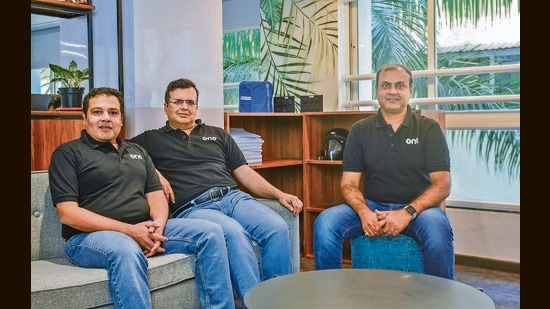
On a mission to re-imagine credit and payments from ‘first principles’, Anurag Sinha, Rupesh Kumar, and Vibhav Hathi founded FPL Technologies in February 2019. Through OneScore app, to monitor credit score and credit report for free, and OneCard, a mobile-first credit card built on a full stack proprietary technology platform, this fintech startup has built a community of credit-aware customers through simple, transparent education and giving them access to digitally enabled state-of-the-art credit consumption products and experiences.
In the beginning…
Anurag, Rupesh and Vibhav, all experienced bankers with expertise in payments, credit, as well as building and scaling digital businesses, were fortunate to see in close quarters the customer-shift from bank interfaces to third-party interfaces. The trio was convinced that the future of interfaces will be led by tech-companies specially on the consumer side. Anurag and Vibhav quit their jobs and founded their first startups. Anurag exited his startup post-acquisition while Rupesh was still working in a leading bank.
Says Anurag, “We understand the strengths and weaknesses of banks. While brainstorming, we agreed that our customer experience should be our core differentiation. To do that we needed to build a full stack platform. We evaluated many products, including consumption credit products.”
Affordability gap
Consumer credit is a very well understood opportunity and we are still bridging the gap between aspiration levels and income levels in India, said Anurag.
“A better way to fund this affordability gap is to build an engagement-oriented product rather than a disbursement-oriented product. In the former, customer interaction frequency is much higher and hence the technology interfaces play a major role. We observed that credit card is one such ‘high-touch’ and flexible product. It is very suitable to customers, but also very dangerous if the customer doesn’t understand to manage their credit, because it is revolving credit.”
Explaining it further, Anurag said, “Most of the customers don’t think they are ‘borrowing’ when they take a credit card. They assume that they will pay on time and make some rewards. In every other product, interest rates or processing fees, etc occupies your mind, but in credit card it’s an afterthought that you might revolve credit or take an EMI.”
OneScore
The founders started discussions with bureaus, to get access to partnerships and agreements. They registered FPL Technologies in February 2019. They started sketching the product, took help of freelancers and within a month hired four employees.
Anurag said, “There are a large number of customers who have got access to credit, but penetration is not good enough. For example, 400 million people are there in bureau, only 35 million have credit cards. It is almost 250 million people who are sitting in top 50 cities and probably still don’t have product like credit card. As a company, our starting point is to give credit to people who do not have access to credit.”
“If we have to drive mass adoption, access to interest-free credit and revolving credit is a killer proposition. However, it’s our job to teach our customers how to manage the credit. Because if the credit management is not great, customers will have a bad experience which will scar them for their life. So, in June 2019, we came up with launching OneScore as our first product.”
No spam
OneScore is an education-cum-management product and its objective is to build a community of users who understand credit very well.
Anurag says, “Most credit-related institutions expect that their customer know what is borrowing. Also, nowadays, the loans per customer are increasing. Buy Now Pay Later (BNPL) offers are also actually small ticket loans. Hence, management and education of this credit segment was a white space.”
“OneScore is a ‘no-spam’ product. We don’t take access to customer’s emails or messages. We work in the backend with credit bureaus like TransUnion CIBIL and Experian. We present a lot of data and insights to customers. Our focus is more on to help people understand credit score and manage credit better. It’s purely ‘no agenda product’. We don’t sell anything there,” he claims.
Credit score
Before OneScore arrived, RBI, since 2016, had allowed consumers to get access to their credit report freely. But customers didn’t know where to look for it and often ended up at some aggregator websites and further got spammed.
Adding further, Vibhav said, “Majority of customers used to check scores just before they took loans. However, after 2018-19, we observed the trend was changing and people had started actually looking for score when they were not interested in loans. Customers had realised that if their score is bad, it’s too late to fix it.”
“One of the first things we wanted to do was how do you tell people that your score changes every month. So, we put a small graph which shows the projected score for next month, just to imbibe on the customer’s mind that their next month score is coming. A notification is sent every month to them. People loved this experience. Also, this ‘soft-enquiry’ does not appear in the bureau report nor does it negatively affect them,” added Vibhav.
•100k users in first month of OneScore app launch
•Total 12 million downloads of OneScore app till March 2022
•1.3 million average monthly downloads (mostly salaried)
•25 to 30 per cent of customer is new to credit (Haven’t borrowed, but still check score)
•0.5 million used OneScore calculator to check viability of moratorium during lockdown
•Users age group – 23 to 30 years
•Gender breakup: Male - 75 per cent
•50 per cent customers from top 25 cities
OneCard
After launching OneScore, FPL Technologies team started building the credit card product parallelly since July 2019. The team hit certification timelines around January 2020. A waitlist was launched on OneScore in January 2020 and the first beta card was issued in February 2020.
Anurag informed, “Within 30 days, 100k people had signed up for OneCard. Another waitlist had to be opened because OneCard app is still in beta because we want to moderate the issuance. Both waitlists together, the demand went up to 300k, because it was unique and dynamic, based on customers data, and the action they do. The customer’s number in the list went up and down.”
“Credit card is a very long tenor asset, but margins are very thin in lending business. We wanted to work with partners who have larger pool of money. They should be larger, stable and have cheap cost of funds. In India, only banks have these three. Besides, bureau data gave a lot of advantage for us to build models which in turn helped banks to underwrite these customers,” he added.
•Number of OneCard users not disclosed officially (part of bank portfolio); Users spread across 5 banks
•Highest activation and spend per card
•One user makes 8 to 9 transactions in a month and visits the app 20 times in a month
•OneScore to OneCard conversion – 60 to 70 per cent
Covid Impact
After RBI blocked the data reporting to bureau during the first lockdown, the fintech startup took a hiatus for three months after issuing first 100 cards.
Vibhav said, “During the first lockdown, banks were flush with liquidity. They were asking us to lend more and hence when that lockdown was lifted in June 2020, we issued about 1,000 cards. But in credit business you just can’t push more because you have to collect money back too. So, we don’t have a ‘Apply Now’ option in OneScore. Customers are invited if they fit into one of the models worked out with the bank partners.”
SecureCard
While the startup was scaling up rapidly, second wave of Covid-19 hit the country which proved more devastating for the startup. The issuance of cards was stopped for a couple of months.
Anurag recalls, “We realised that we need to work with more banks so that our liability pool is more diversified. A large part of our customers was either new to credit or their score was bad. We launched a new product called ‘SecureCard’ to help them build their credit score. We launched this with the SBM Bank India. Users were offered secure credit against their fixed deposit with the bank. It also expanded our product portfolio and no customer was rejected. They were given secure credit and once they built a good history they would shift to unsecured product.”
Serious partnerships
An Indian consumer uses debit cards of multiple banks, their net-banking and UPI services, all at the same time. Talking about the product and its tech architecture, Rupesh said, “Financial institutions in India are ‘vendorised’. Core banking stack of Indian banks, is most advanced as it is built by Indian IT companies and customers and developers sit together and iterate. But in case of credit card stack, the most transaction intensive ones, banks use the stack built by the US vendors in 1990s. They have to be certified by Visa and MasterCard along with lot of security certifications by regulators. Hence, their ability to change and customise is limited. On the other hand, India is leapfrogging. We have customers coming directly on UPI and they are opening bank accounts on mobile. This is why banks are now looking at fintech partnerships seriously.”
“We believe that the next generation of financial institutions will be built on own-tech. It will allow them to control customer experience end-to-end from the time the customer hears your product till the time he has any problem with the product. Customer is expecting more personalisation and they want us to collaborate. This collaboration will happen primarily through technology. To create this differentiation in our credit card product, we have built the platform on which we run the entire lifecycle,” Rupesh stated.
•Total 260 employees
•3.5 lakh credit cards issued so far
•Partnerships with 7 banks
•Certified and audited quarterly by banks and bureaus in terms of information security, etc
•Operates in risk and compliance framework approved by banks
Funding
•Total funding since launch $125 million
•First round led by Sequoia India, Matrix Partners India - $4.5mn – May 2019
•$10mn Series A round – April 2020
•$35mn round led by Sequoia, QED - Jan 2021
•$75 million Series C round led by QED Investors along with Janchor Partners, Sequoia Capital India, Matrix Partners, Hummingbird Ventures – January 2022
•Equity raised at a post-money valuation of $750 million
Anurag said, “We were lucky to get backed by investors very early. Our investor profile is a good mix of people who understand financial services, technology and Indian ecosystem very well. They also like our tech-based approach and our partnerships with banks.”
Revenue streams
Anurag said, “OneScore has no revenue stream. We have issued more than 3.5 lakh credit cards across banks. Our revenue model is essentially performance-linked service fees coming from the bank after interchange and other fees, operational expenses, cost of funds, etc are deducted. We have a good mix of card issuers and non-issuers. Banks partner with us because they want to get access to the digital savvy customer base. Operating agreement is signed with banks and as per that agreement, FPL Technologies manages entire customer lifecycle from origination to customer service to rewards and running the platform.”
Future plans
Scoring works on the availability of data and the ability to use that data. Says Rupesh, “India has four bureaus and the data is federated, so you can apply your mind to improve the scoring. Besides bureau data, we are now getting data from regulated entities like account aggregators and we are super bullish on that. In future, companies which are holding consent will be more valuable. Legitimate models can be built on this regulated data. Customers can revoke their consent whenever they want. Database underwriting, identity verifications, etc are proliferating. We are not yet live with account aggregators, but in future we will connect with them.”
•Total addressable market for OneScore – 0.5 billion people
•Active monthly base on OneScore – 2 million
OneScore Survey (Feb-Mar 2022)
•20 per cent surge in women users inspecting their credit score in FY21 vis-à-vis FY20
•Study conducted on 35 lakh users of OneScore app across the country out of which 4 lakh were women
•Bengaluru, Hyderabad, Pune and Mumbai hosted the maximum number (20 per cent of total) of credit conscious women
•Over 60 per cent women had an ‘excellent’ credit score of over 750
Credit Industry in India
•Four credit bureaus in India – TransUnion CIBIL, Experian, Equifax and CRIF High Mark
•Retail credit industry in India is worth $612 Bn (TransUnion and Google report)
•Only 50 per cent of adult population is in credit bureaus
•Cost of credit scoring is cheaper in India as compared to world
•190 million unbanked individuals in India left out of mainstream financial services due to lack of credit history (World Bank)
Competitors
•CreditVidya – Alternate credit scoring platform – Hyderabad
•Perfios – Real-time credit decisioning platform – Bengaluru
•Credit Kudos – Open banking API solutions to check credit scores – London (UK)
Finance technology startups
•India – 4,595 (DPIIT recognised – 2046)
•Maharashtra – 1,136 (546)
•Pune – 237 (100)
Source: Startup India Portal, Government of India


