
 E-Paper



Survey identifies 12 broad dialect regions of the Marathi language in Maha
The findings of the survey as well as the audio-recorded survey data are now freely available to the public on a dedicated website, www.sdml.ac.in

 Prefer HTon Google


According to an extensive survey called ‘Survey of Dialects of the Marathi Language’ or SDML carried out in Maharashtra from 2017 to 2023 by Deccan College, Pune, along with Rajya Marathi Vikas Sanstha, Mumbai, there are ’12 Broad Dialect Regions’ of the Marathi language in the state. The survey – conducted across 277 villages in 34 districts of Maharashtra – has revealed many other interesting, dialectal facts. The findings of the survey as well as the audio-recorded survey data are now freely available to the public on a dedicated website, www.sdml.ac.in.
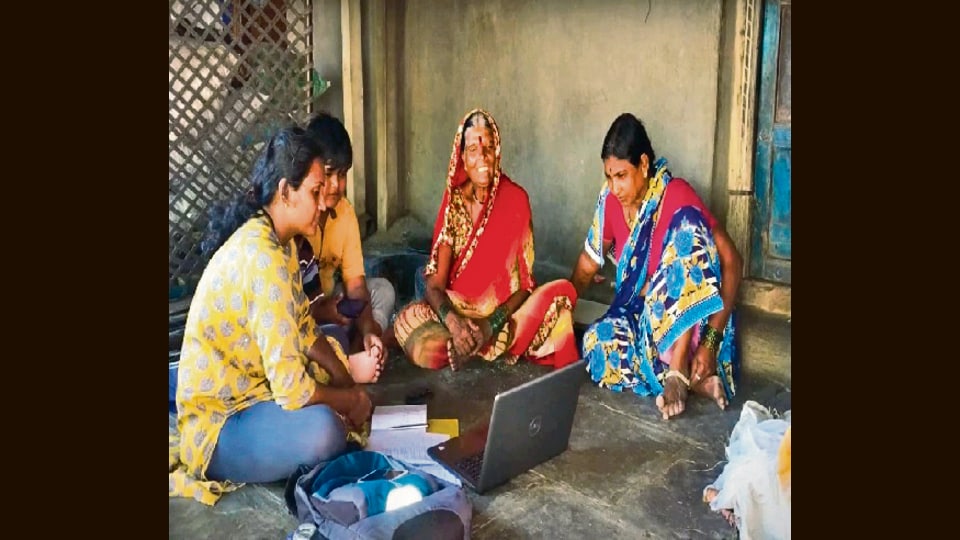
Professor Sonal Kulkarni-Joshi, SDML project head and professor of Linguistics, Deccan College, said, “The primary aim of carrying out the SDML was to create a linguistically annotated digital database of existing social and regional variations in the Marathi language. The second important aspect was to produce a dialect atlas of Marathi based on linguistic methods. The annotated database of this huge survey and the dialect maps are available on the project website, which is available in both Marathi and English. These can be freely downloaded and are open for all.”
“Three kinds of data were collected in the survey – data at the word level (namely selected vocabulary items), the grammar level, and data in the form of narrations which were collected in the sampled villages. Audio-linked and linguistically annotated narrations from each sampled village are provided on the project website. The whole idea was to create a primary resource for researchers of the Marathi language. We believe that this is the most comprehensive survey of the Marathi language since Sir George Grierson’s Linguistic Survey of India (1903-1928) during the British rule which included the Marathi language-speaking areas,” Kulkarni-Joshi further said.
Senior coordinator and member of the project, Dr Manasi Kelkar said, “Earlier surveys of Marathi that were carried out by various scholars had a more focused scope; SDML was mostly about the rural Marathi-speaking people across 34 districts of the state. We used the criterion of grammatical features to identify dialect regions. This has been attempted for the first time for any Indian language in order to identify broad dialect regions.”
The final report is currently available in the Marathi language and has been submitted to the Maharashtra government.
About the utility of the survey, Kulkarni-Joshi said, “By using computer technology and the technique of dialectometry, it will now be possible to objectively measure the distance between standard Marathi and the regional dialects. The survey findings will also be useful to formulate the educational policy. Apart from research and education, this language material can also be used by computer professionals and in the field of language technology. Voice-operated apps, inter-dialectal translation, etc. can now be attempted for Marathi. Language technology tools can be developed which will be very useful for people in rural Maharashtra.”
“The website can be used to introduce dialects of Marathi to school children in an interesting manner. In future, this digital content and the tools in the field of artificial intelligence (AI) can be used to create language games, self-study materials, etc. Moreover, anyone who is curious about the regional and social varieties of Marathi language will surely enjoy the audio-tour of Marathi dialects which is available on the website. Generations to come will have the opportunity to listen to the voices of previous generations of Marathi speakers. Conservation and preservation of local speech varieties is an urgent need today and this will be partially fulfilled through this survey and website,” said Kulkarni-Joshi.
Box
According to SDML, there are ’12 Broad Dialect Regions’ of the Marathi language in the state which are as follows:
1. South Konkan - Sindhudurg, Ratnagiri, Kolhapur
2. Raigad - Raigad, Thane
3. Thane - Thane
4. Khandesh - Palghar, Nashik, Dhule, Nandurbar, Jalgaon
5. Varhad - Buldhana, Akola, Washim
6. West Vidarbha - Amravati, Wardha, Nagpur, Yavatmal, Washim
7. East Vidarbha - Nagpur, Gondia, Bhandara, Chandrapur, Gadchiroli
8. East Marathwada - Parbhani, Hingoli, Nanded
9. North-central Maharashtra - Aurangabad, Ahmednagar, Jalna, Nashik
10. South-madhya Maharashtra - Pune, Satara
11. Eastern Maharashtra - Kolhapur, Sangli, Solapur, Beed, Osmanabad
12. Dravidian Eastern Maharashtra – Sangli, Solapur, Osmanabad, Latur, Nanded


