
 E-Paper



Taste of life: Dining cars on tracks, chugging on race, caste lines
Demand for separate dining cars rose partly from growing affluence of native population and from inspiration derived from racial struggle elsewhere in the world, particularly in the US


Pune: The British colonisation in India was marked by the deeply disturbing phenomenon of racism. India formed a cornerstone in the arch of European imperialism in Asia, and it was there that racism reached its high watermark in the heyday of the British Rule. It permeated all the services and constituted a cardinal feature of the alien rule throughout the nineteenth century and beyond.
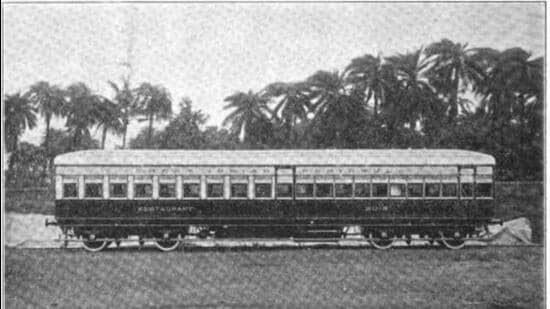
On August 9, 1929, the Marathi newspaper “Dnyanprakash” reported that the Great Indian Peninsular (GIP) Railway’s advisory committee had met in Bombay the previous week and had decided to attach separate dining cars for Indian passengers to three trains originating from Bombay — the Bombay – Poona Express, Bombay – Calcutta Express via Allahabad, and the Punjab Mail.
There were four classes of carriage run by Indian railway companies – viz, “First Class”, used only by wealthy Europeans and government officials; “Second Class”, patronised generally by Europeans throughout India; “Intermediate Class”, filled principally with natives and servants of Europeans travelling by the train; and “Third Class” for the so-called “lower caste” natives. Dining cars in trains till then were reserved only for First Class European passengers.
It was not the first time that the railway authorities had thought of providing Indian passengers with a dining car. In 1924-25, separate dining cars for the natives were attached to the aforementioned trains. However, according to the railway officials, the experiment was unsuccessful since very few Indians used the facility.
The GIP Railway had since then been taken over by the Government of India, and its officials felt that there was some demand for a dining car for Indians. They hoped that it could generate some income for the railway company while facilitating native passengers.
The demand for separate dining cars rose partly from the growing affluence of the native population and from the inspiration derived from the racial struggle elsewhere in the world, particularly in the US.
In March 1904, Judge Jacob Trieber decided in the United States Circuit Court at Little Rock (Pulaski County) that “Black Americans” were not to be barred from dining cars when travelling on first-class tickets when stops were not made at stations for meals. The decision was rendered in the case of Mrs WH Haley, a “Black American” woman, who was refused a meal on a dining car while being a passenger on a first-class ticket between St Louis and Little Rock. Judge Trieber declared that the duty of railroads to keep their passengers safe from injury would permit them to establish separate dining rooms for the races, on the ground of trying to avert race conflicts in which injury or death might result.
There were some who were suspicious about the success of separate dining cars in India. EH Batliwala, a lawyer from Bombay, wondered in a letter written to a Bombay newspaper if such a move would be welcomed by European travellers who might feel their superiority challenged and threatened by Indians patronising dining cars, even if segregated. He also wondered if Indian passengers belonging to different castes and religions would dine together during the journey.
Caste distinctions and fear of pollution had prevented the natives from travelling much in the early days of Indian railroads, but they seemed to have solved the difficulty in some way or another, and by the early twentieth century, they travelled by thousands. However, eating food and drinking water during the journey was a major obstacle that both Europeans and Indians faced.
Hindus followed minute rules regarding restrictions on feeding and social intercourse. These rules mandated what sort of food or drink could be accepted by a person and from what castes, and varied according to regions in India. The separation enforced by religions and castes was so strict that even the cooking of meals was to be performed by people of their castes and communities. Travellers, hence, carried their food with them or went hungry during the journey.
The drawback to European travellers in India had been the lack of good hotel accommodation and refreshment rooms. Europeans took meals at wayside stations; sometimes they happened to be fairly good, but equally often quite uneatable, while the times at which passengers were obliged to partake of them often proved highly inconvenient. The delay to the train for refreshment ran into several hours. For example, the Bombay to Calcutta train via Allahabad had to stop for six hours during its journey to allow its passengers to eat at the refreshment rooms at intermediate stations in the late 1920s. As a result, European passengers often demanded dining cars, but operating those was not easy and made the journey expensive.
At the beginning of the nineteenth century, few trains in India had dining cars. The management of the GIP Railway introduced a dining car for the Bombay – Poona Special Express in July 1904. After that, the “Poona race special” train between Bombay and Poona was fitted with a restaurant car where Indians were not allowed. Each car was fully equipped with linen, crockery, and cutlery. The interior was luxuriously furnished and upholstered.
Poona was an important railway station where the GIP Railway and Southern Maratha Railway (SMR) companies operated. The SMR, in connection with the GIP, provided a route from Bombay to the southern districts in Mysore. The GIP ran from Burma to Poona. From Poona, the SMR ran south to Londa (Karnataka), just outside Portuguese territory, where it joined the main line, branching off again at Hubli and running through Birur, and via Bangalore city to Mysore and Nanjagudi.
Till 1918, once a week, a dining car for First Class European passengers was run on the Poona – Bangalore Express, after which it became a daily occurrence. Dining cars for Indian passengers became operational on this and the Poona–Mysore Express after 1932.
The separate dining cars for Indians on GIP trains were operational from 1929 to 1933, after which they were discontinued for a few years due to a lack of demand, only to be resumed in 1944.
After India attained independence, the Central Advisory Council for Railways met on April 10, 1948, under the chairmanship of the Minister for Railways, Dr John Matthai. Considerable discussion centred on the question of the retention of dining cars. While the consensus in the meeting was that greater attention should be paid to the provision of meals in refreshment rooms at stations rather than in the trains, it was felt that this would cause a lot of inconvenient detention to long-distance trains. Hence, the Council decided that the then arrangements of attaching dining cars to long-distance trains should continue with the provision that both Indian and Western style food would be provided in them.
The 1960s saw the discontinuation of dining cars by the Indian Railways, and they were gradually replaced by pantry cars. Refreshment rooms were the primary choice till most of the 1980s.
The refreshment rooms, or the lack thereof, at Poona Railway Station were often complained about by European passengers. In the late nineteenth century, a demand was made to invite a certain Mr Kellner, a prominent caterer from Calcutta, to run the facilities at Poona.
This story is for next week.
Chinmay Damle is a research scientist and food enthusiast. He writes here on Pune’s food culture. He can be contacted at chinmay.damle@gmail.com


