
 E-Paper



Taste of Life: How Jamsetji Bund watered Poona cantonment, bazaar and native town
Poona is situated in a high tableland and was exposed to frequent and long droughts. The streams of rivers Mula and Mutha united not far from the city; but their bed lied much below the plain on which it was built, and at seasons when they were the fullest, water could be raised from them only with great difficulty


The development of a modern city is an interesting exercise to watch. Plans are drawn, projects submitted. A few get completed. These plans and project reports provide us with an insight that helps us to connect with the city better.
After the Peshwa was banished from the city, the British extensively worked towards expanding Poona and Kirkee cantonments. With more troops came new markets, bigger roads, and larger civilian settlements. Arrangements had to be made to provide water to the ever-increasing population of the city.
Between 1830 and 1880, a few hundred papers and project reports were written to design schemes to supply sufficient water to the cantonments. They were all, more or less, mixed up with the supply to the city of Poona. This made their execution troublesome.
Poona is situated in a high tableland and was exposed to frequent and long droughts. The streams of rivers Mula and Mutha united not far from the city; but their bed lied much below the plain on which it was built, and at seasons when they were the fullest, water could be raised from them only with great difficulty.
One of the most important surveys to assess the need for water in the Poona cantonment was carried out in 1832. “Poona is very much resorted to, particularly in the rainy season, from June till October, on account of its pleasant and salubrious climate. In Poona, the fall of rain averages from 22 to 25 inches annually; whereas at Bombay it is about four times as great. The range of the Ghauts, properly called the Sahyadree range, which rises up as a precipitous barrier 2,000 ft. high, with peaks considerably higher, receives the full burst of the monsoon; so that Khandalla on the top of the Ghauts is drenched with almost perpetual rain for four months. Then the clouds pass on, relieved of their watery burden, and the rainfall eastward of the Ghauts is much less”, it stated.
Drought was reported somewhere in western India every year between 1835 and 1845. The “Bombay Courier” wrote of the “despair” of the “cultivators of the soil”, who “dread a late and untimely fall of rain”. In March 1844, “a great deficiency of the harvest” was reported in Poona due to a failure of the November rains. In early 1845, newspapers were already reporting apprehensions for a drought in Bombay “from the defective fall of rain during the past two seasons”. The predominant complaint during this period was a shortage of water throughout the Bombay Presidency.
The response of the Bombay Government was apparently slow, and plans to create reservoirs in Poona in December 1845 were cancelled following the heavy monsoon of 1846.
Before that, in 1840, it was determined to dam the streams of the two rivers below their point of union, so as to secure at all periods of the year a sufficient supply, and to connect the pond thus formed by suitable works with a reservoir at the city, 9,000 feet in distance from the dam, and elevated 112 ft above it.
During the seven months of annual drought, the streams filled but a small portion of their channel; but in June and July, after a heavy fall of rain, they sometimes rose as much as from 15 to 20 feet in height in 24 hours. The difficulty of erecting a wall 18 ft high and 850 ft long, strong enough to resist such a flood might be imagined. Plans were obtained from England, and the dam was completed in 1845, but cholera had broken out in the neighbourhood, and but a few people could be got to work. So, it was finished nearly a month later than was expected.
The river came down a fortnight sooner than was looking for – the very day the work was completed and before the mortar had hardened sufficiently to withstand the shock – and the whole gave way.
It was rebuilt and again burst through two years later.
Sir Jamsetjee Jeejeebhoy, the illustrious entrepreneur, owned a sizeable property in the cantonment area. It was estimated that the property would need 5,000 gallons of water per day. Jeejeebhoy realised that he had to step in to provide a clean and constant water supply to the cantonment as well as his estate.
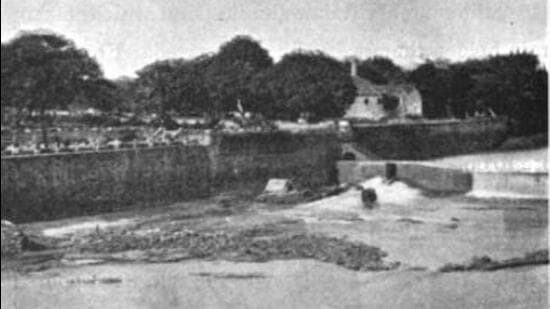
His substantial philanthropy and far-sightedness resulted in the construction of “The Jamsetji Bund”. It was one of the most interesting objects in the neighbourhood of Poona - a large bund, or embankment, solidly built of hewn stone over the Mutha-Mula rivers for the purpose of providing supply of water for the cantonment, and especially the bazaar and the native town connected with it.
The total cost incurred for the construction of the bund was ₹257,499, of which ₹173,050 were donated by Jeejeebhoy.
The bund was 853 ft long and 17 ft high in the centre. It consisted of a masonry dam, built across the stony bed of the river at a distance of about 3,000 yards from the centre of the cantonment; on the upstream side was a sloping pavement with an inclination of 12 to 1 from top of the bund to bed of the river. The principal object of the gentle inclination of the upstream slope was the hope of lessening, if not entirely obviating, the sedimentary deposits which were the bane of all bunds in India, which presented an abrupt wall to the direction of the stream; and the device, with the probably efficient assistance of the four sluices, each on the bed of the river, appeared to have answered its purpose.
On the downstream side of the bund was a reservoir with a filtering apparatus, from which the water was pumped into the cantonment through cast-iron pipes, by pumps worked at first by bullock-power, but afterward by steam, through iron pipes leading to the cantonment.
The work commenced in March 1844 and was completed in 1850, from which date up to 1873 it afforded an unfailing supply of water to the Poona bazaar and cantonment.
Since the opening of the canal from Lake Fife, otherwise known as Lake Khadakwasla, and the completion of the water-supply scheme connected with it, in 1873, the bazaar and cantonment of Poona no longer drew their water from the Mutha-Mula.
After the construction of the bund was completed, the Commerce and Merchant magazine noted that “Poona has gained one of the greatest blessings that can be bestowed on any city and more especially on one within the tropics”.
Philip Lewis Hart compiled the various schemes devised to provide water to the Poona and Kirkee cantonments. More about these schemes the next week.
Chinmay Damle is a research scientist and food enthusiast. He writes here on Pune’s food culture. He can be contacted at chinmay.damle@gmail.com


