
 E-Paper



Taste of Life: The forgotten art of Poona’s lifelike clay figures
The first documented artisans in Poona were Bapuji Supekar and Kaluram Gavandi, who opened shops selling clay figures in the 1840s

 Prefer HTon Google


The practice of making durable representations of fruits and vegetables in materials such as clay and wood has a long history in many parts of the world. By the nineteenth century, this tradition developed into a more specialised craft in India, where artisans produced remarkably lifelike models of fruits and vegetables alongside figures of people and animals.
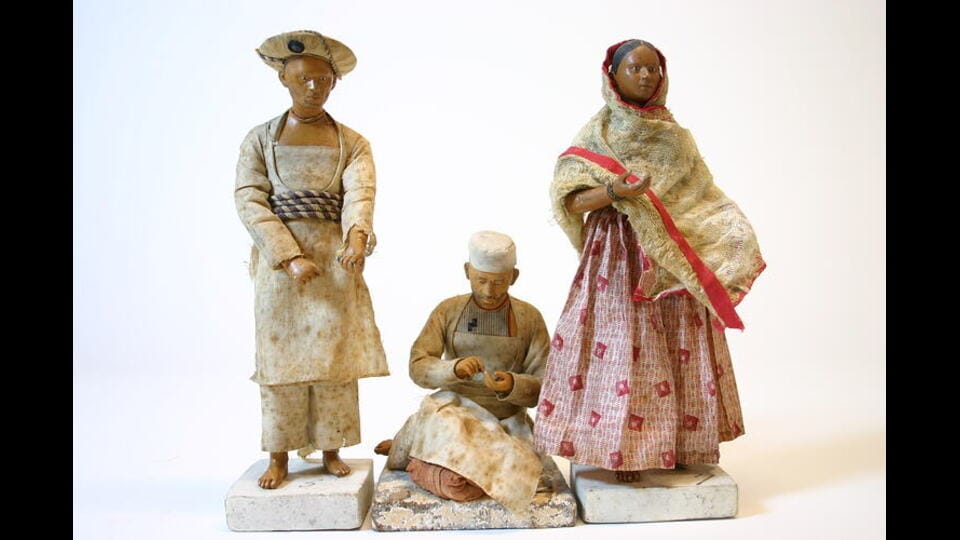
Poona was famous for its elaborate and lifelike models of men, women, animals, and objects, including fruits and vegetables. Known as ‘Poona’ or ‘Poonah Figures’, they were valued for their detailed modelling, colouring, and dress, which depicted the characteristic features of different castes and classes of western India.
The first documented artisans in Poona were Bapuji Supekar and Kaluram Gavandi, who opened shops selling clay figures in the 1840s. They were followed by expert craftsmen including Tatya Vevhari, Sitaram Joshi, Daji Narayan, Sakharamsheth Sonar, Raghopant and Maroti Gurav. Unlike the pottery quarters of Bengal, where clay work was largely a hereditary occupation, figure-making in Poona developed across caste communities. The Gazetteer of the Bombay Presidency (1884) notes that the masters who attained the highest level of detail belonged predominantly to the Jingar, Sonar (goldsmith), and Maratha communities.
The clay models attracted buyers in India and abroad and were displayed at international exhibitions during the nineteenth and early twentieth centuries, including London’s 1851 ‘Great Exhibition of the Industries of All Nations’. Trailokyanath Mukhopadhyay, writing in “Art-Manufacturers of India (1888)” for the Glasgow International Exhibition, recorded that the Poona Municipal Corporation estimated the annual output of the clay-model business at ₹10,000.
The Poona craftsmen made figures representing an astonishing range of occupations and social types: spinners, weavers and goldsmiths at work; water-carriers, milkmaids, camel drivers and messengers; astrologers, ascetics, fakirs and wandering Vaidus; Parsi men and women; and Brahmin women worshipping the sacred tulsi plant.
They also modelled scenes of everyday life, including cooking and dining and gatherings around a public well. More theatrical subjects included European travellers being carried in palanquins, tiger hunts, princes attacked by tigers, and Koli highwaymen waylaying Marwari traders. Among the most characteristic was the native fruit-seller’s shop, with its miniature representation of the produce and activity of a marketplace.
Fruit and vegetable models formed another part of this craft.
Fruit and vegetable models had several practical and decorative uses. In the nineteenth century, painted terracotta specimens were adopted by European botanical societies and agricultural academies as durable didactic tools to classify regional fruit cultivars, illustrate grafting techniques, and document plant diseases when fresh harvests were unavailable.
Fresh fruit was seasonal, perishable, and difficult to transport over long distances, whereas a carefully made clay replica could preserve its appearance indefinitely. Models could be displayed, collected, and carried elsewhere without losing their form. They could also introduce unfamiliar Indian produce to people who had never encountered it in its natural state. For collectors and visitors, a miniature fruit and fruit stall could function at once as a decorative object, a souvenir, and a compact representation of Indian life.
European residents and travellers were among the customers for ‘Poona’ fruit models, buying them as souvenirs and curiosities to take home. Parsee owners of curiosity shops in Bombay also provided an important market for the Poona craftsmen.
The making of the figures required considerable skill despite the simplicity of the materials and tools. According to the Gazetteer of the Bombay Presidency (1884), the craftsmen worked with “shadu”, a fine white clay, “khadu”, a chalky clay, torn country paper, and finely ginned cotton. The materials were soaked in water and pounded together until they formed a smooth, workable mixture. Each craftsman adjusted the proportions according to their own judgement.
The figures were constructed in separate sections. The head, arms, trunk, and legs were shaped individually and supported with small wooden pegs. Once assembled, the figure was left to dry in the sun for several days. The figure was then painted and dressed. Flesh colour was applied first, followed by details such as eyebrows, moustaches, and forehead marks. Small pieces of fabric were glued onto the body to reproduce clothing, while the completed figure was fixed onto a wooden stand made by a local turner.
The Gazetteer describes the simple tools: a handful of iron gouges or “korne”, together with pincers, a drill, files, and scissors. The craftsmen used differently shaped gouges for smoothing, cutting, and making fine incisions. Their brushes were made from squirrel hair, obtained from itinerant Vaidus. Painting depended on mineral and other pigments, including “hartal” or orpiment for yellow, “geru” or ochre, “hingul” or cinnabar, “jangal” or verdigris, zinc white, indigo, English carmine, and lamp black. Another yellow pigment, “gomutra pevdi”, was made from “palas” flowers steeped in cow’s urine.
The finished models could be remarkably convincing, particularly in their colouring and surface treatment. The pigments were suspended in binders of animal glue, isinglass, and clarified butter pastes, topped with fine spirit or shellac varnishes to mimic the living lustre of fresh orchard produce, the Gazetteer stated.
Clay models of fruits and vegetables were also made at Krishnanagar, Lucknow, Delhi, Ambala, and Jaipur. The term ‘Poona Figures’, however, was sometimes applied more broadly to clay figures and models made outside Poona.
The art, unfortunately, did not survive for long. By 1884, only eight figure-makers remained in Poona.
Several nineteenth-century Poona figures and related Bombay Presidency clay models survive in museum collections in India, Britain, and Australia.
The largest documented holding is at Museums Victoria (Melbourne Museum), which preserves 84 ‘Poonah Figures’ acquired from the 1880 Melbourne International Exhibition. In the United Kingdom, significant collections of Western Indian occupational figures and bazaar tableaux are held by the Victoria and Albert Museum. The Royal Botanic Gardens, Kew, and the British Museum also hold relevant botanical and agricultural models. In India, related nineteenth-century clay figures and trade dioramas from the Bombay Presidency are held by the Dr Bhau Daji Lad Museum in Mumbai, the Indian Museum in Kolkata, and the Raja Dinkar Kelkar Museum in Pune.


