
 E-Paper



Taste of Life: When travellers wrote about food
Travellers, in search of history, culture, and money, always introduced the topic of food in their travel letters, guidebooks, personal correspondence, and notebooks

 Prefer HTon Google


“The King alwayes eates in private among his women upon great varietie of excellent dishes, which dressed and prooved by the taster are served in vessels of gold (as they say), covered and sealed up, and so by eunuchs brought to the King. He hath meate ready at all houres, and calls for it at pleasure. They feede not freely on full dishes of beefe and mutton (as we), but much on rice boyled with pieces of flesh or dressed many other ways. They have not many roast or baked meats, but stew most of their flesh. Among many dishes of this kinde He take notice but of one they call Deu Pario made of venison cut in slices, to which they put onions and herbs, some rootes, with a little spice and butter: the most savorie meate I ever tasted, and doe almost thinke it that very dish which Jacob made ready for his father, when he got the blessing”, wrote Edward Terry in his magnificent travelogue titled “A Voyage to East-India” (1655) (sic). As a chaplain to Sir Thomas Row, the English ambassador to the Mughal court, Terry accompanied the embassy between 1616 and 1618, travelling with Emperor Jahangir’s court through parts of modern-day Madhya Pradesh and Gujarat. “Deu Pario”, the dish mentioned by Terry, was “dopiyaza”.
Similar, passionate, and detailed descriptions of food and related rituals can be found in travelogues written by Ibn Battuta, Niccolao Manucci, Jean-Baptiste Tavernier, and many others.
Travellers, in search of history, culture, and money, always introduced the topic of food in their travel letters, guidebooks, personal correspondence, and notebooks. They sometimes used discourses of food to underscore their own sophistication, acculturation, and expertise in foreign cultures.
In the nineteenth century, foreign foods and eating habits were described to emphasise the socio-cultural significance of foreign travel. Reporting food meant establishing exoticness, which established the uniqueness of the foreign experience.
Bombay then was one of the main destinations for Europeans. They also travelled to Poona, to meet their friends and family, or to enjoy the sights and the weather, or as a stopover while travelling to the southern parts of the country.
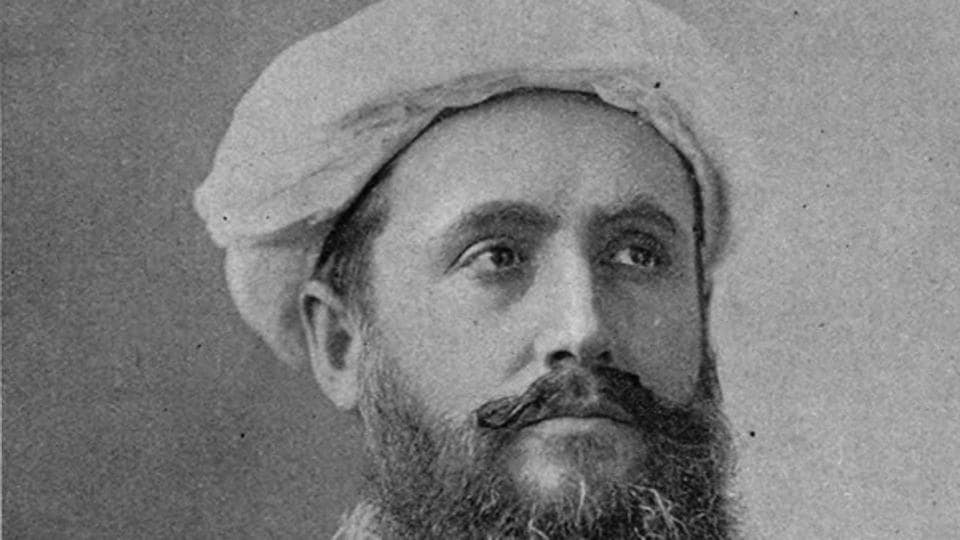
One of the most important travellers to have visited Poona and written about it was Mohammed Alexander Russel Webb, popularly known as “Yankee Moslem” in the United States. He was the second American to convert to Islam and was the popular face of the religion in his country.
In 1892, he travelled to India and visited various cities to seek financial assistance from the wealthy Muslim diplomats and merchants to help him establish a mission in America, The American Islamic Propaganda, which would work towards building mosques in every American city and preaching Islam in the country.
The first volume of Webb’s handwritten travelogue covered August 29 – October 19, 1892, and described his leaving Manila and travelling to Singapore, Penang, Rangoon, and the beginning of his stay in Calcutta. The second volume covered the dates October 20 – December 15, 1892, finishing his time in Calcutta as well as travel to Patna, Benares, Bombay, Poona, Hyderabad, Madras, and Agra.
These journals were edited by Brent D Singleton and published as a book in 2007.
Webb was born on November 9, 1846, and raised in Hudson, New York. His father was a leading journalist of his time, and so was he.
In 1887, Webb was appointed as American consul to the Philippines by President Cleveland, the first Democrat to be elected president since the end of Reconstruction. In Manila, he discovered the writings of prominent Muslim modernists of India from the Aligarh Movement, like Sayyed Ameer Ali and Mirza Ghulam Ahmad of the Ahmadiyya movement. He corresponded with them and, in 1888, embraced Islam.
He contributed to several Indian newspapers, like the “Allahabad Review “about Islam, and built a considerable network of prominent Indian Muslim donors who promised to support his mission for five years. He resigned from the US consulate soon after.
Upon his supporter’s invitation, Webb set foot in India, promoting and seeking further support for his mission.
After a long stay in Calcutta, he was joined by Hajee Abdulla Arab, a Memon merchant, and Moulvi Hassan Ali Bhagalpuri, a missionary of Islam in Bombay. The trio came to Poona on November 17, 1892.
On their arrival, they were received by a large crowd of Muslims and were taken in a handsome carriage to a bungalow assigned for their use. It was the residence of a wealthy gentleman who had gone away on a visit somewhere. It was magnificently furnished and had a superb flower garden laid out in front of it, while the porch surrounding it was decorated with rare plants and trailing vines.
After a brief exchange of courtesies at the bungalow, they were given tea and cake.
The first view of Poona had impressed Webb “very strongly” with the beauty of the streets and the “tasteful arrangement of the place”. He visited the shop of Hajee Haroun Hajee Jaffer, who sold everything from books to furniture.
That night Webb had a “very fine dinner”. Twenty guests were invited, but only fifteen attended. It was a quiet affair.
The next morning, Webb and his companions went out for a walk. The air was cold and bracing. They visited the bund made for the Poona Water Works from a subscription largely given by Sir Jamsetjee Jeejeebhoy. Webb was impressed by the Botanical Garden that was beautifully laid out with gravelled walks and well-kept flower beds and terraces.
They returned to the bungalow and had a “very nice” breakfast of milk, toast, eggs, and fruit. After breakfast, Hajee Haroun Hajee Jaffer Yusuf called and took them for a drive through the town.
Webb wrote – “Poona proper is a quaint old place and is the most oriental town I have seen yet. The little shops kept by Hindoos and Mussulmans were very novel and very dirty. We also visited the market and saw some very fine fruits and numerous piles of peanuts, which grow here very plentifully and form one of the staple articles of food of the people. Very fine pomolos, and custard apples and papayas large and delicious. Poona is a great place for fresh figs.” (sic)
Hajee Haroun bought a lot of fruits for the guests, which were taken to the bungalow.
Webb visited Khan Bahadur Kazi Shahabuddin CIE, who had held various positions in the Bombay Government and served as Prime Minister of Baroda from 1883-86 before retiring. He was also the vice president for the committee raising funds for Webb’s mission.
The next day, Webb left for Hyderabad.
During his stay in India, he criticised the “westernised traditions” adopted by the Muslims in India and urged them to stay true to the essence of their religion.
While several European travellers emphasised their superiority of class, savoir-faire, and elegance, and underscored their cultural exceptionalism in their travelogues, Webb chose to stay neutral and documented his observations. According to Singleton, Webb intended to incorporate his notes in later writings. Hence, they often lacked the descriptive details that travel journals usually provided.
Webb returned to New York in 1893. That year, he was the sole representative of Islam in the Parliament of the World’s Religions held in Chicago.
However, Webb was not successful in establishing Islam in the United States. All he could do was arouse some curiosity.
He passed away in 1916.
Chinmay Damle is a research scientist and food enthusiast. He writes here on Pune’s food culture. He can be contacted at chinmay.damle@gmail.com


