
 E-Paper



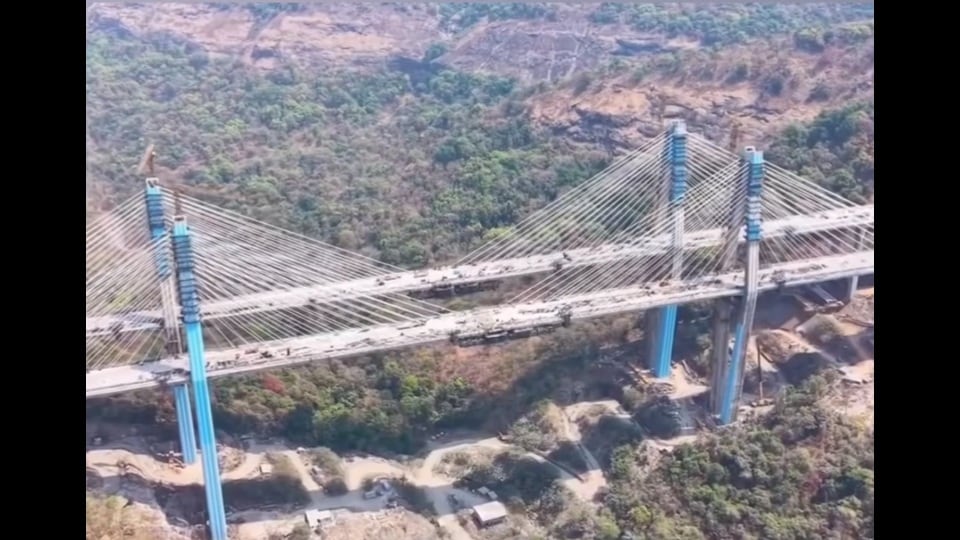
Twin decks of ‘Missing Link’ cable bridge connected, project nears completion
In large cable-stayed bridges, the deck, the roadway on which vehicles travel, is usually constructed from both ends of the valley simultaneously

 Prefer HTon Google


The twin decks of Mumbai’s massive cable-stayed bridge on the Missing Link section of the Pune–Mumbai Expressway have finally met, marking a major milestone in one of India’s most ambitious highway projects. With nearly 98 per cent of construction complete, the corridor is now racing toward its grand opening.
The Maharashtra State Road Development Corporation (MSRDC) will move into the final phase, road laying, finishing works, and structural load testing, aiming to welcome vehicles on May 1, 2026, in time for Maharashtra Day.
Once operational, the project will offer motorists a significantly faster and safer alternative to the existing Khandala ghat stretch of the Pune–Mumbai Expressway, a section long known for heavy congestion, sharp curves and accident risks, especially during weekends, monsoon months and holiday traffic surges.
Why connecting the twin decks matters
In large cable-stayed bridges, the deck, the roadway on which vehicles travel, is usually constructed from both ends of the valley simultaneously. Engineers build segments of the bridge outward from each side while suspending them using steel cables anchored to towering pylons.
Officials explained that the last segment, often referred to as a “stitching segment”, must be installed with extreme precision to ensure perfect alignment of the decks. Even minor deviations can affect cable tension and structural stability.
With the decks now successfully joined, engineers can begin the process of balancing cable forces, completing surface works and carrying out load testing before the bridge is declared ready for traffic.
Engineering challenge above Tiger Valley
Explaining the challenges faced in constructing the bridge, MSRDC vice chairman and managing director Anilkumar Gaikwad said the deep valley at the project site ruled out the possibility of a conventional bridge with multiple piers.
“The valley at this location is extremely deep, making it impossible to construct a normal bridge supported by pillars from below. Because of this constraint, we opted for a cable-stayed bridge design,” Gaikwad said.
The bridge is about 650 metres long and spans a dramatic section of the Sahyadri hills above Tiger Valley near Lonavala. It rises roughly 125 metres above the valley, while the depth from the deck to the valley floor is nearly 180 metres in some locations.
“Each of the two pylons supports 60 cables, making a total of 120 cables that carry the weight of the deck. The deck itself weighs approximately 36,000 metric tonnes,” Gaikwad added.
Global testing and specialised construction
Given the scale and complexity of the structure, extensive international testing was carried out before construction.
According to MSRDC officials, the cables used for the bridge were imported and tested in Vienna, while wind tunnel tests were conducted in Denmark to simulate extreme weather conditions.
“The bridge has been designed to withstand wind speeds of up to 260 kilometres per hour,” Gaikwad said.
The construction environment itself posed significant difficulties. The remote valley location initially had no access road for transporting heavy machinery or materials.
“We first had to build an approach road from the Wakan–Pali–Khopoli side so that cranes, steel components and other construction materials could reach the valley,” he said.
At present, only the final six-metre stitching segment remains to be fully completed and integrated into the structure.
A major engineering corridor
The cable-stayed bridge is only one part of the much larger Missing Link project, which represents one of the most sophisticated highway engineering undertakings in Maharashtra.
A senior MSRDC official associated with the project said the corridor was conceived to address a longstanding problem on the expressway, congestion and safety concerns in the steep Khandala ghat section.
“The project received government approval in 2018, and construction began in 2019. It stretches approximately 13.3 kilometres, starting near the Khalapur Toll Plaza, and provides an alternative alignment that bypasses the steep ghat road,” the official said.
The corridor includes two tunnels measuring 1.67 kilometres and 8.92 kilometres, cutting directly through the Sahyadri mountain range.
The main tunnel is about 23.5 metres wide and accommodates four traffic lanes along with an emergency lane.
“With every blast, the excavation progressed by roughly five to six metres,” the official said.
Cross-passages have been constructed every 300 metres to allow evacuation in emergencies.
An engineering achievement
Structural experts say the bridge represents one of the most technically demanding highway bridges built in India.
Prof Satish Gojekar, a structural engineer and academic specialising in bridge engineering, said the location above the deep valley required extremely careful design.
“Constructing a cable-stayed bridge around 125 metres above Tiger Valley means the structure must handle very large vertical loads as well as wind forces,” he said.
“At such heights, factors like wind load, vibration behaviour and cable tension become critical.”
Commuters expect major relief
For motorists travelling frequently between Pune and Mumbai, however, the biggest benefit will be reduced travel time and a smoother journey.
Pune-based commuter Vipul Alekar, who regularly drives between the two cities for work, said the new route could significantly ease congestion during peak travel periods.
“During weekends and holidays, traffic on the Khandala ghat can become extremely slow and sometimes takes more than an hour to cross. If the new alignment reduces travel time by even 20 to 30 minutes, it will make a big difference for people like us who travel regularly,” he said.
Estimates suggest the new alignment could lead to daily fuel savings of around ₹1 crore, while also improving safety with modern monitoring systems and better road geometry.


