
 E-Paper



Villagers evacuated after deep cracks develop in Beed district
Beed district administration evacuates Kapildharwadi village after deep cracks appeared on roads, houses, and school walls, triggering fears of possible landslide


Pune: The Beed district administration has evacuated the entire Kapildharwadi village after deep cracks appeared on roads, houses, and school walls, triggering fears of a possible landslide. Officials believe the incident was caused by continuous rainfall in September, which has made the hilly terrain unsafe for habitation.
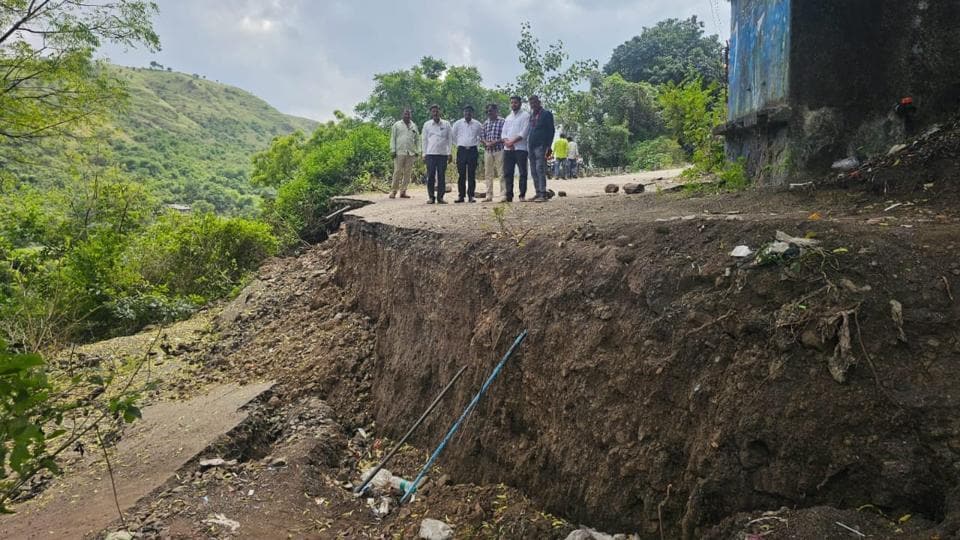
The cracks first appeared on the night of September 30, following heavy rainfall across parts of Marathwada and western Maharashtra. Villagers said the fissures were initially narrow but have since widened significantly. Several houses have collapsed, while many others have developed deep cracks, leaving residents anxious about their ancestral homes.
Responding swiftly, the district administration relocated all affected families to the Shri Manmathswami Devsthan Temple, about two kilometres away. Authorities have arranged food, shelter, and other essentials for the displaced villagers.
“We immediately shifted around 40 families, comprising nearly 250 people, to the temple on the same day. In a phased manner, a total of 80 families have now been shifted, and all are safe,” said Chandrakant Shelke, tahsildar of Beed.
Shelke said that four houses have developed major fissures, the walls of three houses have collapsed, and roads in the village have also been damaged. The administration has identified gairan (common) land nearby for rehabilitation and will begin the process after completing legal formalities.
On October 8, a team from the Geological Survey of India (GSI) visited the site and submitted its report to the district collector. The team studied the soil and rock strata in the landslide-prone zone and found that the absence of a natural drainage system had led to continuous water percolation during the monsoon, weakening the soil layers and causing cracks and subsidence.
The GSI team also observed that the soil-covered slopes had started degrading, stone sliding was visible at several points, and erosion caused by a nearby stream had worsened the situation.
“Due to these conditions, GSI has recommended urgent relocation of residents living in highly vulnerable houses. Around three to four families near the slide-prone hill area remain at risk, though there is no immediate threat to the rest of the village,” said Prashant Waghmare, District Disaster Management Officer.
He added that the district collector has instructed local officials to take precautionary measures, relocate residents from unsafe houses, and ensure prompt rehabilitation arrangements.
Amol Shinde, a 30-year-old farmer from Kapildharwadi village, is worried about his home after deep cracks appeared in the area. His parents, along with most villagers, have been moved to a shelter arranged by the district administration. But Shinde is concerned about his cattle, still tied on the farm.
“We’ve left our cattle behind and have to travel back and forth daily,” he said. “There’s no electricity in the village, making it hard to pump water for them.”
The power outage has raised concerns about safety. Last week, a cow belonging to Sundarrao Shinde died after being bitten by a snake at night. Mobile communication has also been affected due to a lack of charging facilities.
Shinde urged the administration to include livestock in the relocation plan.
Beed District Collector Vivek Johnson said 60–70 hectares of grazing land have been identified around 2 km from the village. “Each family will receive a 500 sq ft plot, and we’ll meet after Diwali to finalise relocation,” he said. The administration is also coordinating with the Shri Manmathswami Devasthan Temple’s Goshala to house animals.
Village sarpanch Mahendra Veer criticised the delay. “We raised concerns in 2023, but no action was taken,” he said.
Tahsildar Chandrakant Shelke responded that the earlier case involved a rolling stone, not a landslide. “Relocation didn’t proceed then due to internal disagreements.”
Villagers continue to wait, caught between unsafe homes and the challenge of caring for their livestock.


