
 E-Paper



Pune’s sudden spike in cases: why, how and... is community transmission now a reality?
While the city’s positivity rate, the number of samples that test positive for every 100 samples tested for Covid-19 was 10 per cent in the month of April. As of Monday, July 20, this rate stands at 18%


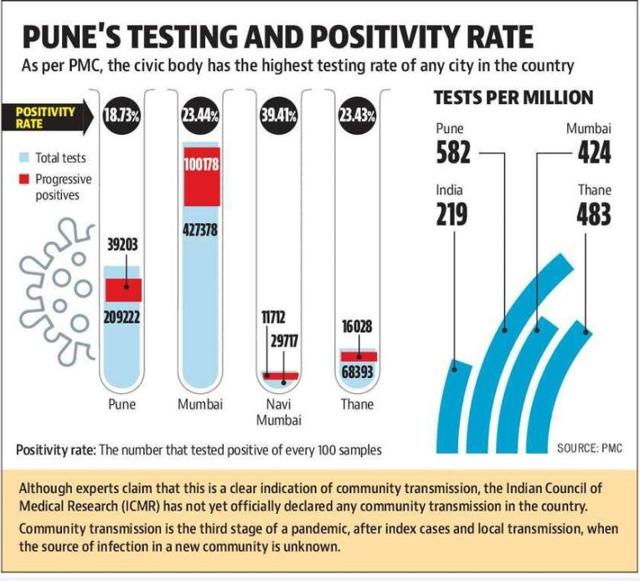
Even as the Pune Municipal Corporation (PMC) claims that it has the highest number of tests per million compared to any Indian city, the number of positives being detected is steadily increasing – 1,500+ cases per day for the last seven days.
While the city’s positivity rate, the number of samples that test positive for every 100 samples tested for Covid-19 was 10 per cent in the month of April. As of Monday, July 20, this rate stands at 18%.
While the district administration claims that this is because of increased testing thanks to the rapid antigen detection kits, health experts believe it is because the PMC has not been able to break the chain by improper contact tracing and, it needs to ramp up testing even more.
Dr Abhijit More, member of the Jan Aarogya Manch, said, “If the number of positives are increasing drastically along with the number of tests, then it does reflect that there is community transmission. The ICMR may not declare it due to political or administrative reasons, but many ground workers have admitted that there is community transmission. The positivity rate needs to be below 5 per cent consistently for at least two weeks and only then, the curve will flatten. Tests per million may be high for Pune, but it does not necessarily prove enough tests are being conducted. The spread of the infection is also more widespread now. If the PMC doubles or even triples its testing capacity, the positivity rate will go down.”
However, Dr Bharat Purandare, infectious disease specialist associated with Deenanath Mangeshkar Hospital, believes that instead of testing asymptomatic contacts, the PMC must test only symptomatic contacts and use the limited testing kits in the right way.
He said, “The spread of the virus is in a geometric fashion and it is more intense. It spreads along the community. The ICMR may not say, it but there are clear indications that there are cases where the source is not known. Also these ratios are just a manipulation of figures which change dynamically. Every city is following this curve and we are just behind Mumbai, while Bengaluru is right behind us now. We must also be prepared that no matter what, anyone is likely to be infected now; and that is how the herd immunity develops. As citizens we must cover our mouth and nose and stop the spread of aerosol, but there is still a mild chance that the virus may enter the body. Quarantining the asymptomatic contacts of a positive person instead of testing them is the way out. Wasting kits on asymptomatic contacts is causing an overall delay as there is a waiting period of almost three days at some labs just to collect the sample, and thereafter, two days just to get the report if it is RT-PCR. This will delay the treatment process.”
As of Monday, 2.09 lakh tests have been conducted by PMC of which 39,203 samples tested positive which bring the city’s positivity rate to 18.73%.
While with the city’s case fatality rate stands at 2.56% with 1005 deaths reported as of Monday.
Of the 14,757 active cases in the city, 591 are critical patients.
The recovery rate of the city is 59.79% as 23,441 people have been discharged as of Monday.
After a thorough house-to-house survey which the PMC claims to have done repeatedly in which 1.68 crore people were covered by 530 teams spread across the city.
With respect to the containment zones and the sealed areas, till date, 5,027 patients were found to have flu-like symptoms and 21,694 were quarantined.
Pune district collector, Naval Kishore Ram said, “The positivity rate is high because the spread of the infection is now more as compared to what it was in the beginning. We are testing specifically as per the ICMR guidelines, but we are working on ramping up our testing which includes those with comorbidities or the high-risk contacts. We are paying more attention to the treatment process and lowering the mortality rate. We will also increase the use of rapid antigen testing kits.”
Dr Subhash Salunkhe, heading the state’s communicable diseases prevention control and technical committee, said, “There are three basic reasons for why the positivity rate is going up. One, the number of tests along with rapid antigen testing is going up. Two, the intensity of contact tracing aggressive and high risk contacts being tested is also going up; and third, the total number of tests is increasing and the denominator is also increasing, which is why the positivity rate is also increasing. It was anticipated that this would happen. At this stage it is critical to maintain strict implementation of home quarantine, and keep a watch on recovery rate and mortality rate.”


