
 E-Paper



Punjab CM orders detailed audit of every Covid-19 death by experts to check high mortality rate in state
Capt Amarinder Singh informs AICC meet that state government is strengthening containment measures under guidance of an expert group


Punjab chief minister Captain Amarinder Singh on Thursday said that he had ordered a detailed audit of every Covid-19 death by experts to understand and check the high mortality rate in the state, and the government was also strengthening its pandemic containment measures, under the guidance of an expert team.
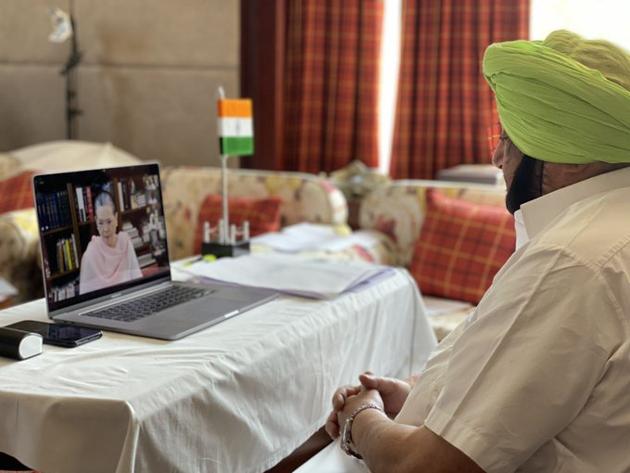
The chief minister gave this update to Congress president Sonia Gandhi during a video conference, at which he informed the party leadership that the state government was being guided by a group of experts in handling the Covid-19 crisis. The group comprises Dr KK Talwar, former director of the Post-Graduate Institute of Medical Education and Research; Dr Raj Bahadur, vice-chancellor of the Baba Farid University of Health Sciences; Dr Rajesh Kumar, a former head of the School of Public Health at PGI; besides experts from John Hopkins University.
CO-MORBIDITY FACTORS,DELAY IN SEEKING HELP
The mortality numbers in the state were high largely due to co-morbidity and lack of health-seeking behaviour (patients come late to hospital), said Capt Amarinder Singh.
Despite the high mortality rate of 6.2%, the rate of growth of Covid-19 in Punjab was lower than India, with the cases doubling in 16 days against the national average of nine days.
In percentage terms, cases in Punjab had steadily declined from 2.57% of the total cases in India (as of March 31) to 1.22% in 3 weeks (till April 22), revealing effective containment of Covid-19 in the state, he said.
EFFECTIVE CONTAINMENT IN SBS NAGAR
Capt Amarinder Singh cited the example of Shaheed Bhagat Singh Nagar, earlier known as Nawanshahar, as a case of effective containment, that had been appreciated by the Government of India and the media.
In Nawanshahar, which was one of the first hotspots in the country, all 18 treated cases, besides the initial death of granthi Baldev Singh, had recovered and no case had been reported since March 26, he informed the meeting.
The chief minister said Punjab had to be compared with Kerala and Gujarat, which were also states with high NRI population. Punjab was doing significantly better than Gujarat, and in terms of cases per million population, even lower than Kerala (9/million in Punjab vs. 12/million in Kerala), he pointed out.
At present, Punjab has 257 positive cases, with 16 dead and two critical patients, while 53 have been cured.
The state has three containment zones, places with more than 15 cases, at Jawaharpur in Mohali district, Safabadi Gate in Patiala district, and Budhlada in Mansa district, while the three districts of Ferozepur, Fazilka, and Bathinda are green zones with no cases.
TESTING FACILITIES
As many as 7,887 tests have bene done so far, with regular testing facility of 400/day each at the government medical colleges in Amritsar and Patiala; 150/day at the medical college in Faridkot and IMTECH, Chandigarh; and 60/day at Post Graduate Institute of Medical Education and Research, Chandigarh.
In addition, testing facilities are available in private hospitals as follows: 40 a day at Dayanand Medical College and Hospital, Ludhiana, and 100 a day at Tuli Diagnostic Lab, Amritsar. The clearance for testing at Christian Medical College, Ludhiana, and SGRD Medical College, Amritsar, is in process, he said.
At present, the testing rate in the state, at 248/million, is slightly lower than the national average of 309/million (excluding rapid testing).
Regarding rapid testing, the chief minister said 3,502 cases were tested before the Indian Council for Medical Research suspended such tests.
The state has 10,500 rapid testing kits supplied by ICMR, while 10,000 have been ordered by the state government, with deliveries in progress. The government has also floated a tender for another 50,000 kits.


