A BCCI maternity policy for players is long overdue
Indian players with Pakistan skipper Bismah Maroof and infant daughter gave a pretty picture at the ICC World Cup, but their own board provides no support system.
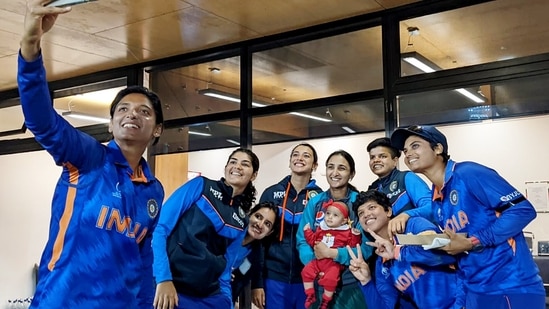
The enduring image of India’s win over Pakistan in this World Cup was so captivating that it sent me back in time. It wasn’t a moment on the field, but off it. It wasn’t during the game, but after it. It was the image of the Indian players spending time with Pakistan captain Bismah Maroof, and her six-month-old daughter, Fatima.
India players click a selfie with Pakistan captain Bismah Maroof and her daughter. (ANI)
Photos and videos of the moment went viral, but shutterbugs should stand ready again: India play New Zealand next, a side with their own baby in the dressing room: one-year old Grace, daughter of Kiwi players Lea Tahuhu and Amy Satterthwaite.
Watching those images took me back to the start of my own career. When I committed to cricket, it was implicit that any plans to have children would have to be relegated to my late 30s, once my career was done. Maroof became pregnant at 29, and has plenty of cricket ahead of her. And as I watched videos of the Indian players playing with Fatima, I thought, has anything changed? Can the Indian players of today think, ‘Could this be me?’
At present, they cannot. Pakistan, New Zealand, and a few other cricket boards have maternity policies written into their contracts. These provide fully paid maternity leave (often with the player moving to a non-playing role), a guaranteed contract extension for the next year. In Pakistan’s case there is also financial assistance to have a carer travel with the team (Maroof’s mother is travelling with her, as she juggles captaining her country and breastfeeding).
But India is not one of those countries.
There are as many mothers at this World Cup as there are teams, eight. It is an unprecedented number, a tectonic shift. The last ODI World Cup had one. And it’s not just Australia (2) and New Zealand (2) making up the numbers. There is Afy Fletcher, who is the first woman to benefit from maternity leave offered by Cricket West Indies. There is South Africa’s Lizelle Lee, who will miss two games as she returns from the birth of her first son.
Some cricket nations are actually world leaders when it comes to pregnancy policies in women’s sport. New Zealand Cricket introduced the provision in 2019 when then captain Satterthwaite announced she was pregnant. Cricket Australia followed later that year. On the other hand, the WNBA included fully paid maternity leave in their contracts only as recently as 2020. FIFA approved maternity leave for professional female footballers (but only assured 2/3rd of regular pay) later that year.
In an interview for her sponsors last year, Smriti Mandhana was asked about who motivates her. She picked two athletes: Tennis star Serena Williams and Alex Morgan, the US women’s soccer player. Perhaps it’s a coincidence that both these women have recently returned to elite sport after having a child. Or perhaps it is a topic that is on the minds of India’s female cricketers. We don’t know.
Nonetheless, it feels obvious that an organisation that contracts female employees should provide them support in the instance they fall/choose to get pregnant. To not do so almost incentivises the athletes to not start a family, because it would mean losing their ability to do the work they are contracted for, and thus their income.
Maroof’s return to cricket after childbirth shines the light on a topic that is rarely talked about. India may be undefeated against Pakistan in ODIs, but off the field Pakistan have jumped ahead. They were also the first Asian team to introduce central contracts for women. And their parental care policy also extends to their men’s team, who are now officially entitled to 30 days paternity leave. India have no such provision in place, and when Virat Kohli went on paternity leave, the divisive response it garnered emphasises the need for both men’s and women’s Indian teams to be looked after better.
With no players association in India representing the current Indian players, it is incumbent on the Board to look out for them. And it is a win-win: A move like that would earn brownie points in the cricket world and with the players. For women cricketers, it would be a signal that their work and family life can coexist. This is important, especially for female athletes in a country where gender norms of how a woman should behave after marriage are deeply entrenched.
Serena Williams’ return from pregnancy changed tennis. After she had to play unseeded in tournaments having lost her ranking while pregnant, the WTA introduced protected rankings for players who return from pregnancy. Imagine the impact on the social fabric of India if a high-profile player had the support of, and chose to use, a maternity leave policy. Imagine the message it would send to working women thinking about having a baby, and their employers. Our neighbours have set the standard. Now India must catch up.


 Live Score
 Cricket Teams
 Cricket Players