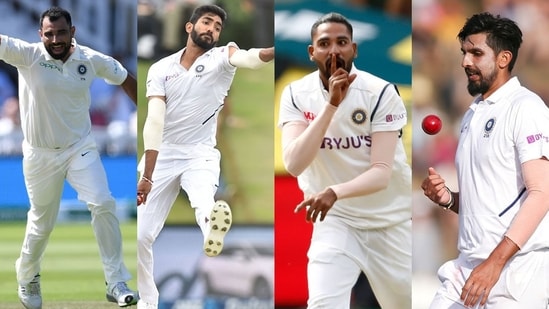
Jasprit Bumrah would target toes, helmets and stumps with a disarming smile. Ishant Sharma would seldom veer away from a probing channel that stifles scoring. Mohammed Shami would bustle in with a bundle of energy before cocking that wrist to deliver the ball with a bolt-upright seam.
From left: Mohammed Shami, Jasprit Bumrah, Mohammed Siraj and Ishant Sharma. (Getty Images)
From 2017 to 2021, the coming together of these fast bowlers, supplemented by a decent back-up line, meant India had one of the most potent pace attacks in the world. In Tests outside Asia from 2017 to 2019, India’s pacers took 158 wickets at a strike rate of 50 and an average of 24.81, third only to South Africa and Pakistan. In the subsequent two-year cycle, which culminated in a loss to New Zealand in the inaugural World Test Championship final, they took 71 wickets at an average of 21.47 and a strike rate of 44.3 – superior to the rest of the world on the latter two counts.
These numbers were truly head-turning. That India, traditionally a land of spin, suddenly had this pot of pace-bowling gold was bound to evoke effusive praise.
“India are at the forefront of this fast-bowling renaissance,” former West Indies pacer and eminent commentator Ian Bishop had said in 2020.
“They recognised years ago that if you are to be the No. 1 team in the world, you cannot rely on your spinners all the time.”
It’s not that India hadn’t produced fast bowlers of repute earlier. From Kapil Dev to Javagal Srinath to Zaheer Khan, they were all stellar bowlers with long-standing careers. But what was lacking was a pace unit that would hunt as a pack; one that had no weak links; one that posed a threat from all corners.
India’s transformation as a pace-bowling powerhouse was underlined by their maiden series triumph in Australia in 2018-19 when Bumrah, Ishant and Shami were perpetually on the prowl. In 2020-21, there were more reasons to rejoice when a second-string (or was it third-string?) attack delivered the goods in the series-clinching victory at The Gabba. The trio of Bumrah, Ishant and Shami aside, there was now also enviable depth highlighted by the emergence of Mohammed Siraj.
Or so it seemed.
If you now look back at that period wistfully, it’s because India’s pace bowling pack hasn’t sustained those standards since January 2022. In this period, they have allowed England to chase down a record 378 with seven wickets in hand and conceded over 200 in the fourth innings in successive defeats to South Africa. Their latest indiscretion was at the World Test Championship final versus Australia at The Oval, where conceding 469 in the first innings despite appreciable assistance for the pacers had a telling impact on the outcome.
Over the past 18 months, India’s pacers are averaging 37.5 with a strike rate of 63.3 outside the subcontinent — unflattering figures reminiscent of the phase from 2011 to 2015 when overseas victories were hard to come by. It was a phase when Zaheer’s career was winding down; when Bumrah, Shami and Ishant were still a few years away from becoming a collective force.
The reasons for the current dip are manifold. Though Bumrah played in all three overseas Tests last year, he wasn’t quite hitting his stride. That he later broke down with a serious back injury — which he is yet to recover from — is perhaps an indication that all wasn’t well with him during those games. And Ishant, in the twilight of his career after 105 Tests, hasn't played since 2021 as India began looking ahead.
But the pace attack has fallen back in the absence of Bumrah and Ishant. While Shami and Siraj are excellent bowlers, they don’t have a supporting cast that can sustain pressure through an innings. That hurt the Indians against Australia at The Oval where splendid opening spells by Shami and Siraj came to nothing due to the scattergun radars of Yadav and Thakur. Eventually, Shami and Siraj too started spraying the ball around.
“In terms of the bowling, we could have been a little more disciplined. We started off very well. In the first 12-13 overs, we bowled in the right areas. But maybe after that, we kind of weren’t disciplined with our bowling. We conceded a little more than we would have preferred,” India bowling coach Paras Mhambrey lamented after Day 1 of the Test.
Such displays raise several concerns. Is the Indian pace attack back to its erratic ways dishing up a boundary ball every over? Is the unit fit enough to be just as sharp and incisive in the final session as in the first? Where is the fast-bowling depth that was ostensibly visible two years ago?
These are pressing issues with no easy answers. At the core of any top Test team is a fit-and-firing pace bowling unit that can deliver across surfaces and time zones. Virat Kohli recognised that as captain and harnessed a fitter group of fast bowlers with the skill and psyche to succeed.
For India to get back to that, a younger crop of bowlers with the ammunition to thrive in red-ball cricket will have to be identified. And then moulded mentally and physically to meet the taxing demands of Test cricket. Otherwise, there will be more examples of bowlers — Prasidh Krishna, Navdeep Saini and T Natarajan come to mind — not converting red-ball potential into performance. If Krishna, 27, can put his injury travails behind him, he’s still worth pinning hopes on.
The road ahead is certainly challenging but necessary to navigate through if India are to reclaim the mantle of the best Test team in the world.
Vivek Krishnan is a sports journalist who enjoys covering cricket and football among other disciplines. He wanted to be a cricketer himself but has gladly settled for watching and writing on different sports.Read More


 Live Score
 Cricket Teams
 Cricket Players