


 Live Score
 Cricket Teams
 Cricket Players
Facing blows, winning battles, silencing Kohli-Shastri: How Cheteshwar Pujara became cricket’s ultimate Test warrior
Cheteshwar Pujara retired after a career defined by grit, discipline, and resilience, helping Virat Kohli and Ravi Shastri secure historic Australia series wins

 Prefer HTon Google


When Cheteshwar Pujara batted, you watched. Fascinated. Transfixed. Wide-eyed, open-mouthed. And not because he was a ‘blink-and-you-miss-it’ batter. You marvelled at the discipline and the self-control, at his obsession with batting, at the price he put on his scalp, at his control, his courage and character, at his unflappability, at his supreme disregard for physical discomfort, at his unmatched ability to ride shattering blows to body and limb. At his bloody-minded, pig-headed determination to protect his wicket, at all costs.
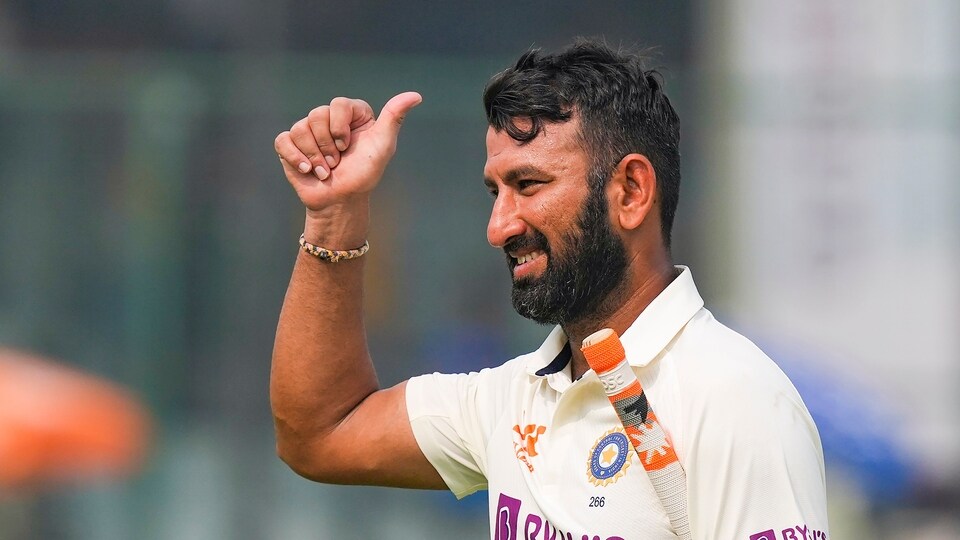
When Pujara batted, he brought the world to a standstill. His, and ours. Not because he thrilled and excited, but because he was relatable, he appeared capable of emulation (much like the man he replaced as India’s No. 3, Rahul Dravid). One of the best compliments Dravid received, from a gob-smacked fan, went thus: “I want to bat like Sachin (Tendulkar) and (VVS) Laxman, but I feel I can bat like you.” Replace Dravid with Pujara and Tendulkar/Laxman with Kohli, and you wouldn’t be wrong.
More than two years after he played his last Test, the World Test Championship final against Australia at the Oval in June 2023, Pujara called time on a career most glorious, a career that will be celebrated in time to come though it should already be, and not only for his extraordinary exploits in successive tours of Australia that brought India their only two series triumphs Down Under.
ALSO READ: Cheteshwar Pujara announces retirement from all forms of cricket: 'Wearing the Indian jersey...'
ALSO READ: Cheteshwar Pujara’s full statement on retirement: India great says ‘set out to aim for the stars'
An unsuspecting cricketing world had no idea of the true Pujara avatar when he danced to a magnificent 72 in the second innings on debut, against Australia in Bengaluru in October 2010. Set a target of 207, Mahendra Singh Dhoni and Gary Kirsten came up with a masterstroke, pushing the debutant who batted at No. 5 in the first innings to No. 3 in the second, ahead of Dravid. The 22-year-old tore into the Aussies, taking just 89 deliveries to announce himself. Few would see that version of Pujara in international cricket again; the river-in-spate Pujara quickly became the immovable object, taking over the No. 3 spot on a permanent basis after Dravid’s retirement in early 2012 and making it his own despite unjustified barbs surrounding his strike-rate.
It took Anil Kumble, eloquent and wise, to put the stringent criticism of Pujara to bed during his time as the India head coach. Kohli and Ravi Shastri, in his first stint with the national side as the team director, had reservations about Pujara’s ability to force the pace; Kumble sought to put that debate to bed by pointing out that in his book, strike-rates in Test cricket related only to bowlers.
ALSO READ: Cheteshwar Pujara, Rahul Dravid’s true heir, carried India’s No.3 legacy with stats, records, and unforgettable innings
Ironically enough, it was Pujara’s adhesiveness that drove Kohli and Shastri into the history books as they became the first Indian captain-coach duo to register a series victory in Australia. The Aussies are insular and self-obsessed; one needs to be an exceptional performer to earn their respect. In the modern era, Tendulkar, Laxman, Virender Sehwag and Kohli had stormed their consciousness with their scything strokeplay, Dravid had impressed them with his organised defence and his temperament and grace. That it was Pujara whose wicket they coveted the most is the ultimate tribute to the ultimate competitor who showed that aggression doesn’t necessarily have to manifest itself in abusive vocabulary or intimidating body language.
In 2018-19, Pujara top-scored with 521 runs, sure, but he also frustrated Australia to distraction. He faced 1,258 deliveries for those runs – no one else from either side negotiated even 700 balls – and by the time of the Sydney Test, which the hosts had to win to square the series, had mentally and physically deflated the Australian bowlers. He took the score board out of the equation, he didn’t care about milestones and individual accomplishments. He started the series with 123 in Adelaide, finished it with 193 in Sydney. After receiving the Border-Gavaskar Trophy, the entire team did a ‘mock Pujara dance’ on the SCG outfield; the sport that he is, the man from Rajkot took it in his stride, perhaps recognising it as a backhanded compliment when more was certainly the need of the hour.
Two years later, Pujara was again at the forefront of India’s challenge. As the four-Test series progressed, senior players dropped away like autumn leaves, but Pujara stood tall while Ajinka Rahane marshalled his meagre resources. Like a warrior, he took numerous blows in Sydney and Brisbane, the first to eke out a draw and the second to carve a place in his history. His 271 runs spanned 928 deliveries, he scored throughout the series at 29.20. Not even Shastri griped at his strike-rate!
Pujara was ambitious without being in-your-face, his ambition restricted to stacking up runs for whichever team he batted for. Within the confines of the changing room, he was a leader in his own right, but one can’t shake the feeling that because he chose to fly under the radar, he hasn’t been quite as celebrated as he should be. As always, Pujara won’t complain, because that isn’t his nature. He will put his feet up, content that he gave it his all and secure in the knowledge that history will recognise him for what he was – an uncompromising warrior with the heart of a gentleman.


