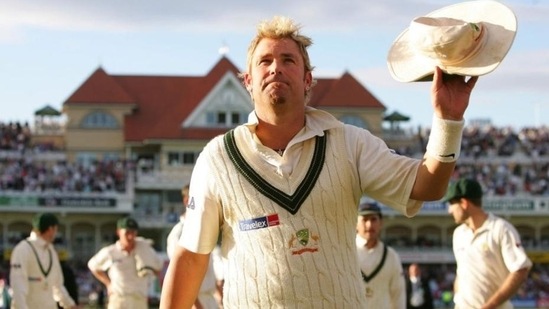
Warne infused life into the declining practice of leg-spin, leading the world into believing that turning a five-and-a-half-ounce cricket ball can be an art; all it needed was an artist.
Magic realism. How does one begin to decipher that? Literary theorists have, of course, defined this captivating strand of storytelling in some detail, but there have been few living, breathing specimens that embody the narrative in all its nuance. Shane Warne was one.
File Photo of late Shane Warne (Twitter)
To call him a cricket legend would be a boring travesty. Warne was a showman; a one-man theatre who implored you to his concert, and once you were in, you never really left. An artist who evoked joy and inspiration as easily as he straddled his multiple lives. A cricketer whose spirit imperceptibly loomed over the matches he lorded, almost bending them to his supreme will, leaving the audience – and batter – gasping.
Warne was an idea whose time had come, an inspiration that the game of cricket needed. He infused life into the declining practice of leg-spin, leading the world into believing that turning a five-and-a-half-ounce cricket ball can be an art; all it needed was an artist. Sure, Australia had Clarrie Grimmett and Richie Benaud in another era, and Stuart McGill came along later, but Warne was different. How, you ask?
Ask Mike Gatting. Or Alec Stewart. Or Basit Ali. Or Daryll Cullinan. Or anyone who ever saw him bowl. The drama would begin long before the ball had left his hand. There he was, at the top of his mark, standing with a magician’s aura and a scientist’s acumen, contemplating his next trick. Of that, there would be many, and then there would be none, which, come to think of it, would be his biggest deception.
Tossing the ball – right to left, left to right – he would begin a chain reaction, on the field and off it. Watching him perform that simple act, countless hypnotic dreamers would get hold of a sphere – ball, orange, marbles, apple, anything – and give it a try. Miming his mirth, they would whirl the object, one hand to another, trajectory over the eye line, and would inevitably drop it. That’s when the first realisation -- of his expertise and one’s ineptitude – would strike. Not that easy.
On the field, it’s Act 1, Scene 1 of the Warne epic. The batter, hot under the helmet, eyes squinting at the magical hands, looks for a clue where none exists. Then, the pause. The Warne pause. Tongue rolling over his lips. Index finger flicking beads of sweat from the brow. Glistening slaps of Zinc. Glowing blonde hair. A wicked, know-it-all half-smile. The slowing down of time. Warne waits for the right spur, for the universe to whisper to him that the most perfect alignment he sought was ready. A fleeting moment for Warne, a lifetime for the batter. If this were tennis, the umpire would have gone, “Quiet, please. Play.” If this were a rocket launch, the countdown would begin precisely now.
Then came the run-up. Two-step walk, tongue poking out, a jump to put him in the delivery stride. The leading arm goes across the chest, the bowling arm holds the ball up, before letting it rip. At the MCC vs Rest of the World Dinner in 2014, Gatting, the recipient of Warne’s “Ball of the Century,” tells Mark Nicholas that he could hear the fizz as the ball drifted into him. He wasn't lying. Notice how much body Warne put in his action. Look at his left leg, the braced knee, the pivot, the way his heavy hips gyrated over the tip of his left toe. We could well be watching a sinuous ballerina on the prowl.
“If it seams, it spins,” he once famously said. Simply put, it meant that any assistance off the seam – even for faster bowlers – can be used by the slower bowlers, provided the latter can land the ball. So, Warne would go to cold and wet England and traumatise them, landing the ball now on seam, now on lacquer, playing with angles and minds, extracting turn, bounce, fizz, and wickets.
As if to walk the talk, he forged an undeniable alliance with pace legend Glenn McGrath. Their combined haul of 992 wickets across 103 Tests makes them the most successful bowling pair in Test history; the next best – Muttiah Muralitharan and Chaminda Vaas – are 97 behind. Fittingly, Warne and McGrath ended their Test careers together, leaving the Sydney Cricket Ground arm-in-arm, their tired tortured bodies trudging into the hallowed hallway of cricketing immortality.
Warne, like most good bowlers, would read the pitch well. Few, however, could read the batter better. Visit the decade-old YouTube video of one of Big Bash League’s earlier seasons. Warne is miced up, bowling to Brendon McCullum. He anticipates that McCullum may try to go over extra cover or attempt a sweep. “I’ll slide one in... fast,” he says before letting go his famous slider.
McCullum, on cue, tries to sweep, but the ball is quick and goes straight through, bowling the Kiwi batter.
With Warne, the fun lay in waiting. Waiting for the ball to leave his hand, carrying the last remnants of his magic touch. Waiting for the batter to move, only to realise that he’s doomed. The concert would reach its crescendo with the ball having hit its flight path. The strings, however, rest with Warne, his entire cricketing life coalesced in this ephemeral moment where he is at once the creator and destructor. If he ever felt a tinge of vulnerability in this passing moment, it never showed. It must be a moment of purity and calm, never mind the clamour of the match situation.
Warne lands it, of course. He rarely bowled googlies, but relied a lot on flippers, while his stock delivery, the roaring leg-break, was as lethal as his surprise weapons. The ball, like Warne, has a mind of its own. It can’t be cornered or conquered. Try padding, it’ll break right across. Try sweeping, it’ll jump to take the top edge. Go inside-out, and it’ll turn a mile. The batter is clueless, the audience is bemused. “Bowling, Shane,” they cry from behind the stumps, before breaking into a cackle. The magician has pulled his string; the magic is real. How does one decipher the magic realism of Shane Warne?


 Live Score
 Cricket Teams
 Cricket Players