


 Live Score
 Cricket Teams
 Cricket Players
How India's top-order learnt a T20 trick from England to beat them at their own game
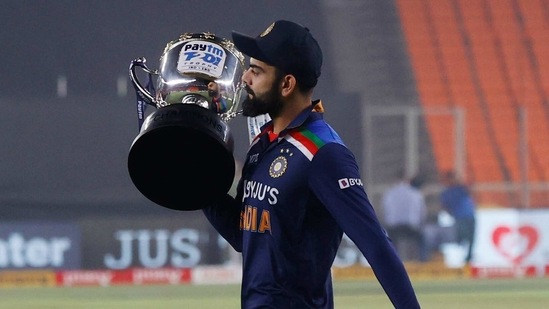
Throughout the T20I series, Kohli relentlessly tweaked India's usual approach of pacing the innings till he got the formula right in the final match.


Not too many international teams that had gone unbeaten for seven T20 series' in a row end up tinkering with their tried and tested templates for success. But against England in the recently concluded five-match T20I series, Virat Kohli’s India did just that, especially when it came to their batting formula – a key reason for their long string of success in the first place.
In T20I cricket, India often won matches due to their terrific top order players in Rohit Sharma, Shikhar Dhawan, KL Rahul and captain Kohli himself. And in all their success before the series against England, there was a strict pattern to their play: get set before playing aggressively.
Also read: Kohli names the opening combination for 1st ODI
Whenever these four established Indian batsmen got big runs, their respective strike rates would eventually hit the 150 plus mark. But strike rates in T20 cricket can be misleading, as most batsmen only usually accelerate towards the end of their innings. Not this time around in the five matches against England, though, as there was a conscious effort to go hard from the outset – quite like the template established by Eoin Morgan’s men in the format.
On the eve of the series, captain Kohli talked about players “who have the X factor” playing "aggressive cricket" with a "free mind". In other words, he was demanding his top-order to shun their usual approach of building an innings and to look to cash in early and quickly.
This was possibly because Kohli’s side was up against the World No 1 ranked side in T20 cricket. As Morgan admitted at the presentation ceremony after the final game, they always look to out-bat the opposition. England are not bothered about how many runs they concede; they simply back their batsmen to get more runs than the opposition and that too at a breakneck speed. If India had won six out of their last seven series (and one drawn), England were coming into the series at the back of winning seven of their last eight (and one drawn).
The two teams’ success had been built around their respective top orders; top-threes had diametrically opposite approaches to run making. India’s top-three were brilliant at pacing their innings, but England’s equivalent always looked to go hard from first ball to last. So, the Indians came up with a radical plan to make up for relatively smaller numbers.
According to the data provided by Cricviz, England’s average run-rate in the powerplay overs has been 8.49 since the last T20 World Cup in 2016, a shade ahead of India’s 8.24. England were also ahead in the comparison of the run-rate of the top-three batsmen of the two teams. The visitors’ top-three had an average run-rate of 8.92, which is the best in the world along with Australia, while India’s top-three had a run-rate of 8.80.
While playing at home in the last four years, India’s run-rate in powerplays has been 7.8. For their first 20 runs, Sharma (126.8), Kohli (123.5) and Dhawan (122.5) scored at a strike rate in the 120s. Only Rahul’s strike rate was 132.4. In keeping with their style of pacing their innings, Sharma’s strike-rate exploded on crossing fifty runs to 174.12, just like post-fifty Kohli increased his SR to 167.18, Rahul to 152.11 and Dhawan to 144.54.
Evidently, India had been playing the shortest format as an extension of the one-day game, rather than looking at it as a version that demanded a different thought process and skill set. That began to change in the course of the series in Ahmedabad, where the hosts literally beat England using their own strategy.
Teething trouble
While the intent was always honest, the execution went awry in four out of the five matches. In the first game, India were reduced to 20 for 3; the second T20I also started on a disastrous note as India lost their first wicket on 0 but recovered to win the low-scorer. In the third match the hosts were 24 for 3, and India won the fourth contest despite Sharma and Rahul falling for low scores.
That they continued to experiment in the decider was a credit to the team management. And this time the new approach worked, right from the moment Kohli walked out to open the innings along with Sharma. The two best Indian batsmen across formats made the adjustments to go from touch artists to power hitters in no time at all.
Sharma was the quicker to adapt to it, when he looked adventurous from the get go, even converting good balls into scoring opportunities. He took fast bowlers Jofra Archer and Mark Wood by surprise. By the end of the powerplay, Sharma boasted of a remarkable strike rate of 170-plus. Kohli didn’t quite have the same numbers during their 94-run stand at the top, but it was his intent that really set the tone for the assault.
Known to stick to proper cricketing shots even in white-ball cricket, the Indian captain smashed the first four of the innings by hitting uppishly past the cover fielder. Soon, Sharma also threw caution to the wind and began hitting in the air, back past bowler Wood. It was a full-blooded shot, unlike his soft return catch in the fourth game to Archer. This strategy is regularly implemented by England’s Jason Roy and Jos Buttler.
Among the other Indian batsmen used in the top three, Suryakumar Yadav dazzled in his debut series, scoring his 89 runs in two innings at a phenomenal strike rate of 185.42. The other series debutant, Ishan Kishan, also got his 60 runs in two outings at 146.34. It wasn’t very often that India’s batsmen stood out for the rate of scoring in the recent past. But after Ahmedabad, it could well become a regular occurrence in the future
.


