The last time Indian Premier League was a 10-team tournament—in 2011—an equal number of Indian and foreign players were leading the franchises. Held close on the heels of India’s ODI World Cup win at home, five of the victorious members –MS Dhoni, Sachin Tendulkar, Virender Sehwag, Gautam Gambhir and Yuvraj Singh—were captains in this edition. The five overseas captains were Shane Warne, Adam Gilchrist, Daniel Vettori, Mahela Jayawardene and Kumar Sangakkara.
Ten teams will again feature in the 15th edition of the IPL that starts on March 26, but there will be eight Indian captains this time. The only exceptions this year are Royal Challengers Bangalore’s Faf du Plessis—owing to Virat Kohli stepping down as captain at the end of last season—and Sunrisers Hyderabad’s Kane Williamson, provided the latter recovers from his elbow injury in time for the tournament.
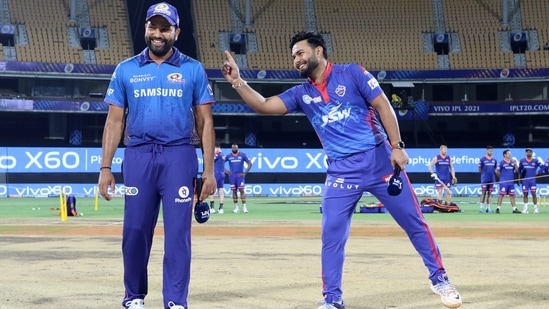
Unlike the 2011 edition, when all the Indian captains were top names with plenty of international experience behind them, there is a varying bunch of leaders this year. The list includes Rohit Sharma (Mumbai Indians), MS Dhoni (Chennai Super Kings), Rishabh Pant (Delhi Capitals), Shreyas Iyer (Kolkata Knight Riders), Mayank Agarwal (Punjab Kings), Sanju Samson (Rajasthan Royals), KL Rahul (Lucknow Super Giants) and Hardik Pandya (Gujarat Titans). Among them, Agarwal, Samson and Pandya are on the fringes of the Indian setup right now while Iyer has enhanced his case across formats only in the last few months. Pant is the youngest of the lot at 24.
That most teams are preferring Indians over overseas players for this job is significant. Punjab, for instance, have given the reins to Agarwal despite his IPL captaincy experience being limited to just one game as stand-in skipper. Pandya is an untested captain altogether, faced with the challenge of moulding a new franchise into a successful unit, never mind his own issues with form and fitness and that he hasn’t played a competitive game since India’s exit in the T20 World Cup in November last year.
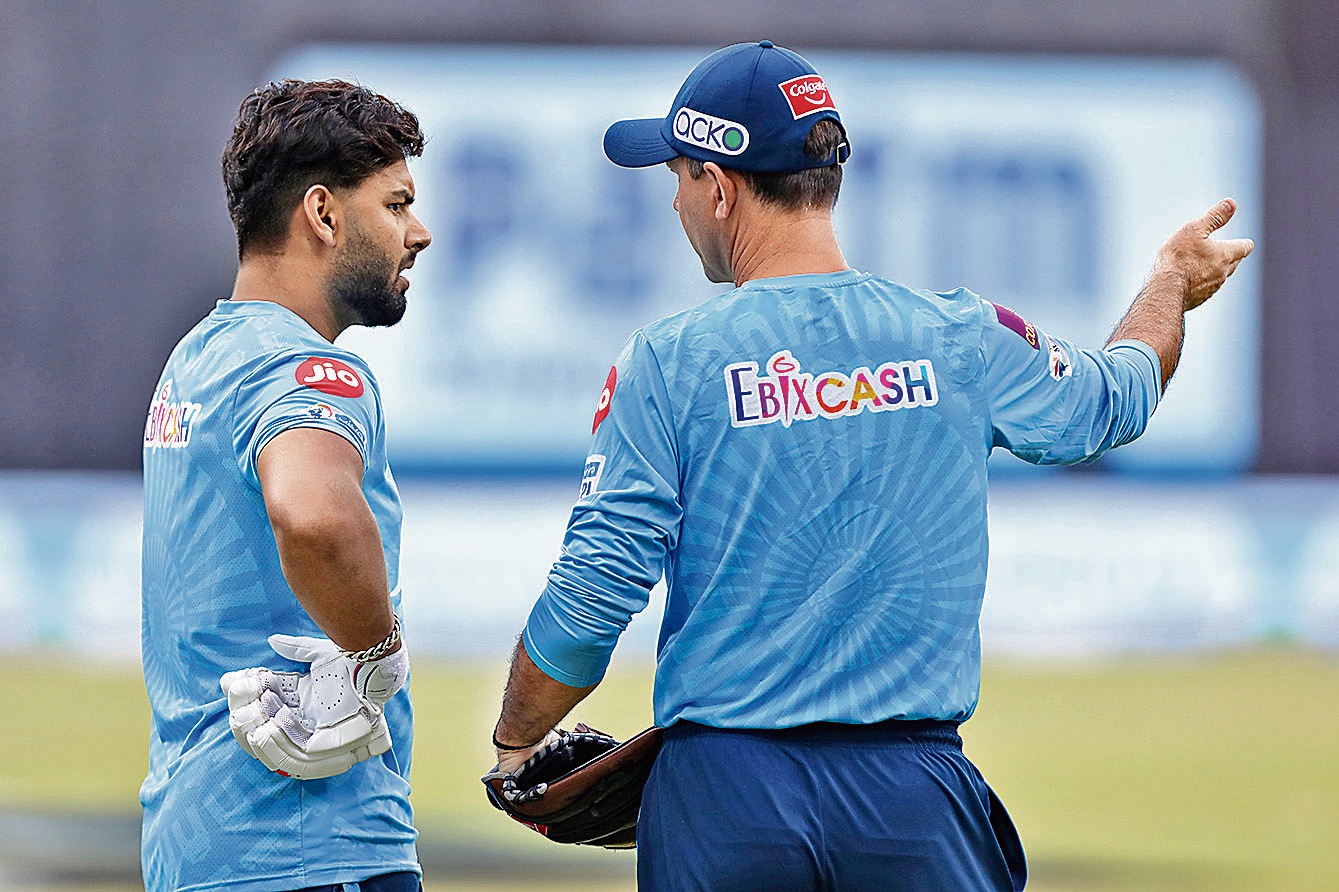
Rishabh Pant and Ricky Ponting of Delhi Capitals (IPL)
The likes of Pant, Samson and Iyer don’t have much experience either, but their franchises have been willing to back them in the hope of unearthing their leadership potential. In Samson’s case, he replaced Australian Steve Smith as captain before the 2021 season. They could have very easily opted for another overseas skipper in either Jos Buttler or Ben Stokes—this being a franchise that has had quite a few foreign captains—but Royals co-owner Manoj Badale underlined the importance of now having an Indian in charge. “As the IPL has grown, the captaincy has become a year-round task, and strong local Indian leadership has become increasingly important,” Badale was quoted as saying by the franchise.
Pant, too, was promoted to the role last season. The decision was forced on Delhi Capitals after an injury to Iyer ruled him out of the initial stages of the season, but it also seemed an ideal time to capitalise on Pant’s soaring stocks after his series-winning pyrotechnics in Australia. He ended up staying on as captain even when a fit-again Iyer returned for the second half of the season in the UAE.
It perhaps did not sit well with Iyer, who decided that he didn’t want to be retained by Capitals. He will now be turning up for Kolkata Knight Riders as captain, marshalling senior players of the calibre of Pat Cummins, Sunil Narine and Andre Russell. Iyer has no reason to be overawed of course. He had it far tougher when he first took charge of Capitals as a 23-year-old in 2018 with just six ODIs and as many T20Is under his belt.
“The importance of Indian cricket is growing worldwide,” former India wicketkeeper and national selector Saba Karim, who is Capitals’ head of talent search, said. “It is so heartening to see so many youngsters getting the responsibility of captaining IPL teams.”
There are also practical reasons why appointing an Indian as captain is beneficial. “All the owners have matured. They understand the dynamics of the IPL,” said Karim. “We have noticed for instance that if a foreign captain is out of form, you possibly can’t drop that player (even though there are other foreigners who can step into the team). Foreign players may also not be always available. Communication (with domestic players) is also an advantage with Indian captains.”
According to former KKR team director Joy Bhattacharjya, there is a long-term direction that a team can take with an Indian captain on board. “Teams are placing a lot more faith in Indian captains. They are bound to be more switched on and committed. When you are investing in a good Indian player, you invest in them for a period of 5-6 years at least. It means your captaincy is also taken care of for that period. With overseas players, beyond 3 years, you have to be exceptional if a team wants to keep retaining you. There are younger and better international players coming through all the time.”
Vivek Krishnan is a sports journalist who enjoys covering cricket and football among other disciplines. He wanted to be a cricketer himself but has gladly settled for watching and writing on different sports.Read More


 Live Score
 Cricket Teams
 Cricket Players