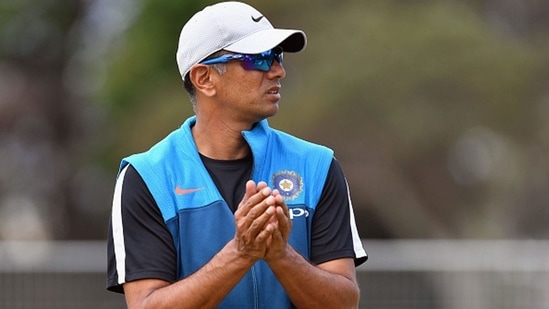
Among the first things Rahul Dravid needs to wrap his head around, in fact this should be top priority, is why the Indian team falters consistently in multi-nation tournaments. The recent T20 World Cup setback is one of several in the past eight years, though none has been as grievous.
File Photo of Rahul Dravid. (Getty Images)
After winning three ICC titles (T20 WC 2007, ODI WC 2011 and Champions Trophy 2013 under M S Dhoni), India were perceived as the best side in the sport, knocking hard to be clubbed alongside the West Indies team of the 1970s and 80s and Australia between 1990 and 2005.
While the team’s record in bilateral contests–across formats–since 2013 has substantiated that claim, reaching a crescendo in the Test series against Australia in 2020, in ICC tournaments it has remained stagnant or, as in the recent case, dipped badly, which makes comparisons with those West Indies and Aussie teams tenuous.
A great deal has been discussed about Virat Kohi’s failure to win a multi-nation tournament, but it would be unfair–and more pertinently, obfuscating the issue –by laying the blame at his door. Remember, India had lost in the 2015 ODI World Cup semi-final and the 2016 T20 WC semi-final. Before that, in 2014, India finished runner up in the T20 WC, and going even earlier, didn’t qualify for the knock outs in the 2012 and 2010 T20 WCs.
In all these tournaments, the captain was MS Dhoni, whose captaincy credentials in white ball cricket are unimpeachable. The "Kohli Factor" in India’s failure to win such tournaments does have a role, especially after the breakthroughs provided by Dhoni, but is clearly not the only one.
As an aside, India’s record since 2013 is in stark contrast to the time when the team was on a winning spree of multi-nation limited overs tournaments in different conditions and pitches in the mid-1980s, but losing almost every bilateral ODI series played in the same period.
Between 1983 and 1985, India won the Prudential World Cup (England), the Asia Cup (Sharjah), World Championship of Cricket (Australia) and Rothmans Cup (Sharjah). Just prior to the Prudential Cup, however, the team was thrashed in an ODI series by Pakistan (1982-83), beaten by West Indies (1983), thrashed by West Indies (in India, 1983-84) after the World Cup, then thrashed by England (1984-85) and Australia (1984-85) both in India.
I brought in that digression to highlight that limited overs cricket is intrinsically more unpredictable than Test cricket. Yet not everything can be attributed to quirkiness of the format. When West Indies and Australia were at their peak, they swept aside all opponents most times, in bilateral as well as multi-nation contests.
India’s flop show in ICC tournaments in the last 7-8 years is baffling and flies in the face of cricket logic. The quality of players has been excellent, performances in bilateral contests brilliant. No other team has been as consistent–across formats–in this period as ICC rankings testify. With data analytics feeding so much relevant information nowadays, these failures become even more intriguing.
There have been no major controversies as distraction either. The only parallel I can draw with the recent debacle is when India, under Dravid, were knocked out of the 2007 ODI WC in the first round. But at that time, the Indian dressing room was stricken with internecine dissent over coach Greg Chappell.
No team is bereft of personality clashes. A bunch of individuals living in blissful harmony, especially given the excruciating demand sport makes on passion, ego and ambition, is a chimera. Players compete externally and among themselves for attention, records and rewards. As long as these differences don’t disrupt the team’s overall stability and focus, this in fact could be incentive to perform better.
So, what gives?
In Covid times, spending weeks and months in the bio-secure bubble takes its toll, but this would be true for most teams. Physical and mental fatigue because of isolation and unrelenting workload are issues that have to be addressed by administrators the world over, but again, not peculiar to only one side.
The issue is complex but Virat Kohli gave a hint about what may be at the crux. “We were not brave enough’’, he said of the defeats against Pakistan and New Zealand—a startling but candid admission. More than team overhaul (or not) and rotation of players, addressing this “fear factor” becomes paramount.
Given his vast expertise, understanding of player psychology and vicissitudes of sport, Dravid must tackle this asap, with captains Rohit and Kohli in different formats. His two-year assignment includes three ICC tournaments: T20 WC in 2022, ODI WC in 2023 and also the World Test Championship which culminates in 2023.
Time is short, the task onerous: To transform title-shy chokers into winners.


 Live Score
 Cricket Teams
 Cricket Players