


 Live Score
 Cricket Teams
 Cricket Players
Nepal's fearless near-takedown of England raises an old question: How long can associate nations wait?
Four matches from the opening six games reignited a familiar debate: the need for the ICC to implement a serious, sustained plan for Associate Nations.

 Prefer HTon Google


After a sea of blue on Saturday evening, Wankhede wore a different, and unlikely, outfit the next night. On India’s home soil, the iconic Mumbai venue got a taste of Nepal’s remarkable fan base. Clad in red and blue, some even donning the traditional dhaka topi, Nepalese supporters rallied behind their team with heart and voice, even as the contest appeared a mismatch. “They sound even noisier than yesterday,” observed one of the commentators.
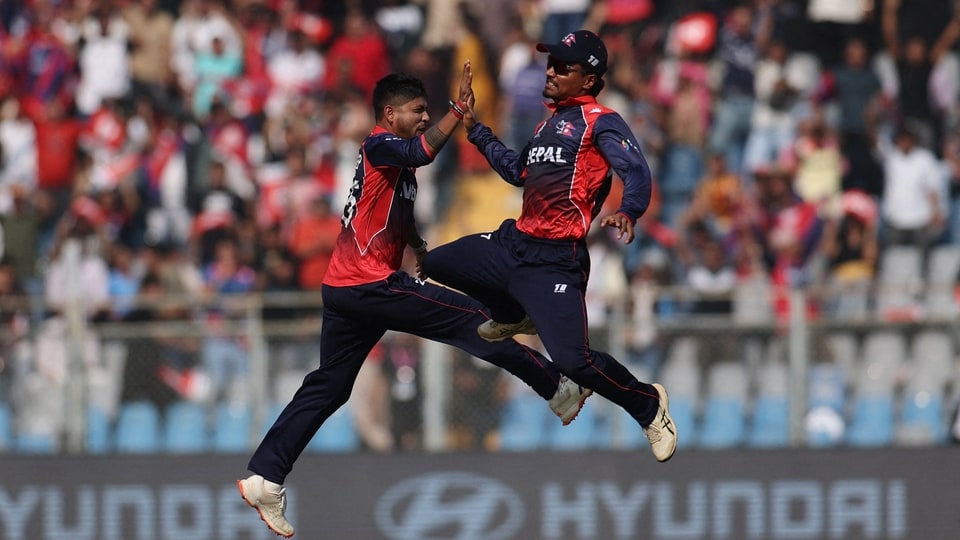
Pitted against the 2022 champions, the imbalance looked evident on paper after half-centuries from captain Harry Brook and Jacob Bethell powered England to 184 for 7, a total seemingly beyond Nepal’s modest batting resources. But it took just 12 deliveries for that assumption to be challenged. Opener Kushal Bhurtel tore into Jofra Archer with three boundaries in the second over, then repeated the treatment against Luke Wood, collecting a four and a six in a 15-run burst.
Tension gripped the England camp when their ploy to exploit Nepal with spin backfired spectacularly. Adil Rashid, the senior bowler, bore the brunt as he was taken apart for 42 runs in three overs. The nerves eased only when England’s pacers used cutters to leave Nepal gasping, before a late charge from Lokesh Bam dragged the match back into a contest.
Brook could barely stand still as Bam took down Sam Curran in the 17th over and then smashed Archer for 22 in the next, reducing the equation to 24 off 12. England were staring down the barrel. Coach Brendon McCullum could only watch helplessly from the dressing room, walkie-talkie in hand, as Brook engaged in prolonged discussions with Jos Buttler. It did little to calm the storm.
Even after another message from upstairs and a second on-field conference, Wood leaked 14 runs in the penultimate over, eight off boundaries and three wides. He did end the over with a wicket, but Bam remained at the crease.
When it mattered most, Curran held his nerve. Executing pinpoint yorkers, he conceded just five runs in the final over as Bam sank to the ground in despair. It was heartbreak again for Nepal, following their one-run loss to South Africa in St Vincent in the previous World Cup.
England had secured a nerve-jangling win, but the stadium still echoed with chants of “Nepal”. Mirroring a home side, Rohit Paudel led his team on a lap of the ground to thank the supporters. “They are very passionate. Today, it felt like the whole of Nepal was here,” Paudel said later. “When we go out, we carry your hopes and belief. I think today all of Nepal will be very proud.”
This was the second time in two days that minnows had pushed former world champions to the brink. Pakistan, the 2009 winners, needed till the final over to chase 148 against the Netherlands in Colombo. Scotland, later that evening, surged within 50 runs of victory with five wickets in hand against West Indies before Romario Shepherd’s hat-trick crushed their hopes. Even India, the overwhelming favourites, found themselves reeling at 77 for six against the USA before a captain’s knock from Suryakumar Yadav rescued them.
Four such matches from the opening six games reignited a familiar debate: the need for the ICC to implement a serious, sustained plan for Associate Nations. This wasn’t a one-off. Over the years, these teams have repeatedly threatened, and sometimes toppled, cricket’s Goliaths at global tournaments. Yet once the spotlight fades, so does the momentum. They return to the margins, resurfacing only years later with another reminder of what might have been.
The David-versus-Goliath narrative will always pull crowds. It offers hope, romance, and belief, much like India’s 1983 Prudential Cup triumph did. That single victory transformed the nation’s sporting culture. But such revolutions need more than isolated moments; they require opportunity and exposure.
“Many games are decided by small moments, like a single catch. Skill levels are very close,” Namibia captain Gerhard Erasmus told The Times of India. “More exposure will level the playing field. That will make the global game stronger.”
The lack of consistent international exposure hasn’t stalled progress entirely. Players have found alternative routes. The explosion of T20 leagues over the past decade has opened doors for Associate Nation cricketers to rub shoulders with elite professionals. Those experiences are then carried back into ICC events, breeding belief that they can punch above their weight.
“We didn’t come here just to participate. We came to compete,” Paudel said. His words resonated beyond Nepal’s near-miss. Because on a night when England survived, and Nepal fell short, the bigger takeaway lingered in the noise at Wankhede, proof that the gap is narrowing, and that these stories deserve more than fleeting applause.


