


 Live Score
 Cricket Teams
 Cricket Players
Prolific Sarfaraz Khan keeps expectations low
The Mumbai batter, once ultra-aggressive but now a smart reader of the situation, has emerged an India contender due to his series of big scores and temperament


“Mein uske baare mein nahi sochta hoon (I don’t think about it). I’m focussed on scoring runs which is in my control. Agar naseeb mein hey toh India cap zaroor milegi (if it’s in my destiny, I will get the India cap,” says Sarfaraz Khan when asked about his hopes of breaking into the Test squad.
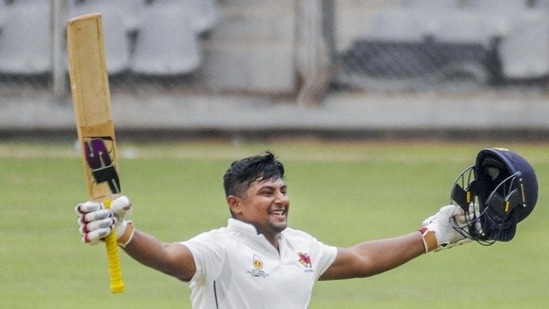
Sarfaraz may sound modest but the rate at which he is piling big knocks in the last two Ranji Trophy campaigns for Mumbai, he is emerging a strong claimant for an India spot. He is also ticking all the boxes required—showing the temperament, playing big knocks and switching between the attack and defensive modes.
“I always keep expectations low,” says the 24-year-old. “The idea is to improve my game to a level that whenever I get an opportunity, I shouldn’t be found wanting.”
In the 2019-20 season—he returned to Mumbai after playing briefly for Uttar Pradesh—he scored 928 runs, averaging 154.66 after three big knocks—301, 226 and 177. This season, he has already tallied 704 runs in four matches (avg 140.80) with three big knocks—275, 165 and 153.
A look at Ranji performers since 2015-16—the last time Mumbai won the title—suggests that selectors reward them with a spot in one format or the other. In 2015-16, Shreyas Iyer scored 1,321 runs in 11 matches and by 2017 he had made his India T20 debut. Rishabh Pant burst onto the scene in 2016-17, scoring 972 runs for Delhi. In February 2017, he made his T20I debut, and before 2018 end, he was in the ODI and Test squads. That year, Priyank Panchal was the top-scorer with 1,310 runs, following it up with 898 runs in 2018-19. He has been in the India ‘A’ set-up since then and last year was Rohit Sharma’s replacement in the Test squad for South Africa.
Mayank Agarwal topped the charts in 2017-18 with 1,160 runs in eight matches. Towards the end of the year, he had played for India in Australia. The same season Hanuma Vihari scored 752 runs in six matches, continuing his consistent performances in seasons before. He made his Test debut on the 2018 England tour.
Sarfaraz’s record and consistency has been similar. He was picked for India ‘A’ at the end of last year, scoring 71 not out on debut against South Africa ‘A’. So what has Sarfaraz done over the last few seasons to become a run machine?
“Me and abbu (top Mumbai coach Naushad Khan) have worked hard. There was a time when I was associated only with white-ball cricket. Some said I didn’t have the technique to succeed in red-ball cricket. But I believed I can do it, I worked on my technique,” says Sarfaraz.
“I’ve been scoring runs for the last three years. Big knocks are coming as well. People lose focus when they score for one year, but I’m very not letting that happen. My only focus is to play quality cricket, make runs and make sure I don’t waste the effort put in by abbu.”
Sarfaraz puts his success down to the hard work done since he
was a boy—“three nets sessions a day, facing 600-700 balls”.
“I make it more difficult for myself during practice; I watch a lot of videos and discuss (with father) what we can improve. When I walk in to play, I try to enjoy, don’t put much pressure on myself,” he says as he prepares to lead Mumbai’s batting in the Ranji Trophy semi-final against Uttar Pradesh starting in Bengaluru on Tuesday.
Sarfaraz built his reputation as a big-hitter, but he has learnt the virtues of patience.
“With experience, you know what to do, what to avoid. Now I think ‘if I have to score big runs, I can’t hit sixes and get those runs, I need to play 200-300 balls to get those runs’,” says Sarfaraz, whose all seven centuries have been 150 plus. His 153 against Uttarakhand in the Ranji quarter-final was his lowest 100-plus knock.
The knock against Uttarakhand and the 275 he scored in the season opener against Saurashtra highlight how good he is at adapting his game. Against Uttarakhand, Mumbai were 176/3 and the pitch had settled. He kept attacking the bowling, scoring at a strike-rate of 74.63.
Against Saurashtra, Mumbai were 44/3 and he played cautiously.
“I try to stay ahead of the opponents, play around with the field, pick the shot I must play, and many more things. It helps me stay on top of my game, keep myself ready for the next ball…”
Coaches who have worked with Sarfaraz vouch for his street smart approach, which has earned him the nickname Javed (Miandad).
“Sab Javed Miandad bolte hey (everyone calls me Miandad). Abbu has taken me to different localities to play cricket so street smartness has developed over the years, roaming the country, travelling by trains, sleeping at railway stations, observing things…”


