


 Live Score
 Cricket Teams
 Cricket Players
Sanju Samson thanks his ‘lucky charm’ after match-winning century vs DC: ‘Please come to every game’
CSK secured their first win of IPL 2026 against Delhi Capitals, led by Sanju Samson's unbeaten 115 off 56 balls.

 Prefer HTon Google


After a poor start to IPL 2026 and a string of disappointing performances, CSK badly needed one innings to change the mood around them. They got exactly that against the Delhi Capitals at Chepauk. Sanju Samson’s unbeaten 115 off 56 balls powered Chennai to 212/2, set up their first win of the season, and gave a stuttering campaign its first proper breath. For Sanju, too, it was a release. He had come into the match with scores of 6, 7 and 9 in his first three outings, so this was not just a hundred. It was a statement wrapped inside one.
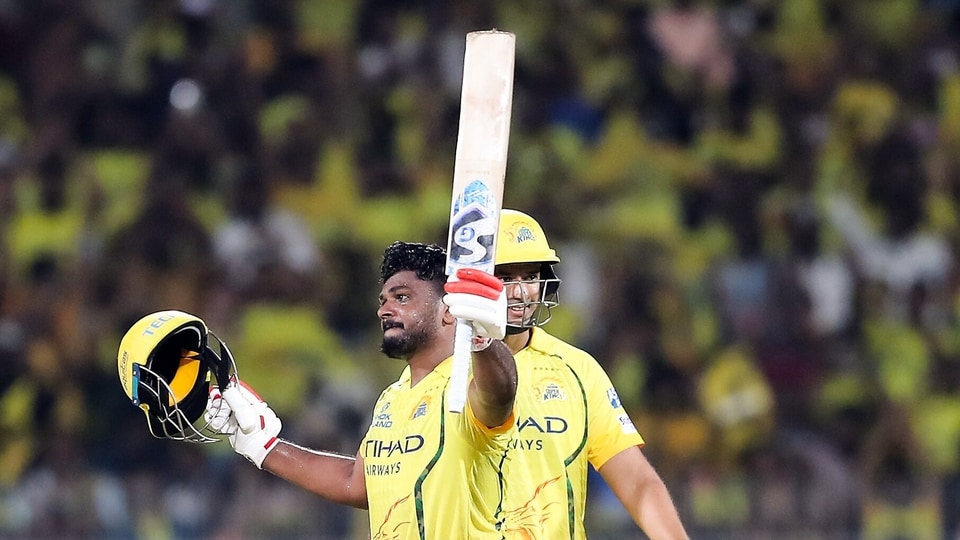
Ayush Mhatre’s 59 off 36 gave Chennai crucial support through the middle overs, but the innings revolved around Sanju’s control. He judged the conditions smartly, never let the knock lose shape, and then accelerated hard enough to put Delhi under scoreboard pressure. By the time CSK sealed the win, his effort had become more than the centrepiece of the innings. It had become the innings that gave Chennai a reset.
That is what made his post-innings interview on JioHotstar worth listening to. It was not just a smiling television exchange after a big score. It was a player explaining what had been happening inside his game.
Sanju Samson’s honesty gave his Ravi Shastri line real meaning
The most revealing part of the interview came when Sanju spoke about the uncertainty that follows a few low scores, “A couple of failures put doubts in your mind, but I wanted to trust my basics and stick to what I was working on.”
That line explained the hundred more clearly than any highlight reel could. Sanju Samson was not batting like someone trying to smash his way out of trouble. He was batting like someone who had returned to the frame of his game and trusted it to hold. The timing was pure, but the real strength of the innings was clarity. He did not chase the knock. He built it.
His understanding of the pitch showed the same calmness. “It was definitely holding a bit with the new ball. When it became old, it became a great wicket to bat on.” That was exactly how Chennai’s innings unfolded. They did not begin recklessly. They absorbed the early challenge, trusted that batting would get easier, and then expanded. Once the ball softened, Sanju’s range opened up and Delhi never quite regained control.
He also made sure the partnership got its due. “Ayush is such a great youngster. Really enjoyed batting with him.” That mattered because Mhatre’s innings ensured Delhi could not load all their pressure onto one end. The stand kept the score moving and gave CSK the kind of middle-overs momentum they had badly lacked in earlier matches.
There was another sharp line when Sanju spoke about the chat in the middle after 15 overs. “You can’t set a target these days. You just have to get as big a score. We just wanted to contribute as much as possible.” That is modern T20 batting in one sentence. Teams no longer trust a total unless they have stretched it beyond comfort, and Chennai batted with exactly that mindset here.
Sanju had actually begun the interview with the line that drew the quickest smile. “I feel great. You seem to be my lucky charm in every game, so please come to every game,” he told Ravi Shastri. It was playful, but because the honesty that followed was so strong, the line landed even better. It did not feel like empty banter. It felt like a player who had come through a rough patch, played the innings his team needed, and finally had room to smile again.
That belief proved right. Chennai defended the total, Sanju’s 115 not out stood at the centre of their first win.


