


 Live Score
 Teams
Teams Players
Usman Tariq's unusual pause-and-sling bowling action sparks 'chucking' uproar — but does it breach ICC’s 15-degree rule?
Usman Tariq was reported twice during the Pakistan Super League. On both occasions, he underwent testing and was cleared.

 Prefer HTon Google


The run-up is bizarrely short. He staggers in, almost diagonally, veering past the cutting line before pausing for what feels like an eternity. Then comes the sling, reminiscent of Lasith Malinga (not in pace, of course), and the release, almost shielding the umpire’s view. Pakistan’s Usman Tariq has attracted plenty of attention for his unusual bowling action. Much of that scrutiny, from keyboard warriors, a few experts, and even cricketers like Cameron Green, has centred on his release.
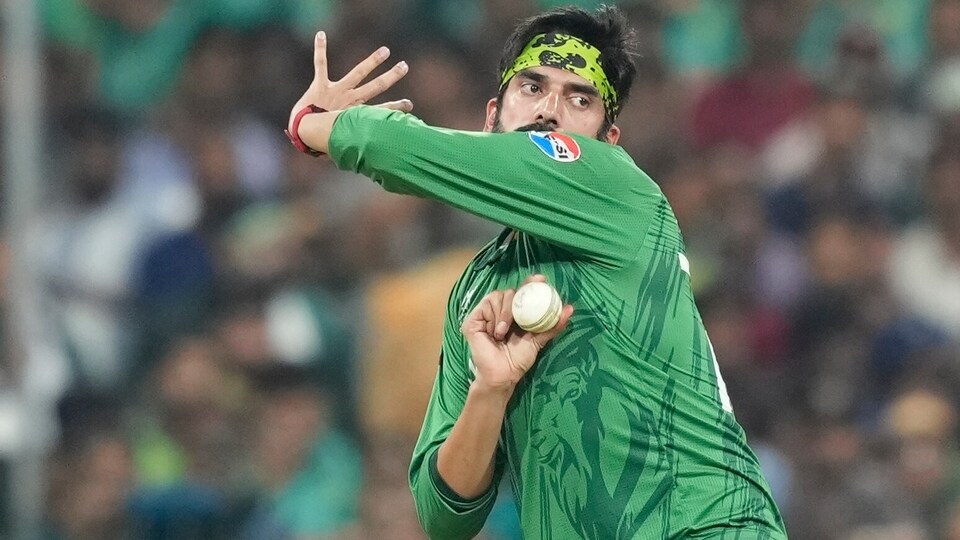
Earlier this month, a visibly frustrated Green mimicked Tariq’s action after being dismissed by him during a bilateral T20I series in Lahore, seemingly hinting at chucking. England batter Tom Banton expressed similar concerns during the last edition of the ILT20. Even India great Ravichandran Ashwin raised doubts, leaving what he called the “ultimate decision” to the ICC.
A fresh wave of social media criticism erupted on Tuesday evening when Tariq picked up three wickets in Pakistan’s 32-run win, pushing them to the brink of the T20 World Cup’s second round. Clips were paused and rewound. Screenshots were dissected. Angles were marked. Accusations quickly followed that Tariq had exceeded the 15-degree limit.
There was no subtlety, as is often the case online. The label “chucker” was thrown around freely.
It is a serious allegation for any bowler. But would the ICC really ignore it?
What does the ICC rule say?
According to ICC regulations: “An Illegal Bowling Action is where a player is throwing rather than bowling the ball. This is defined as the elbow extending by more than 15 degrees between the arm reaching horizontal and the ball being released.”
It is the responsibility of match officials to report suspect actions. Tariq was reported twice during the Pakistan Super League. On both occasions, he underwent testing and was cleared.
So what explains the visible bend in his elbow?
The spinner, who gave cricket a second chance after being inspired by MS Dhoni’s biopic, addressed the issue in an interview with MYK Sports.
“I do have two elbows in my arm. My arm bends naturally. I have got this tested and cleared. Everyone feels I bend my arm. My bent arm is a biological issue.”
In medical terms, Tariq has a hypermobile elbow, sometimes referred to as being double-jointed, a congenital condition. Muttiah Muralitharan had a similar trait and endured years of scrutiny before finishing as Test cricket’s highest wicket-taker.
Closer to home, Jasprit Bumrah’s hyperextended elbow has also raised suspicion in the past, until advanced broadcast analysis confirmed it was within legal limits and, in fact, part of his natural advantage.
Interestingly, Tariq was not originally a spinner. He began as a pacer but switched to off-spin after an injury during a tennis-ball game left his team short of bowlers. The move proved fruitful; wickets followed, and his coach encouraged him to pursue spin seriously.
His action now carries an element of mystery. In a format built on speed and aggression, the pause before release disrupts a batter’s rhythm, often forcing errors. Since making his international debut just three months ago, Tariq has taken 11 wickets in four matches at an economy rate just under six.
Unusual? Yes. Illegal? The ICC has twice said no. And until proven otherwise, that distinction matters.


