


 Live Score
 Cricket Teams
 Cricket Players
Virat Kohli at 100: How he got the bowling attack up to speed
India’s fast, furious pace attack has been Virat Kohli’s biggest legacy after leading the team in 68 Tests


On the third evening of last year’s Lord’s Test, Jasprit Bumrah had made up his mind to pepper James Anderson with a barrage of bouncers. His first delivery flew off Anderson’s helmet to gully. Anderson took his own time before taking strike. Again, a bouncer. Another, and then another. To Anderson, this was a flagrant violation of the unwritten but widely acknowledged fast bowlers’ truce—you don’t send down dangerous stuff at your own tribe. By the time he was dismissed, Anderson was seething.
ALSO READ | For pursuit of excellence, King Kohli deserves a salute
Day four. India had lost their seventh wicket in the form of Rishabh Pant with a lead of only 167. Enter Bumrah with a sly grin plastered on his face. India’s lower-order was possibly one of the weakest at this time, averaging 13.80 per wicket in the previous three years—better than only Sri Lanka (12), South Africa (13.23) and Pakistan (13.64). But on that day, Bumrah raised an unbroken 89-run stand with Mohammad Shami as England let emotions dictate their plans. Anderson tried to counter-bounce Bumrah, Sam Curran sprayed around the ball while Mark Wood tried—quite unsuccessfully—to overwhelm with pace. Every ball off target allowed India to swell an already threatening total, only because England couldn’t resist the temptation to intimidate. And it all traces back to that one over from Bumrah.
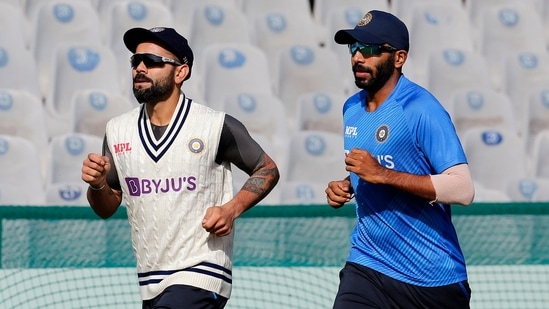
In another time, in another world, Indian fast bowlers playing mind games with England in England would have been nothing short of fantasy. It is the new reality now. On the cusp of his 100th Test—Virat Kohli’s first in seven years and 68 Tests, when he is not captain—beyond the numbers he has amassed, he would be proud of an indelible legacy—the emergence of India as a fast bowling force. From design to execution, this is Kohli’s handiwork. Be it Johannesburg (2018), Melbourne (2018), Lord’s (2021) or Centurion (2021), India’s new penchant for winning Tests overseas leaned heavily on aggressive, accurate fast bowling.
Kohli's boys
Kohli’s love for attacking with pace changed Indian cricket, but how does that attack compare to some of the great pace line-ups from the past? Does it even hold a candle to, say Clive Lloyd’s legendary quartet? India’s pacers have taken 591 wickets at an average of 26 runs and a strike rate of 51.3 in the 68 Tests led by Kohli. There have been more prolific fast bowling attacks but what really makes Kohli’s statistics pop is that strike rate of 51.3—better than the returns from pace attacks under Lloyd (54.8), Greg Chappell (56.5), Steve Waugh (55.6), Ricky Ponting (56.7), Hansie Cronje (57.8) and Graeme Smith (54.8). Only Viv Richards’s pacers, with a strike rate of 50.1, remain marginally ahead of Kohli.
What Kohli has achieved is extraordinary not only because modern batters hold an undeniable edge over bowlers but also because it is symbolic of a cricketing nation that has never been known for great fast bowlers undergoing a fundamental transformation. Add to it the fact that India managed to accomplish this dominance without home advantage—unlike West Indies in the 80s or 90s or South Africa and Australia.
Looking for his strike team, looking for his own philosophy, Kohli chopped and changed the Indian Test side in 2015, 16, and 17. Then came a moment that may be, arguably, marked as the line between before and after. It was October 2017, India vs Bangladesh in Hyderabad, and Umesh Yadav was bowling the spell of his life to Mushfiqur Rahim and Shakib Al Hasan. There was seam, plenty of zip off the surface, and even reverse swing. Shakib later said it was the best spell he had ever faced. India’s control, especially over the older ball, was one of the biggest gains for Kohli from that Test. “If you can have 3-4 seamers in your squad who are attacking bowlers and can pick you wickets at any stage during the day, then it is a bonus for any side,” Kohli said after that Test. “When we start going away from home, it is going to help us big time.”
Dominance
All of this was leading up to 2018, a rare year where India toured South Africa, England and Australia. Kohli knew only a five-bowler template could keep India in the game on these tours. It was a huge punt, fielding five bowlers, compromising the batting depth, going against the grain of tradition. Kohli never wanted it another way. Starting with Ishant Sharma, Shami, Yadav and Bhuvneshwar Kumar, Kohli added to his pool Bumrah in 2018 and Mohammed Siraj in 2020 (though he made his debut under Ajinkya Rahane, at the MCG).
On the South Africa tour in 2018, pacers accounted for 50 out of the 57 Proteas wickets. But India’s new pace approach truly shone on the hard Australian pitches, where Kohli led the team to a historic first series win. At home, spinners were understandably given longer spells on abrasive, uneven pitches but Kohli also kept the attack multidimensional by making his pacers bowl shorter, more incisive spells that found swing—both conventional and reverse—while exploiting inconsistent bounce to bamboozle batters.
Kohli had found his strike force, but he also put in place a way to keep them battle ready. A rotation policy, another first for India, ensured that Bumrah first played a home Test in 2021, three years after making his debut and making waves across the cricket playing world. Shami too was taken off most white ball games (he played just six ODIs and T20Is in 2017-18). All this helped pacers get better and better. Ishant, for example, improved several notches—from an average of 36.65 and a strike rate of 65.1 under Dhoni to 25.85 and 55.6 respectively under Kohli. No other India fast bowler has taken a greater proportion of wickets at home than Yadav. And now, in Siraj, India have another option who can step up if Shami and Bumrah are to be rested for a home series.
 ABOUT THE AUTHORSomshuvra Laha
Somshuvra Laha is a sports journalist with over 11 years' experience writing on cricket, football and other sports. He has covered the 2019 ICC Cricket World Cup, the 2016 ICC World Twenty20, cricket tours of South Africa, West Indies and Bangladesh and the 2010 Commonwealth Games for Hindustan Times.Read More


