


 Live Score
 Cricket Teams
 Cricket Players
Virat Kohli beats Kumar Sangakkara, only Sachin Tendulkar ahead: Why his scary consistency takes him beyond greats
Virat Kohli scored his 54th ODI century, reinforcing his status as a unique talent in modern cricket.

 Prefer HTon Google


Virat Kohli went past 28,000 runs, and it isn’t just another milestone to file away. It is a reminder that modern ODI batting has one repeatable outlier: a player who treats a milestones like a standard outcome once he’s set.
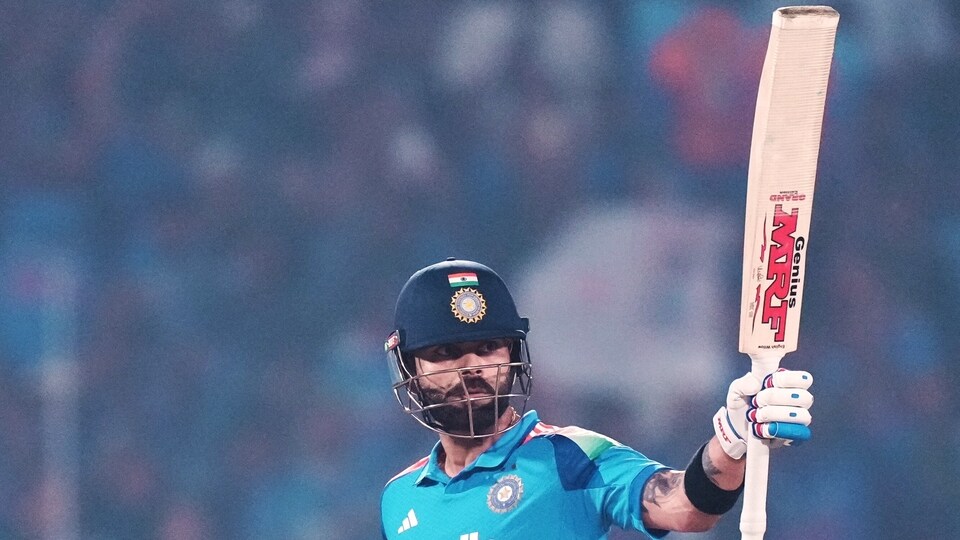
It came in the India-New Zealand series opener at Vadodara’s Kotambi Stadium with India chasing 301 after New Zealand posted 300/8.
The unreal consistency of Virat Kohli
The simplest way to measure Kohli’s consistency machine is to ask: how often does he convert an innings into a big one?
Going into this match, Virat Kohli had played 308 ODIs and batted 296 times. He already owned the all-time ODI hundreds record at 53, a mark he reached during the home ODI series against South Africa in December.
- Before today: 53 hundreds in 296 innings - one hundred every 5.60 innings
In a format where even legends are thrilled to reach a century every 8-10 innings over a long career, Kohli is sitting in the mid-5s, sustained over nearly 300 innings.
Why he’s different: Kohli's batting in ODIs
Kohli’s century record is inflated by something ODIs constantly demand: finishing under pressure. He averages over 65 when batting second in ODIs, and an absurd near 90 average in successful cases.
Those are not just clutch; those are career-long patterns, evidence of a batter who understands the chase as a sequence of phases, not a single frantic act.
That is the big difference from many great ODI batters. Plenty could dominate when everything was set up. Kohli’s edge is that he keeps his batting solvable when the equation is changing - early wickets, spin in the middle, required rate creep, late dew, field spread, nerves tight.
Also Read: Virat Kohli decoded ODIs like no-one else: Simon Doull brands him ‘the outlier’ and rejects ‘ODIs are easier' claim
The conversion habit
Kohli’s hundreds often look deceptively ordinary on a highlights reel. That is the point.
His best ODI innings are built around control: low-risk options early, ruthless singles, then a sharp acceleration once the ground dimensions and the match-ups are mapped. His hundreds arrive so regularly because even in a big century, he can mine runs through running, an example was the 40 singles in that Ranchi Hundred against South Africa.
That single-hunting does two things at once: it keeps the scoreboard moving, and it punctures the bowler’s ability to build pressure. The boundaries become the bonus, not the obsession, and that is exactly why he keeps batting deep enough to reach three figures.
The Tendulkar context - and the scale of the gap in frequency
Notably, Virat Kohli is now the second highest international run scorer in cricket, right after Sachin Tendulkar. He now has 28,068 runs in international cricket. So, the comparsion between the two is inevitable.
Sachin Tendulkar’s 49th and final ODI century came in his 451st innings. Kohli by contrast, has crossed 50 and kept sprinting ahead while operating at a far higher hundred per innings rate, the most telling stat in this whole conversation.


