
 E-Paper



Eye infection: No test as sample of blue sheep decayed
Staff of the national park along with porters and members of Uttarkashi-based Nehru Institute of Mountaineering (NIM) had trekked for three days in the first week of December at Kedar Tal in the protected area, after mountaineer Love Raj Dharamsaktu said the blue sheep are suffering an eye disease in the high-altitude area.


DEHRADUN: The Indian Veterinary Research Institute (IVRI) was unable to carry out tissue examination of a sample sent by the Gangotri National Park management for ascertaining whether an eye infection is affecting ‘Bharals’ (blue sheep) in the region.
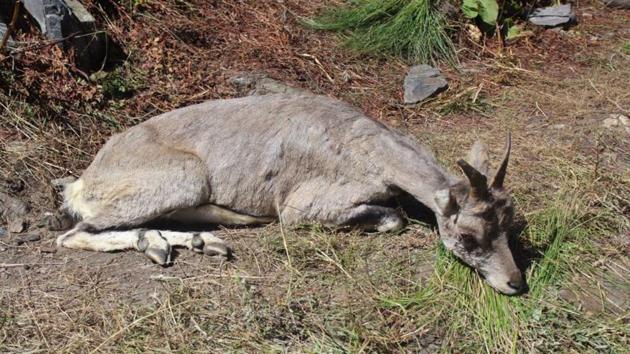
The park management had handed over the head of a blue sheep but the sample was decayed, making it of no use. “The institute said the head was decayed due to which scientists could not assess whether it (the blue sheep) was suffering from eye infection,” Gangotri National Park director Shravan Kumar told Hindustan Times.
Staff of the national park along with porters and members of Uttarkashi-based Nehru Institute of Mountaineering (NIM) had trekked for three days in the first week of December at Kedar Tal in the protected area, after mountaineer Love Raj Dharamsaktu said the blue sheep are suffering an eye disease in the high-altitude area.
Dharamsaktu had written to the chief wildlife warden on September 9 that blue sheep in the region were suffering from an eye disease. “Their eyes bleed,” he told HT.
In December 8 edition, Hindustan Times reported that the survey team did not find any infected blue sheep. The team found the carcass of a Bharal and brought its head which was sent for tests.
“The peaks are covered with snow and its impossible to go there now. Even animals are migrating to the lower Himalayas. We have deployed teams to closely monitor blue sheep and report immediately if they come across any such ailing animal,” chief wildlife warden Digvijay Singh Khati said.
Dharamsaktu alleged that teams did not visit the areas where he found the infected animals. “The forest staff is confined to the accessible locations and do not go to higher areas due to which they couldn’t spot any such (infected) animal. But, I have proof and photographic evidences,” he asserted.


