E-Paper



Counselling, rehab biggest challenges for rape victims
Emotional, psychological and timely financial support is crucial for rape survivors and their families to recover and to fight a tedious legal battle that is known to drag on for years in many cases.


Raka Sinha Bal dreads calls from the police, even though she gets at least one each day and always knows what it will be about.

As head of the NGO Angaja Foundation, Bal has been counselling rape victims, among them several toddlers, since 2000.
Hers is one of the 11 NGOs that are part of the state government’s Crisis Intervention Cell operating in 11 police districts under the Delhi Commission for Women (DCW).
She is on call 24x7 from the Delhi Police to counsel victims of rape, domestic violence and accused juveniles after they are out of observation homes.
From the moment the police reach the victim till the case is heard, Bal and her counsellors are there physically and on call.
Angaja Foundation receives two to three calls in a week, mostly for rape counselling, from the New Delhi district alone. “Earlier, we used to handle North-east district and would, on an average, get at least one call a day. On some days, we’d get even two or three calls,” she says.
“It takes at least half a day to break the ice and persuade the victim to open up. To build that level of confidence in such a short span of time is quite challenging. We receive calls mostly after 5pm,” she says.
In two out of three cases, the perpetrator is part of the family, where the pressure on the victim to withdraw the case is immense.
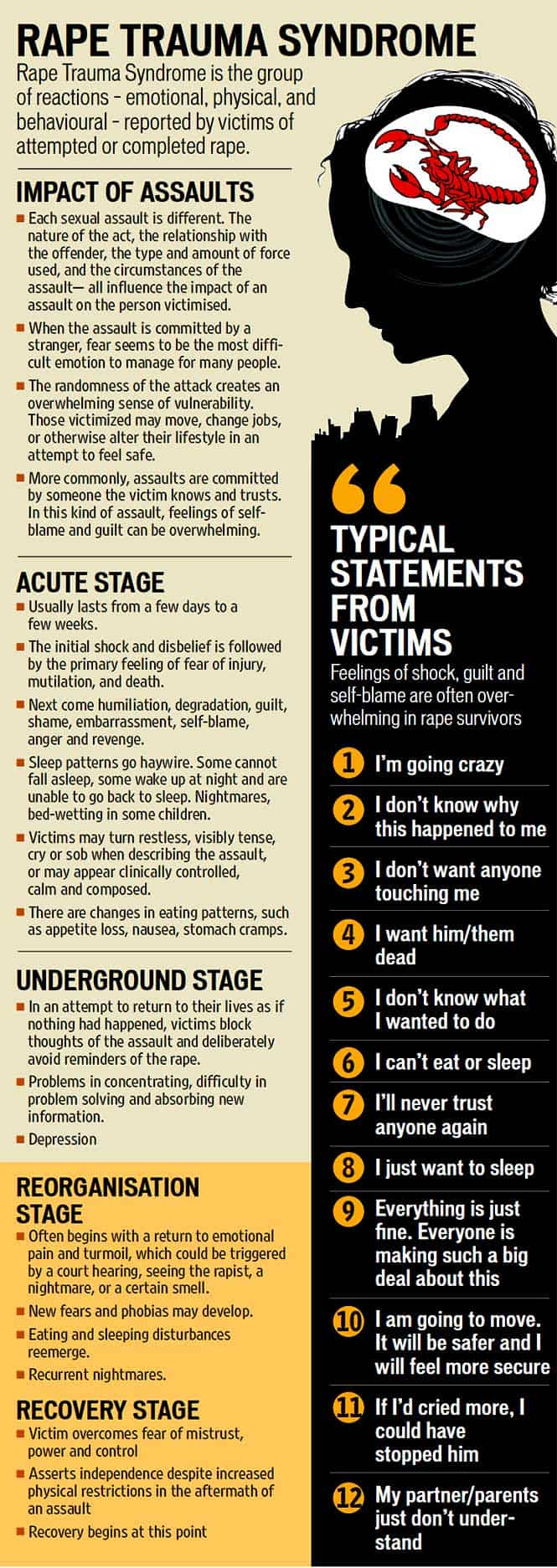
Bal recalls the case of a teenager who was repeatedly raped by her brother-in-law over a period of five years. “Her family is pressuring her to take the case back and she is under tremendous mental strain. This girl is so traumatised that she has stopped going to school and does not want to live with her family,” says Bal.
“We have to be very patient with her as she is emotionally very vulnerable,” she says.
Young adults under 30 years constitute the majority of victims, followed by older women and children under 15.
Bal’s first case was counselling a woman whose boyfriend and a friend brutally raped and beat her four-year-old daughter to death.
“The mother was heartbroken. She trusted that man blindly and it was too much of a shock for her to discover that he’d raped and murdered her daughter,” says Bal. “It was emotionally challenging... the case dragged on for years.”
Since then, Bal and her team have counselled more than 1,000 women.
“We are two counsellors, and are available 24X7 on call. We act on a tip-off from the police who call us when there is a rape victim in the police station. The first session always takes place inside the police station but if it’s a child we even go to the hospital,” says Santosh Kumari, a counsellor with Mehar Charitable Society that takes up cases from South district.
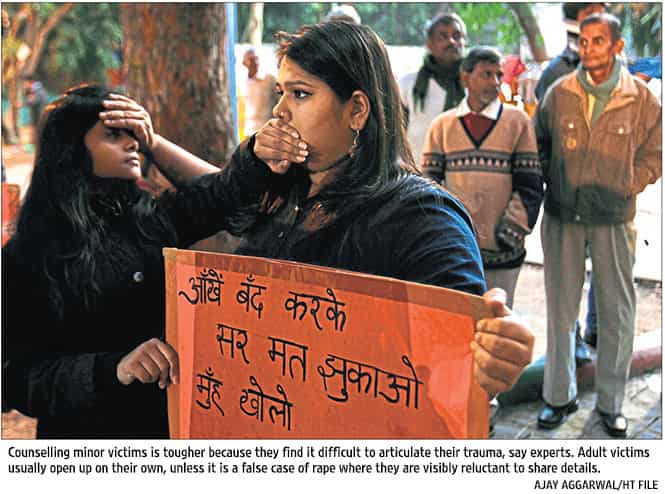
Counselling underage victims is tougher because they find it difficult to articulate their trauma.
“How you approach the issue depends on the victim’s frame of mind, but with children we avoid asking details of the incident. We ask about the school, friends, favourite food, television channel or programme and details we take from either the parents or the investigating officer. Only if a child feels comfortable, we ask her/him about the pain in private parts,” she says.
Adult victims usually open up on their own, unless it is a false case of rape where they are visibly reluctant to share details.
“We make victims at a comfortable place, offer water, tea or coffee. Adults take 15-20 minutes to open up,” she says.
After the first session at the police station, the counsellors are with the victim when they record their statement before a magistrate, in the courtroom and during trial. “We are in constant touch with the victim, sometimes even after the case is over,” says Bal.
Counsellors get in touch with juvenile accused after they are out of the reform homes. “Counselling given to juveniles isn’t good enough. There’s some kind of psychological reason when a juvenile commits heinous crime that needs to be dealt with. We have tried to meet these juveniles once they are out as it’s important to counsel them if they are going back into community. There’s a risk of them becoming hardened criminals,” says Kumari.
“Most women who complain to the police belong to lower middle-class homes with limited resources. I feel passionate about this issue because I know from my experience these women need help. They are emotionally vulnerable and must be handled sensitively,” says Bal.