
 E-Paper



Delhi’s daily Covid-19 cases hit a worrying record at 6,842
As the Covid-19 outbreak in Delhi continued to spiral to record levels under the third wave of infections, the city reported yet another single-day record for cases as 6,842 new infections were detected on Wednesday.


As the Covid-19 outbreak in Delhi continued to spiral to record levels under the third wave of infections, the city reported yet another single-day record for cases as 6,842 new infections were detected on Wednesday.
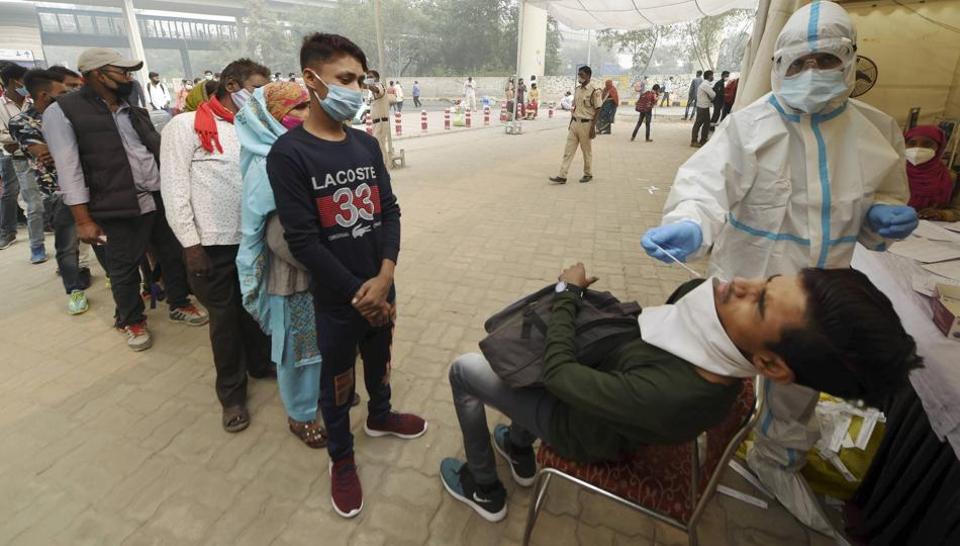
As the daily infections inched closer to 7,000, the positivity rate continued to rise with 11.6% of the 58,910 samples tested in the past 24 hours returning positive. Delhi’s positivity rate has been in double digits the last five days.
The number of cases has seen a sharp uptick over the last three weeks, forcing the Delhi government to concede on Wednesday that a third wave had gripped the Capital. “This can be called the third wave,” said Delhi health minister Satyendar Jain on Wednesday during an interaction with the press.
In the past week, the seven-day average of new cases, also referred to as the case trajectory, in Delhi has touched 5,703 and now stands 37% higher than the peak of the second wave when Delhi was reporting 4,174 new cases every day for the week ending September 17. Delhi saw a surge in the number of Covid-19 cases in June-July, which was the first wave, and then again in September, which then was identified by experts as the second wave.
A committee led by Niti Aayog member Dr VK Paul has said this surge may go even higher and that Delhi might see up to 15,000 cases a day during winter.
“The rise in the number of cases is because we have focussed on aggressive contact tracing and testing all contacts of the positive cases in the last 15 days,” Jain had said on Wednesday.
Data available with HT shows that for each positive case, Delhi traced only two contacts till September 30. This number has now gone up to 13 contacts per positive case, according to health officials.
Experts, meanwhile, disagreed with the government’s reasoning that testing was the primary reason behind the spike in cases in the Capital and said the current surge could largely be fuelled the by laxity shown by people in adhering to the basic principles of safe Covid behaviour.
“Look at what is happening outside, people are out and about. The markets are crowded, traffic is back to normal on the roads. The masks have become chin-accessories and no one is following social distancing. Add to that the increase in the levels of air pollution in the city and the dip in temperature,” said Dr Shobha Broor, former head of the department of microbiology at All India Institute of Medical Sciences (AIIMS).
Other experts added that early onset of winter and pollution was not helping either.
“We have always maintained that the number of cases is likely to go up in the winter. This is what happens with every respiratory infection. And, this is what we have seen in the other European countries,” said Dr Puneet Mishra, professor of community medicine at AIIMS.
The current spread in Covid-19 cases is among the population that was not affected during the previous surge.
“In April and May, most of the cases in Delhi were recorded in congested areas and slums where social distancing was not possible. However, the middle and upper middle class people who weren’t stepping out of their homes due to the lockdown remained safe. Now, with people joining back at offices and going out to restaurants and pubs has led to them getting infected,” said Dr Mishra.
Delhi health minister agreed, adding that this was one of the reasons private hospitals were running out of beds.
“The issue is that many people want to go to private hospitals. People who come from outside Delhi already have a particular hospital in mind. The other reason is that the number of cases now being recorded are mainly in middle and upper middle class. Earlier when the cases came it was from the congested areas. These are people who go to the private hospitals, they can afford it, or many have insurance. However, we have the same facilities in government hospitals as well,” said Jain.
Currently, 44.7% of the total beds and 71.1% of the ICU beds are occupied.
Private hospitals bear a higher burden of the disease, with 60.2% of the total beds and 79.8% of the ICU beds being occupied.
Experts consider the spread of the infection to be in control when the positivity rate remains at 5% or less over two weeks


Stay updated with all top Cities including, Bengaluru, Delhi, Mumbai and more across India. Stay informed on the latest happenings in World News along with Delhi Election 2025 and Delhi Election Result 2025 Live, New Delhi Election Result Live, Kalkaji Election Result Live at Hindustan Times.


