
 E-Paper



Paying with plastic for a clean Delhi
From ‘garbage cafes’ to ‘bartan bhandars’, the authorities are trying different ways to get residents to curb the use of single-use plastic both at home and outside.

 Prefer HTon Google


Early Friday morning, as guests arrived at Urmila Sharma’s house, she rushed to a confectionary shop to buy samosas, kachoris, and cold drinks. But instead of paying cash or with a credit card, she handed over a bag of old plastic bottles at the shop’s counter.
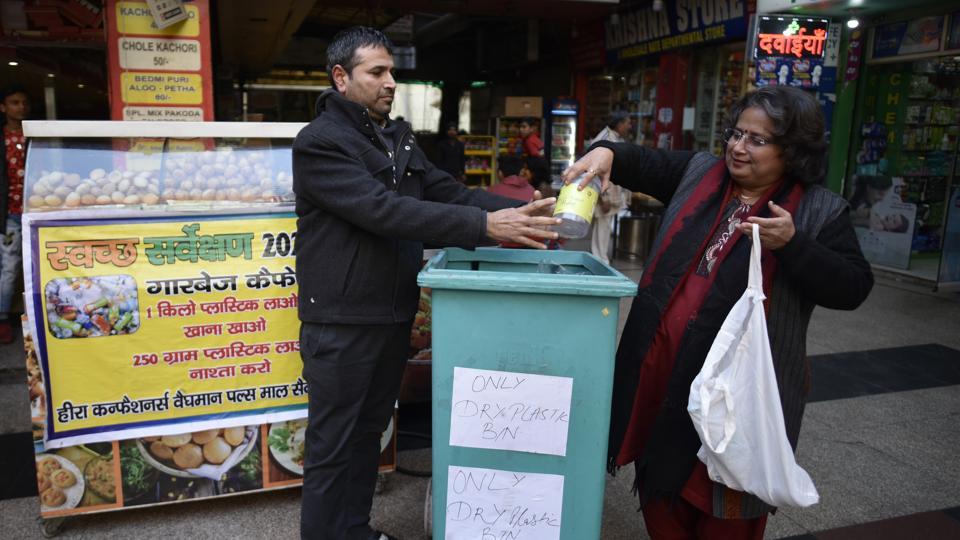
Pooja and Ramesh Sharma, the owners of New Hira Sweets in Dwarka Sector 23’s Vardhman City Mall, have partnered with the South Delhi Municipal Corporation (SDMC) to turn their shop into a ‘garbage cafe’.
So what happens at a ‘garbage cafe’? The concept, which is already popular in Europe, the USA and in Cambodia, allows customers to pay for their food and drinks with plastic waste. The idea is to incentivise garbage collection and control the use of single-use plastic.
The plastic collected by eateries is deposited with a municipal agency, which recycles and reuses it.
From ‘garbage cafes’ to ‘bartan bhandars’, the city’s administration is trying different ways to curb the use of single-use plastic. Prime Minister Narendra Modi had, in his address on August 15 last year, asked people to abandon single-use plastic. “Food discounts are a good incentive, but the larger aim of this move, to control single-use plastic from going into landfills, is what got us to come here,” Urmila said.
Pointing at the pile of trash right outside the shopping complex, most of which comprised plastic waste, Ramesh said that the primary reason behind signing up for this scheme with the local municipality was to do something for the city.
“People ask us what we get in return when we give discounts and free food coupons to customers in exchange for their plastic waste, which would have ended up in garbage bins. We wanted to do something to manage waste and thought this would be a great way to do it,” Ramesh, who added that publicity for their shop is a bonus, said.
His wife, Pooja, who managed the garbage bank, said that many in the neighbourhood —from children to the elderly—have shown interest in their initiative.
“We have kept a bank outside our shop. People look at the banner, ask us how this works and return with plastic bottles. Many don’t do it for discounts, they just want to contribute and that encourages us further. With more publicity, we are confident that more and more people will join us,” Pooja said.
While at Sector 23, only one shop offers discounts in exchange for plastic waste, an entire mall at Dwarka Sector 12 hosts visitors who come there with sacks of plastic bottles.
As soon as one enters the City Centre Mall, just beside the Sector 12 Metro station, banners offering lunch and snacks in return for at least 1kg plastic waste invite one.
Kuldeep Rathi, the manager of the City Centre Mall, said that since the initiative was kicked off only a fortnight ago, they have not been weighing the plastic waste before giving out coupons to people.
“People are making the effort, it would be wrong to dissuade them by weighing it and sending them back if they are short by a few grams,” Kuldeep said.
After depositing the plastic waste at a counter, customers are given coupons that can be used at any counter at the food court.
Data provided by the Ministry of Environment and Forests (MoEF) shows that Delhi generates about 10,000 metric tonnes of garbage every day. Of this, about 690 metric tonnes is polythene and discarded plastic items. Only around 55% of the entire solid waste generated in the city is processed at its three waste-to-energy plants, located at Ghazipur, Okhla, and Narela-Bawana.
Though many visitors to the mall appreciated the initiative of the municipality, most rickshaw-pullers and waste-pickers around the area, who were supposed to have benefitted the most from this project, remain unaware. “We can get them a sack full of plastic bottles, but do you think they will let us inside a mall? The actual test would be when they offer food to the needy,” Manohar Singh, a cycle rickshaw-puller outside the mall, said.
For instance, the first such ‘garbage cafe’, which opened at Ambikapur in Chattisgarh last year, mainly serves waste-pickers and the homeless who do not have money to pay for their meal. They collect plastic bottles from railway stations and roadsides and deposit them at the cafe to earn lunch.
The waste collected at the cafe is used to develop the city’s public infrastructure—to pump plastic into something productive. A road was built using eight lakh crushed plastic bottles in Ambikapur last year.
“We have got a great response from eatery owners. Looking at the success of the concept, we are converting popular eating joints into garbage cafes in areas such as Lajpat Nagar, Defence Colony, Moolchand, New Friends Colony and Sunder Nagar market,” Radha Krishan, SDMC spokesperson, said.
Meanwhile, the North Delhi Municipal Corporation has been experimenting with the concept of “bartan bhandar” (utensil bank) to encourage religious groups in the area to make a bank of steel crockery that can be taken while organising community lunches during festivals and religious functions.
The north civic body’s standing committee chairperson Jai Prakash said that the maximum amount of plastic waste is generated by religious congregations wherein people organise lunches for devotees and serve food in cutlery made of plastic or Styrofoam. In his office at Sadar Bazar’s Azad Market, he has set up a bank of 250 steel plates, glasses, spoons and bowls that can be loaned for religious functions. “The bartan bhandar concept is to dissuade people from using single-use plastic in any form. Till now, bartan banks have been opened at 20 places, including Ashok Vihar, Azad Market in Sadar, Peeragarhi, Shastri Park, Shalimar Bagh, Tri Nagar, Moti Nagar. Here, the organisers can borrow steel utensils free of cost. They have to return them when the event is over. It is much more economical than to purchase new plastic cutlery every time, plus it helps reduce plastic waste,” Prakash said.
He said that his team has been working towards informing more people in the area of the bank by distributing pamphlets. They have also roped in school students to become ‘brand ambassadors’ of the ongoing plastic-ban campaign.
“The students are being told how harmful single-use plastic is and what are the alternates available for it. They will then be able to educate their siblings and parents. All councillors of the north body will also distribute handbills in their wards to make each citizen aware of the subject,” he added.
Kamal Singh, the manager of one such “bartan bhandar” at Azad Market in the Sadar area of the city said that the experiment was a success last year especially during the festive season of Dussehra, Durga Puja, and Bada Mangal when devotees usually organise religious lunches.
He, however, said that to get people to return the borrowed utensils, they charge a nominal security fee. “We were short of utensils when we first launched in August because we had received advance bookings . Initially, people took utensils and did not return them so now we charge a nominal security fee of ₹500 to ₹1,000, which is returned after the utensils are,” Kamal said.
Users of the service said that they have not only benefitted financially from borrowing utensils from the ‘bartan bhandar’ but have also found it easy to manage the waste after mass lunches.
“This has not only helped a lot in cutting on plastic waste but has also made cleaning up after such functions easier. Earlier, I had to spend around ₹3,000 on plastic cutlery but this money was saved this time. Plus, there was no fear of getting penalised for using plastic items,” Vijender Sinandi, who organises religious lunches on the occasion of Valmiki Jayanti every year, said.
In the power centre of the Capital too, steps are being taken to involve people in cutting down plastic waste. The NDMC areas produce 40 metric tonnes of plastic waste every day, of which 20 metric tonnes are picked up by waste collectors and the rest gets dumped at the Okhla landfill site, where it is processed at the waste-to-energy plant.
Along with centralised ‘bartan bhandars’ at Laxmi Bai Nagar and Madhu Limaye Marg last year, the civic body has also distributed steel plates to ‘pradhans’ (heads) of 66 slum clusters for community usage. “We have provided steel utensils at community centres. Now we are mulling making it mandatory for people who wish to hold events there to use these steel utensils instead of plastic cutlery,” a senior NDMC official said.
Besides, the New Delhi Municipal Council (NDMC) has also set up kiosks at different locations such as Connaught Place and Khan Market among other places where people can get cloth bags in exchange for plastic bags.
“When we shop, cloth bags are extremely useful. We drink soda and water from plastic bottles and just throw them away. If we just deposit them at the NDMC counters instead, we get cloth bags, which can be used for future grocery shopping,” Mridula Warrier, a shopper at Connaught Place, said.


