
 E-Paper



Story of a movie and a Delhi village
In Delhi’s Nangal Thakran, a village where Upkar — the 1967 patriotic movie that glorified farming was shot, villagers fondly remember their tryst with famed film stars, even as their agricultural woes mount

 Prefer HTon Google


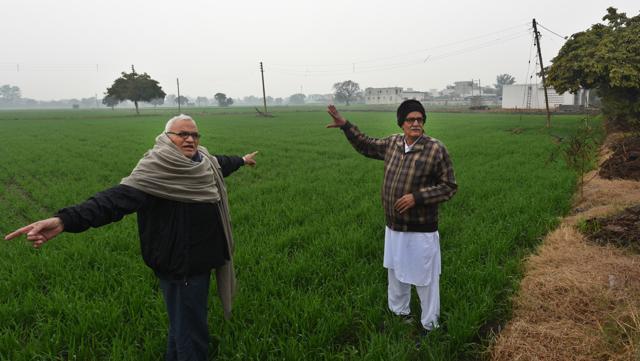
It is drizzling, and a strong icy wind is sweeping across the sodden wheat and mustard fields, but the inclement weather has not dampened the spirit of Davinder Singh. “See, that is where the song ‘Mere desh ki dharti’ in the film Upkar was shot,” says Singh, 64, pointing towards lush green agricultural fields in his village, Nangal Thakran in northwest Delhi, about 45 km from Connaught Place. “Most rural scenes in the movie were filmed in our village.”
For the uninitiated, the 1967 cult movie was written and directed by Manoj Kumar. It is a story of two brothers – Bharat (played by Manoj Kumar) and Puran (Prem Chopra), who chose to follow different paths in life. Bharat is educated but chooses to stay back in the village, working in the fields every day to support his family, while Puran wants to return to the comforts of the city where he studied.
The movie, which glorified farming life, was made at the suggestion of former prime minister Lal Bahadur Shastri who, impressed by Manoj Kumar’s Shaheed, requested him to make a film around his slogan, “Jai jawan, jai kisan” after India defeated Pakistan in the 1965 war.
It was also the time when the country was facing acute food grain shortage due to low productivity.
Majorly shot in Nangal Thakran, Upkar was an instant hit, and Manoj Kumar, whose original name is Harikishan Giri Goswami, earned the sobriquet of ‘Bharat Kumar’.
Light, Camera, Action
In the summer of 1966, villagers, including Davinder Singh, who was 11 then, were pleasantly surprised when a film crew and cast arrived and spoke to villagers about their need for suitable fields, a few houses, ploughs, bullocks, among other things.
Jhuman Chowdhry, one of the biggest farmers in the village, offered his fields and house, another villager Amar Singh gave his bullocks. In fact, the whole village pitched in.
The movie was shot over several months, piecemeal.
“The cast and crew would generally come to the village in the morning and would return to Delhi in the evening. They also stayed in the village when they needed to shoot night scenes,” says Azad Singh Bhardwaj, 72. “I remember there were several retakes of the song ‘Kasme wade pyaar wafa’ before Manoj Kumar was satisfied.”
On days of shoots, Bhardwaj, who was 19 then, recalls the village had a festive atmosphere with patriotic fervour, with men, women and children coming to the shooting locations every day.
“I headed straight to the shooting sites after school, even bunking classes at times. The cast and crew were friendly and mingled freely with villagers,” says Narain Singh, 73. Apart from Manoj Kumar, the movie’s cast included Asha Parekh, Prem Chopra, Pran, Kamini Kaushal, and Madan Puri.
“Unlike others who were besotted with Manoj Kumar and Asha Parekh, I was happy to have conversations with Kamini Kaushal, who played Manoj Kumar’s mother in Upkar and whose films with Dilip Kumar were my favourites,” says Narain Singh, 73. “A lot of college-going students from Delhi used to come to the village on their bikes to see the shooting,” says Azad Singh.
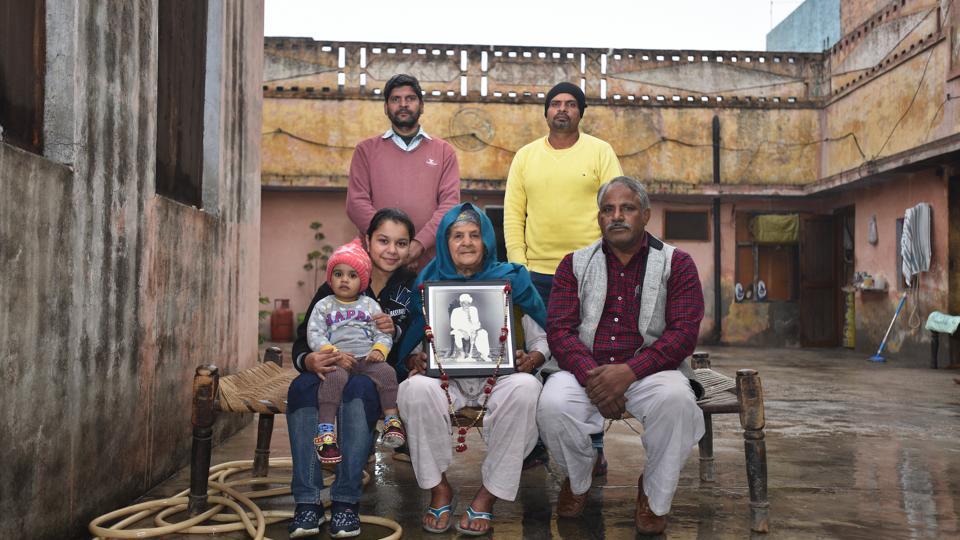
Most villagers remember the story of the film scene by scene, and takes us on a tour of the sites featured in it—the fields, the village chaupal, the canals, houses, including that of Jhuman Chowdhry, whose name figures in the opening credit roll of the movie. He died in 1980, but his great-grandson, Pawan Kumar 36, is quite proud of the support his great- grandfather lent to the making of Upkar.
“Manoj Kumar had offered handsome compensation for allowing our family’s fields and house for the movie shoot, but my great- grandfather did not accept any money,” says Kumar, sitting in his house, which served as Bharat’s (Manoj Kumar) house in the movie. On the wall of one of the rooms is a picture of Chowdhry.
Sunheri Devi, Chowdhry’s daughter-in-law, now 79, shows the spots where some major scenes in the film were shot. “This is where the theft scene involving Charan Das (played by Madan Puri) was shot ; this is where Bharat’s mother used manual flour mill,” she says with child-like enthusiasm. While the house has changed over the years, some parts remain as they were in the movie.
After the release
Pawan says that his great-grandfather got a special invitation from Manoj Kumar to watch the movie when it was released in 1967. Most villagers watched the movie with their families in Filmastan and Alpana theatres.
“We very happy to see that our village’s name figured in the movie’ credit rolls,” says Bhardwaj. The movie, he adds, instilled a new sense of pride and purpose among the youngsters in the village in those days. “Suddenly, they became more hardworking in the fields, taking a lot of pride in being farmers.”
The success of the movie also kindled hope among the villagers that it will help bring development to Nangal Thakran.
But their own real life story did not follow their expectations.
“While ‘Mere desh ki dharti’ became one of the most patriotic songs – playing it almost becoming a sort of tradition during Independence Day and Republic Day over the years — nothing changed for the village,” says Davinder Singh.
Farmers in Nangal Thakran rue the fact that while they continue to cultivate their land and depend on agriculture for income, they are not officially identified as farmers and so don’t get government subsidies for seeds and farming equipment, or any other facility.
“Eighty per cent of the village still depends on agriculture, but like all like other cultivators in Delhi, we are not recognised as farmers by the Delhi government, ” says Praveen Kumar, 43.
Falling fortune
With lush green fields, water bodies, including a robust canal system for irrigation, the village was indeed a farming paradise it was depicted in the movie.
But no more.
“Most water bodies and canal have dried up, and farmers are forced to pump water from the village drain for irrigation,” says Bhardwaj.
The village, farmers say, has not seen much development on the infrastructure front either. In the 1960s, the village had kachha houses, a senior secondary school, a primary school, and there was no dispensary. “More than five decades after the film, the only addition in infrastructure is a girl’s primary school, there is no dispensary, no bank,” says Ram Kumar , 61, another villager.
No future in farming
With growing families, land-holdings are shrinking in the village, making it harder for them to earn through agriculture. According to 2011 census, Nangal Thakran has 722 households and its population is 4,202. Many farmers say there is need to extend Lal Dora area considering the growing population of the village. Lal Dora refers to land that is part of the village ‘abadi’ (habitation) and is used for non-agricultural purposes.
“Extending the Lal Dora area is necessary to improve the living conditions and economic opportunities in the village. We are conducting a study in the village to find out how lack of facilities such as irrigation, minimum support price and absence of formal credit facilities against land, among others are affecting livelihoods,” says Paras Tyagi, co-founder, Centre for Youth Culture, Law & Environment (CYCLE), an NGO.
A large number of youths in the village — almost all of them have the movie on their mobile phones — are unemployed and not interested in agriculture.
“I have seen the film a few times, but it belongs to another era,” says Sonu, 26, who goes by one name. “I have been trying for a job for the past few years, but failed.”
In Upkar, Puran ultimately decided to stay back in the village and cultivate his land. “But now, I don’t see any future in farming,” says Sonu.


