
 E-Paper



Bird watch: Endangered bustard spotted in Dadri
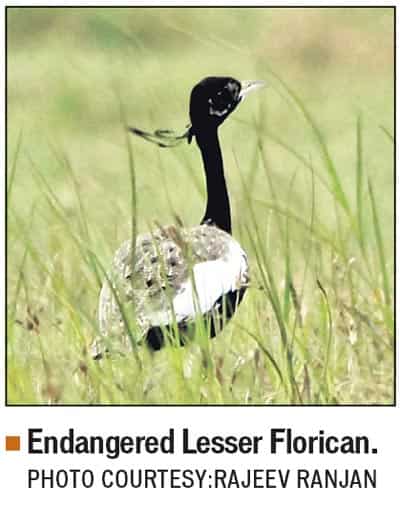
It was a once-in-a-lifetime click for Greater Noida resident Rajeev Ranjan who recently managed to snap a photo of the endangered Lesser Florican at the Dadri Wetlands in Ghaziabad. It’s only the third time the bird has been spotted in the NCR area in the last 100 years.


It was a once-in-a-lifetime click for Greater Noida resident Rajeev Ranjan who recently managed to snap a photo of the endangered Lesser Florican at the Dadri Wetlands in Ghaziabad. It’s only the third time the bird has been spotted in the NCR area in the last 100 years.

Ranjan’s trip to the wetlands wasn’t even planned. He had gotten off work early last Thursday and had decided to use the free time to do what he loved most – birdwatching. He couldn’t believe his luck when the bird, belonging to the Bustard family, jumped out from the tall grass.
“I saw it taking a leap and as soon as it landed I clicked a picture. It was a once in a lifetime opportunity,” said an overjoyed Ranjan.
Known for making long parabolic leaps in grasslands, the Lesser Florican is found mostly in Rajasthan, Gujarat and north-west Maharashtra. Its numbers have plummeted due to destruction of grasslands, delayed monsoons and over hunting. According to official figures only 1,500 now remain in India.
Delhi Birds – a group of scientists and birdwatchers – said that in a period of just seven years (1982-89), the Lesser Florican population fell by 60%. “It has been listed as an endangered species by International Union for Conservation of Nature,” said Surya Prakash, an environmentalist and an avid birdwatcher.
“It was hunted for food and as a sport in the manner of clay pigeon hunting as it jumps in a pyramid pattern,” Prakash added.
Efforts were taken to save the bird and in 1983 Rajasthan declared a ban on hunting it. Madhya Pradesh earmarked two sanctuaries for its protection in Sailana and Sardarpur.
The bird was first spotted around Delhi in 1914 by an Englishman called Whistler. It remained elusive for nearly 92 years before it was finally spotted again in 2006 – this time too by a Britisher, ornithologist Bill Harvey.
What makes Ranjan’s sighting unusual is that the monsoon season is the bird’s mating period and Delhi or the nearby areas are not its breeding grounds. During this period, the male jumps up to two metres high to attract females. “It’s a shy bird but jumps only when it has to attract a female or check for predators,” said Ranjan.
Throngs of birdwatchers flooded the wetlands on July 19 and 20 after news broke about the spotting but the rare bird was not sighted again.

Stay updated with all top Cities including, Bengaluru, Delhi, Mumbai and more across India. Stay informed on the latest happenings in World News along with Delhi Election 2025 and Delhi Election Result 2025 Live, New Delhi Election Result Live, Kalkaji Election Result Live at Hindustan Times.


