
 E-Paper



Let Army decide how to try personnel in fake encounter cases: SC
Amid raging debate over alleged misuse of the Armed Forces Special Powers Act in insurgency-hit J&K and northeastern states, the Supreme Court on Tuesday ruled that army men accused of encounter killings cannot be prosecuted without the Centre’s sanction as they enjoyed immunity under AFSPA.


Amid raging debate over alleged misuse of the Armed Forces Special Powers Act in insurgency-hit J&K and northeastern states, the Supreme Court on Tuesday ruled that army men accused of encounter killings cannot be prosecuted without the Centre’s sanction as they enjoyed immunity under AFSPA.

“In order that the public servant may not be unnecessarily harassed on a complaint of an unscrupulous person, it is obligatory on the part of the executive authority to protect him,” a bench of justice BS Chauhan and justice Swatanter Kumar said.
But, it said performance of public duty under colour of duty can’t be camouflaged to commit a crime.
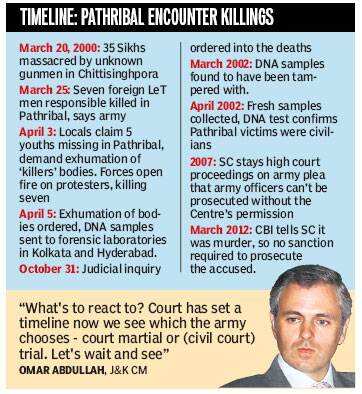
The bench gave the ruling while deciding the fate of army men accused of killing seven persons in a fake encounter in Pathribal in Kashmir 12 years ago and another encounter in which five persons were killed in Assam’s Tinsukhia district in 1994.
The SC set an eight-week deadline for the army to decide if it would hold court martial inquiry against its officers allegedly involved in the two encounters or let the CBI prosecute them in a criminal court.
In case the army decided in favour of a CBI prosecution the agency would have to seek government sanction, it clarified.
In such a scenario, the application seeking sanction should be made within four weeks of receiving order from the army. On receiving CBI’s application, the Centre has to take a final decision within three months.
“If the law requires sanction, and the court proceeds against a public servant without sanction, the public servant has a right to raise the issue of jurisdiction as the entire action may be rendered void ab-initio for want of sanction,” it added.

Stay updated with all top Cities including, Bengaluru, Delhi, Mumbai and more across India. Stay informed on the latest happenings in World News along with Delhi Election 2025 and Delhi Election Result 2025 Live, New Delhi Election Result Live, Kalkaji Election Result Live at Hindustan Times.


