
 E-Paper



High on intent and investment
The agreement with EFTA could be a precursor to much larger deals that India has been eyeing with the EU and the UK

 Prefer HTon Google


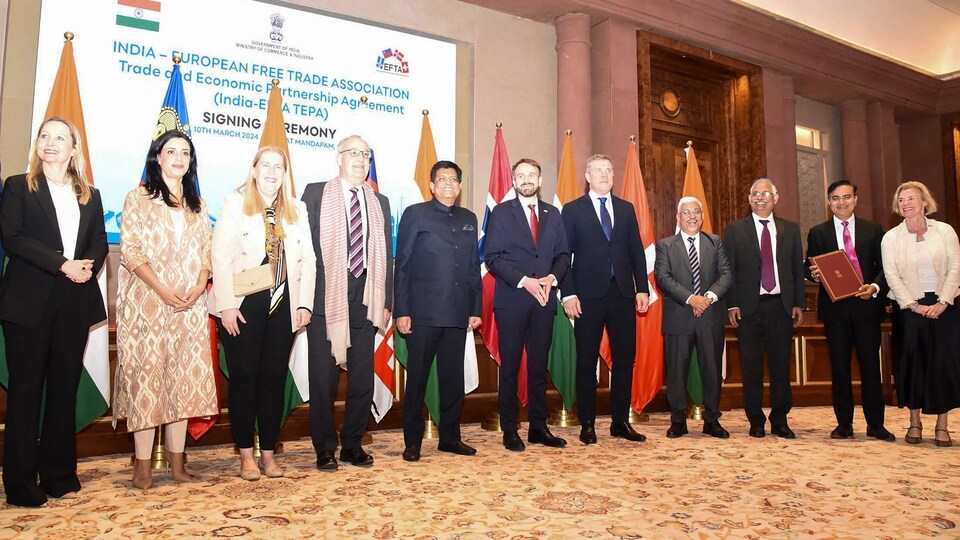
India’s trade agreement with the European Free Trade Association (EFTA) — comprising Iceland, Liechtenstein, Norway and Switzerland — may not reflect the country’s true level of ambition on trade deals, but it has considerable signalling value. For starters, the trade deal ties non-sovereign fund investment of $100 billion by the EFTA nations to tariff concessions being granted to a chunk of their exports to India. This is expected to create a million new jobs in the country. The first $50 billion must come within 10 years of the agreement coming into effect, and the next $50 billion, in the subsequent five. Given India saw just $10.8 billion of foreign direct investment (FDI) from the EFTA nations in the past 23 years — and $9.9 billion of that from just Switzerland — the scale-up in pace is not insignificant.
Though India runs trade deficits with the EFTA nations, their share within India’s overall trade remains small (just 1.6%) with Switzerland making up the bulk of it. Also, since EFTA tariff rates across lines are already low, the impact will most likely be on the import side from an Indian perspective. Against such a background, the country’s openness to trade access to its markets for investment commitments should pay off in the long-run — and encourage talks with others along similar lines.
India could also benefit from the services-trade portion of the deal. The major sectors covered — IT, financial, recreational, and audio-visual services — are all where the country has significant strength to leverage. The EFTA nations are also seeing significant demographic shifts, making the Mode-4 access (movement of natural persons) granted under the deal a big potential win for India.
However, the biggest takeaway from the agreement with EFTA is that it can be a precursor to the much larger deals that India has been eyeing for some time, with the European Union (EU) and the United Kingdom (UK). The problems, of course, are different, ranging from non-tariff barriers for Indian exports (environmental, labour, IPR, and quality compliances, among others) that the EU wants to the UK’s reluctance over visas to professionals. But the EFTA deal underscores both the readiness of India and the EU nations to partner for trade and growth.


