The India Meteorological Department (IMD) admitted on Tuesday that it failed to issue the correct forecast on Sunday or Monday morning for the extremely heavy downpour from late Monday night to early Tuesday that inundated the country’s financial capital, Mumbai. The deluge took place due to a cloud patch over the city’s suburbs that led to continuous and extremely heavy showers for six hours. The warnings were finally modified by 12.30 am on Tuesday, and IMD website was updated by 2 am.
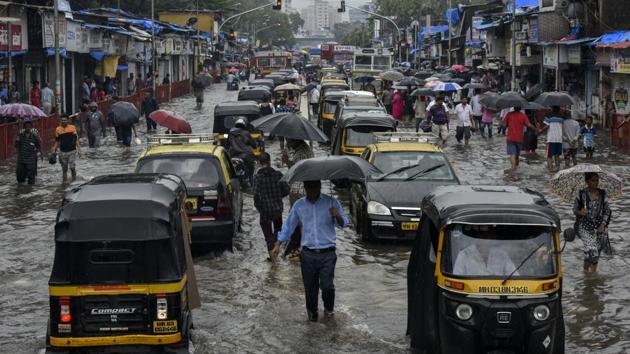
While most of the attention has been devoted to Mumbai’s governance failures in coping with the rains, it will be useful to step back and look at the gaps in forecasting. This is not the first time that the IMD has failed to provide a timely forecast of a deluge of this magnitude: In August 2018, when excessive rainfall inundated the state, Kerala chief minister Pinarayi Vijayan accused IMD of not giving any prior information about extremely heavy rain on August 14 and 15. The IMD had forecast an estimated 98.5mm rain in the state between August 9 and 15. But, the actual rain received was 352.2mm. But the Centre had defended IMD and said necessary severe weather warnings were given to Kerala.
While it is easy to blame IMD for such failures, it is important to understand where the organisation stands in its monsoon forecasting capabilities, the challenges that climate change poses to forecasting, and what more needs to done to augment IMD’s capabilities. In the past decade or so, IMD’s forecasting capabilities have improved vastly. The seasonal forecasting of the southwest monsoon is now done with the help of statistical and dynamical models since 2017. Earlier, it was based only on statistical models. Its error of margin for monsoon forecast has reduced from 7.94% between 1995 and 2006, to 5.95% between 2007 and 2018, even over the last 11 years. Yet the actual rainfall matched the forecast only half the time. The predictions are not likely to get better because of the uncertainties associated with one of biggest challenges of our time: climate change.
{{/usCountry}}While it is easy to blame IMD for such failures, it is important to understand where the organisation stands in its monsoon forecasting capabilities, the challenges that climate change poses to forecasting, and what more needs to done to augment IMD’s capabilities. In the past decade or so, IMD’s forecasting capabilities have improved vastly. The seasonal forecasting of the southwest monsoon is now done with the help of statistical and dynamical models since 2017. Earlier, it was based only on statistical models. Its error of margin for monsoon forecast has reduced from 7.94% between 1995 and 2006, to 5.95% between 2007 and 2018, even over the last 11 years. Yet the actual rainfall matched the forecast only half the time. The predictions are not likely to get better because of the uncertainties associated with one of biggest challenges of our time: climate change.
{{/usCountry}}To help IMD, experts say, the State needs to invest more weather observations because without today’s data, future computations can go wrong. In fact, there are large data gaps within India. Almost no data is generated from the Himalayan range, for instance. For a country of its size, India also does not have enough climate and weather scientists. Since the weather models in use were imported from the US and the UK and not home-grown, adapting and refining them to suit India’s tropical conditions will require a large pool of manpower and research, say experts.
Essentially, India needs to invest on three fronts — supercomputing upgrades, an increase in weather observation data, and a significant boost in scientific manpower — to ensure better prediction, and limit the climate-related losses. Equally important is to improve the communication between IMD, the state governments and the people so that warnings about disasters can percolate seamlessly and without delay.