
 E-Paper



An average Bihari's life after the Bihar results | Number Theory
The data used has been taken from the National Sample Survey Organisation’s Time Use Survey (TUS) report for 2024
Updated on: Dec 2, 2025, 08:57:06 IST

 Prefer HTon Google
Share via


Copy link

Bihar now has a new government in place, and the newly elected assembly started working from Monday with MLAs being administered oaths. To be sure, it is largely the same government the state has had in the last two decades. There has been enough analysis, including in these pages, of the election results from the perspective of electoral statistics. What follows below is the last of the analytical pieces on the Bihar results. However, what makes it different is that it is based on an average day in the life of a Bihar rather than politics. The data used has been taken from the National Sample Survey Organisation’s Time Use Survey (TUS) report for 2024.
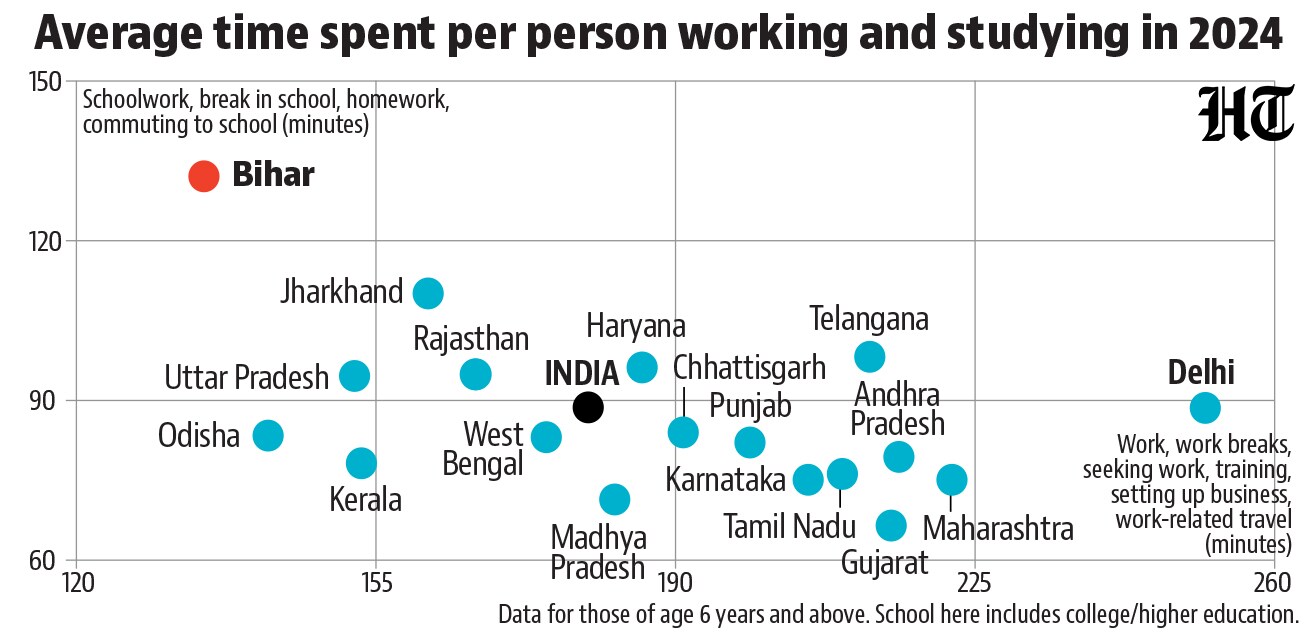
 Bihar is the only major state in India where people give almost equal time to studying and workingThis is by far the starkest difference Bihar has with any other large state in the country. The average Bihari spent 132 minutes in a day on activities which can broadly be clubbed as studying, 43 minutes or 49% more than the average Indian. Bihar is on the other extreme when it comes to time spent working. The average Bihari spent just 135 minutes working, 45 minutes or 25% less than the average Indian. This wide gap in time spent studying and working makes Bihar the only state where the former and the latter command an almost equal amount of time.
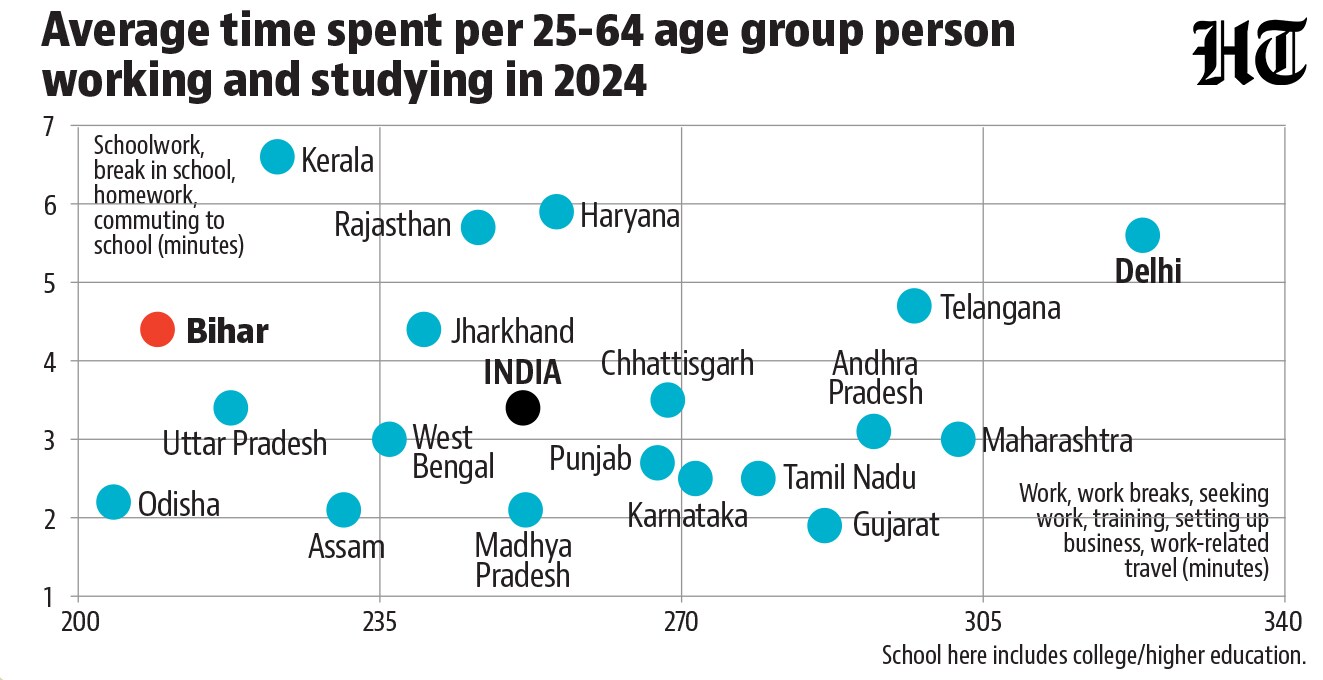
- A lot of this balance between studying and working is thanks to Bihar’s young demographyThe reason an average Bihari spends more time studying than working is not that they are more thinkers than doers. It is essentially a reflection of the fact that Bihar is the youngest state in the country – we had highlighted this fact in these pages – and a large part of its population has not yet reached working age. Bihar’s outlier status on the time use of these two activities becomes relatively muted if one were to compare just the 25-64 age group, which is what one would normally associate with a working age (demographic statistics usually consider 15-64 age group as working age, but HT increased the lower threshold to exclude students as far as possible) rather than retired or still studying population. This should also serve as a reminder that employment generation is going to be the key challenge in the state of Bihar. If one were to use population projections made by the National Commission on Population, Bihar is expected to add 7.7 million people to its 25-64 age group from March 2026 to March 2031.
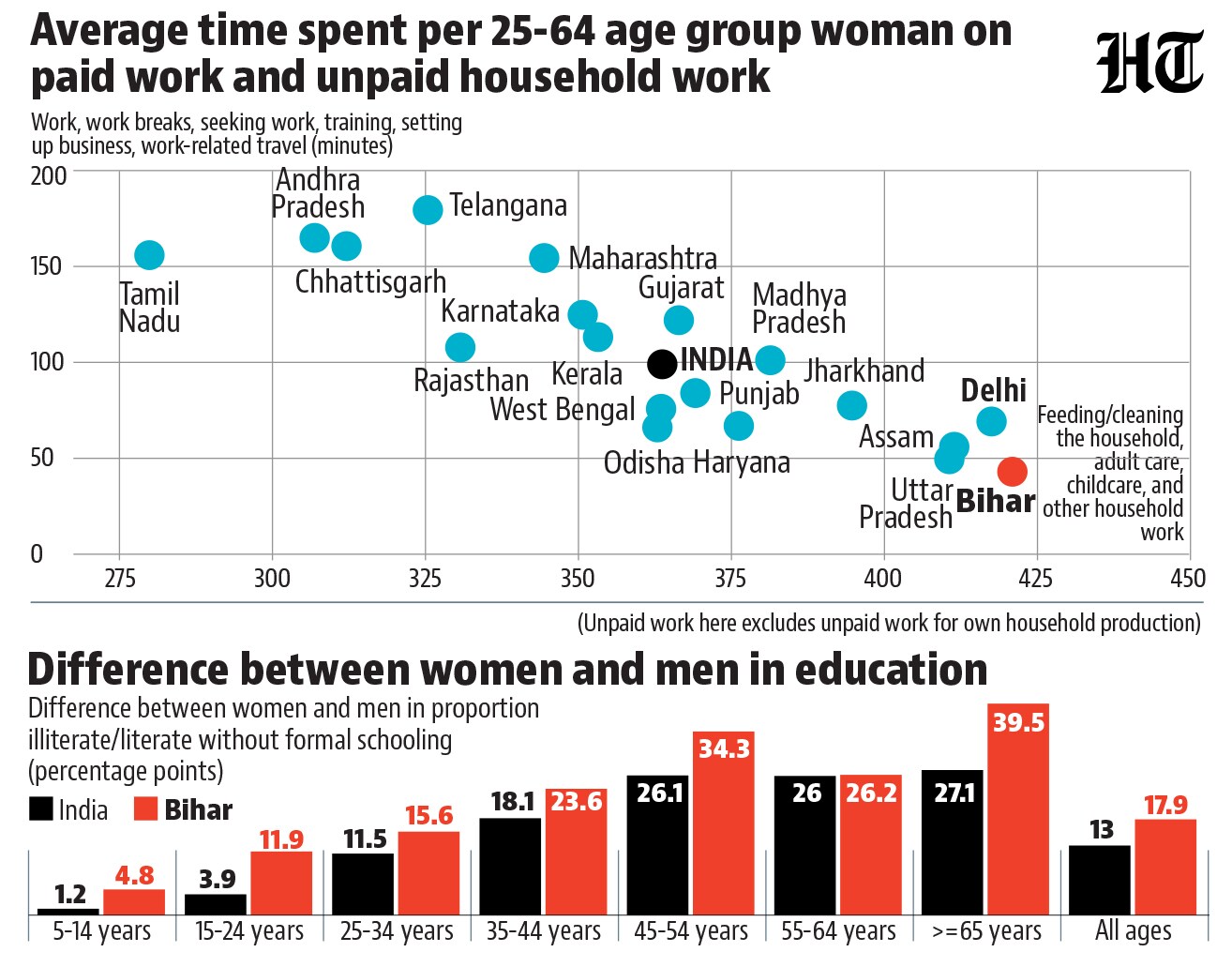
- Bihari women are the most bogged down by unpaid work in the countryA lot of analysts have attributed NDA’s landslide victory in Bihar to a much larger support from women rather than men. Lack of credible polling data in India makes it difficult to accept or reject such claims. However, what the TUS data does show is that the average Bihari women are much worse off than their peers in the country on at least two counts: the time they spend working and the time they spend doing what can broadly be described as unpaid household labour. The time spent on employment by 25-64 age group women in Bihar is just 43 minutes a day, the lowest for any major state in the country. On the other hand, they spent 421 minutes on a host of activities which can be clubbed in unpaid household work (feeding, cleaning, childcare, and other household work), the highest among major states in India. While some of this can be attributed to Bihar’s largely rural population and may be also the fact that gender gap in education is larger in Bihar than most other parts of the country, what is also important to note is that the gender gap in education in Bihar has narrowed significantly for the younger population .



Unlock a world of Benefits with HT! From insightful newsletters to real-time news alerts and a personalized news feed – it's all here, just a click away! -Login Now!


