E-Paper



Can Chirag Paswan reinvent the LJP in its 25th year? | Number Theory
.

 Prefer HTon Google


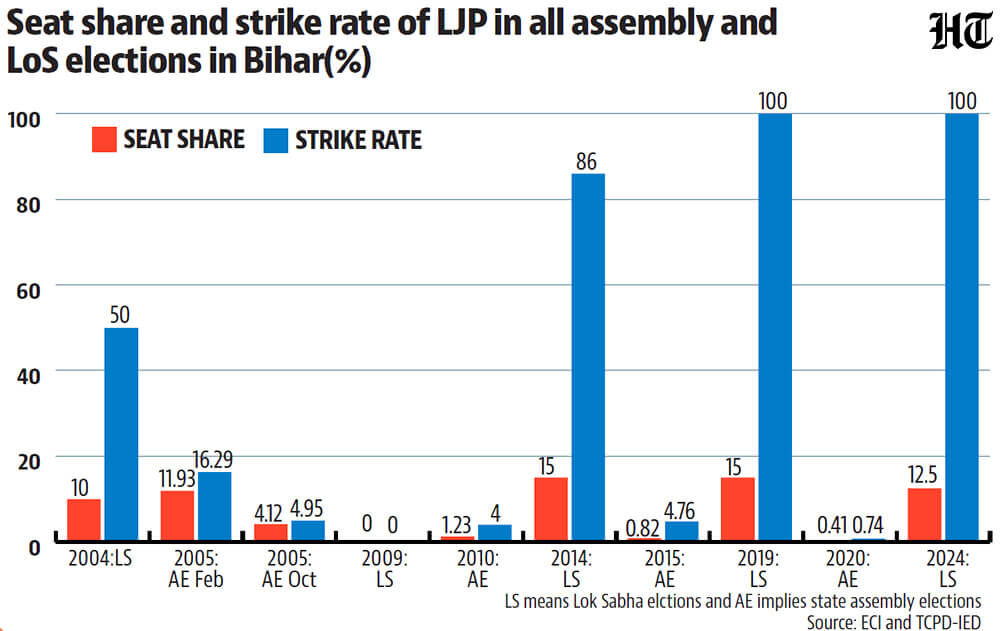
The 2020 Bihar assembly elections were the first the Lok Janshakti Party (LJP) fought under the leadership of Chirag Paswan. His father, and the founder of the LJP, Ram Vilas Paswan had passed away 20 days before the first phase of the election, and Chirag fought against the National Democratic Alliance (NDA) of Bharatiya Janata Party (BJP) and Janata Dal (United) in the state despite being a part of the same grouping at the Centre. The results were an unmitigated disaster for the LJP. It won just one assembly constituency (AC) in the state. Chirag was subsequently thrown out of the party by his uncle in 2021, formed the Lok Janshakti Party (Ram Vilas) and had to wait until 2024 to come back to the NDA, when his faction won five seats. The uncle. Pashupati Kumar Paras named his faction Rashtriya Lok Janshakti Party. Can Paswan do better in the 2025 assembly polls in Bihar? It is important to understand the LJP’s history to have an informed opinion on this question.

 LJP’s Lok Sabha and assembly election performances have been drastically differentThe 2004 Lok Sabha election was the first election the LJP fought. It contested eight parliamentary constituencies (PCs) as part of what later became the United Progressive Alliance (UPA) and won four. Less than a year after the 2004 Lok Sabha elections, however, Ram Vilas Paswan turned against Lalu Prasad Yadav’s RJD and contested 178 out of the state’s 243 ACs in the February 2005 assembly elections. Paswan emerged in a kingmaker’s position with 29 ACs when the NDA and the Rashtriya Janata Dal (RJD)-led alliances had 92 and 79 ACs. However, neither of the alliances accepted Paswan’s demand of making a Muslim chief minister in the state Bihar was put under President’s rule. Paswan’s obduracy cost him deeply when the elections were held again in October 2005. LJP’s seat tally dropped to just ten and the NDA won a clear majority. Winning no PC in the 2009 Lok Sabha election and just 3 ACs in the 2010 assembly polls posed an existential threat to the LJP, but Paswan’s timely switch to the NDA in 2014 resuscitated his and the party’s fortunes. However, the 2014 success did nothing to boost the LJP’s performance in the 2015 assembly elections, and a similar story was repeated in the 2019-20 Lok Sabha and assembly election cycle. Can the LJP (RV) exploit its 2024 Lok Sabha performance and an accommodation within the NDA to improve its assembly performance in the 2025 elections? That is the jinx Chirag is hoping to break.
- A caste-wise break-up of LJP’s MP and MLAs also shows upper castes barring Paswan’s extended familyHT has done a caste-wise break-up of all 45 MLAs and 22 MPs the LJP (and its factions) has had so far. 27.3% of its MPs and 51.1% of its MLAs are actually non-SC-ST-OBC. If one were to exclude members of Ram Vilas Paswan’s extended family, the share of Dalit elected representatives in the LJP falls to just 4.55%. What is even more remarkable is the fact that OBCs (including the EBCs in the state), which have a more than 60% share in Bihar’s population, account for just 9.1% and 28.9% of the LJP’s MP and MLAs.
- And LJP’s performance in SC reserved ACs in the state has been quite underwhelmingThis is another statistic which shows that even LJP’s popular support does not really come from SC voters in the state. Of the 632 ACs the LJP has contested in the five assembly elections it has participated in so far, only 109 have been SC-reserved ACs. Even in terms of strike rate, the LJP performs poorly in SC reserved seats in assembly elections. SC-reserved ACs are considered to have a higher share of the Dalit population, and therefore, a better performance in these ACs can be taken as a proxy for support among Dalit voters.