E-Paper



Can Gaurav Gogoi restore his father's Congress bastion in Assam? | Number Theory
.

 Prefer HTon Google


Congress MP and the party's former state president Pradyut Bordolai joining the Bharatiya Janata Party (BJP) right before the forthcoming assembly elections in Assam is a big setback to the Congress. It is an even bigger setback to Gaurav Gogoi, the Congress’s de facto face in the state. Gogoi’s father, Tarun Gogoi revived the Congress party in the state and served as the chief minister from 2001-2016, making him the longest serving in the history of the state. One of his protegees, Himanta Biswa Sarma, is now the BJP’s chief minister in the state. Sarma is, in fact, the only former Congress-to-BJP turncoat who has been given the chief minister’s post in a large state. What is the nature of the challenge facing the Congress party and its leader, Gaurav Gogoi, in Assam? Here is what the data shows.
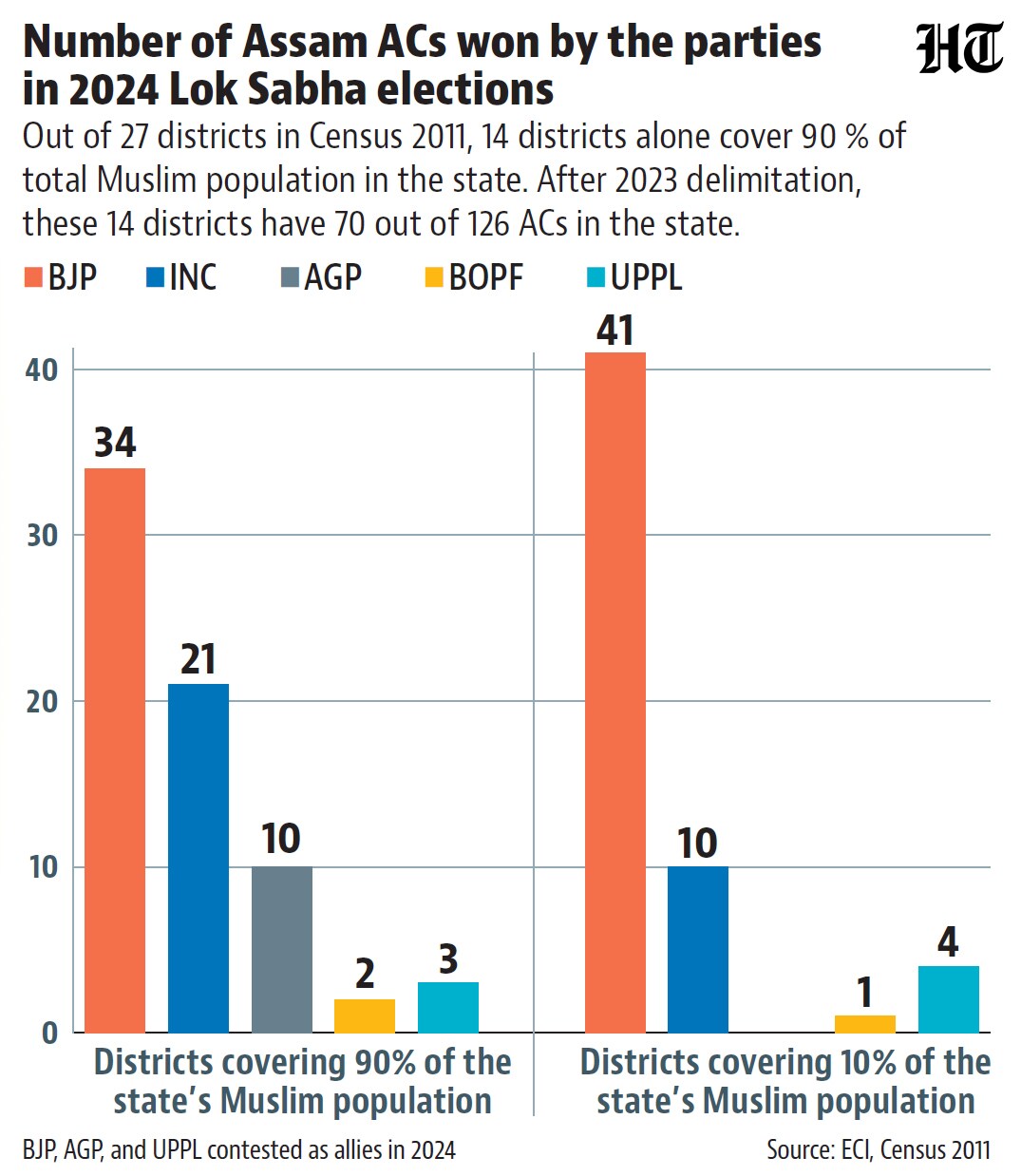
 What really explains the BJP’s massive edge in seats over Congress?As was shown in the first part of this series, Congress’s vote share gap with the BJP is significantly smaller than its seat share gap. Why? Assam has two critical demographic features that make it unlike any other state in India. It has the highest share of Muslims for a large state in the country. The state’s Muslim population is extremely regionally skewed on an intra-state level. A little bit of number play makes this more obvious. In 2011, Muslims were 34.2% of Assam’s 31.2 million-strong population. Of the 10.7 million Muslims in the state, an overwhelming 90% were living in just 14 out of 27 census (2011) districts of the state. These districts, after the 2023 delimitation, have 70 assembly constituencies out of the total 126. The BJP did not do very well in these districts, but extremely well in the remaining 13 districts. In 2024, the BJP and its allies won a whopping 45 of the 56 ACs outside these districts in the state. The Congress won 30% of the 70 ACs in Muslim districts, while it won only 10 of the remaining 56.
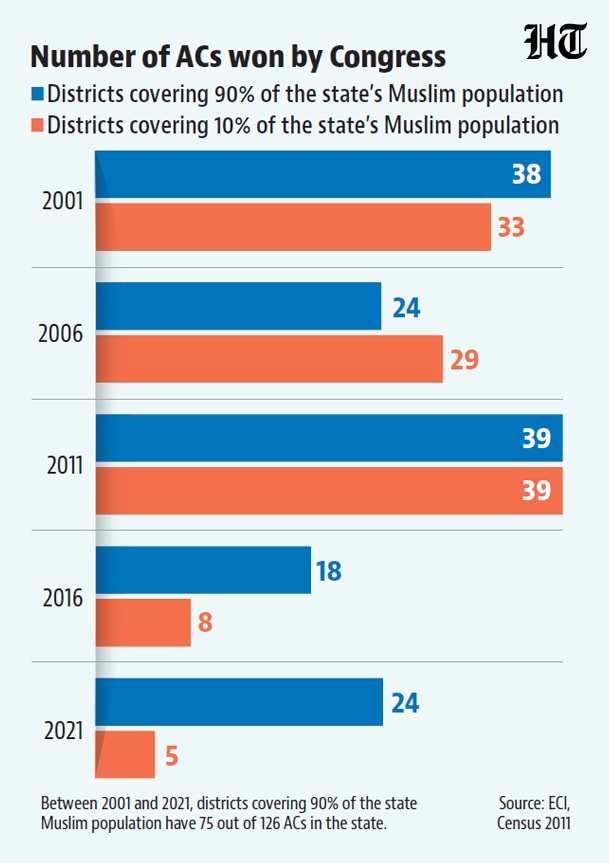
- Gogoi Senior’s political victories were very different in nature - Part 1Tarun Gogoi had three consecutive terms as Assam’s chief minister from 2001 to 2016. In 2001 and 2011 elections, the Congress had a majority of its own in the assembly. In all three elections , the Congress won at least 29 seats in districts that had not more than 10% of the state’s Muslim population. In 2016 and 2021, this number dropped to just 8 and 5. The Congress could win just 10 out of the 56 assembly segments from districts with a similar threshold for the Muslim population in the 2024 Lok Sabha election which happened after the 2023 delimitation exercise in Assam. Assam and Jammu and Kashmir did not have delimitation like all Indian states in 2008.
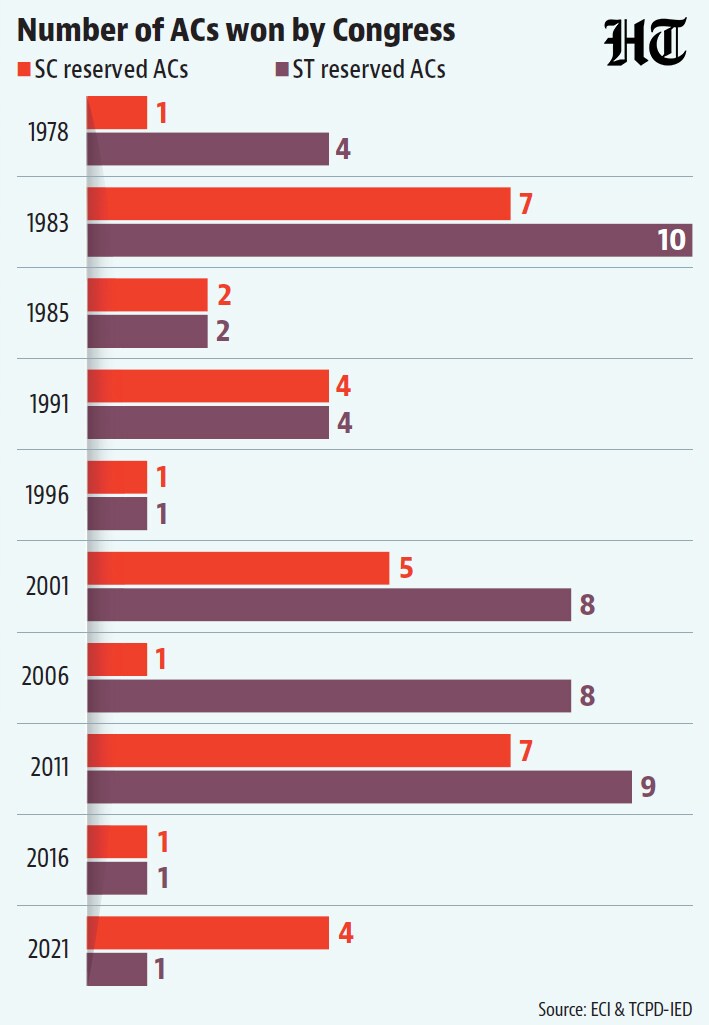
- Gogoi Senior’s political victories were very different in nature - Part 2Between 2001 and 2021, 8 and 16 ACs were reserved for SC/ST candidates. The Congress just won one ST reserved AC in both the 2016 and 2021 assembly elections, while it won at least 8 ACs in three elections between 2001 and 2011. Even in the 2024 Lok Sabha elections, the Congress could win in only one out of the 28 assembly segments of SC and ST reserved Lok Sabha constituencies. Between 2001 and 2011, the Congress won at least 37.5% of the SC-ST reserved ACs in the state.
- The nature of political contradictions has changed in AssamAs the leader of the Congress party in Assam, Gaurav Gogoi will, almost always, be expected to live up to the political legacy of his father, Tarun Gogoi. However, what is often missed in comparing the senior and junior Gogoi with each other, especially by observers outside the state, is that Gogoi senior perfected a far more subtle and effective form of politics in the state than his son has been able to . Tarun Gogoi’s claim to power was supported by a large majority of the state’s non-Muslim population, which has now moved behind his one-time protege’s current party, the BJP. In fact, the BJP’s entire game plan seems to be to portray the Congress supported predominantly by Muslims in the state. Whether or not the Congress and Gaurav Gogoi can pull back this support in the forthcoming elections or later, or whether this marks a triumph of what historians such as Amalendu Guha termed as big nationalism winning over little nationalism – where the BJP has consolidated the larger Hindu vote bank overcoming ethnic and linguistic differences with a mix of Hindutva and welfare – is something which remains to be seen. Gogoi Senior’s success might have come from optimally exploiting little nationalism fault lines. Gogoi Junior faces the might of big nationalism, which is also the national hegemon today.