
 E-Paper



Despite patches of heavy rain, 2025 has been largely dry | Number Theory
.
Published on: Jul 11, 2025, 08:42:15 IST

 Prefer HTon Google
Share via


Copy link

The floods in Texas last week and in South Carolina and North Carolina this week are not the only rain-related disasters reported this year. In India, the north-eastern states flooded in late May and early June and Himachal Pradesh has been flooded regularly since late last month. Parts of China have also experienced floods and landslides since last week. These rain-related disasters notwithstanding, extreme rain this year is neither as high on average, nor as widespread as in 2024, an HT analysis shows. While this trend can change as the year progresses, dryness seems to be a more dominant trend this year.

Despite patches of heavy rain, 2025 has been largely dry
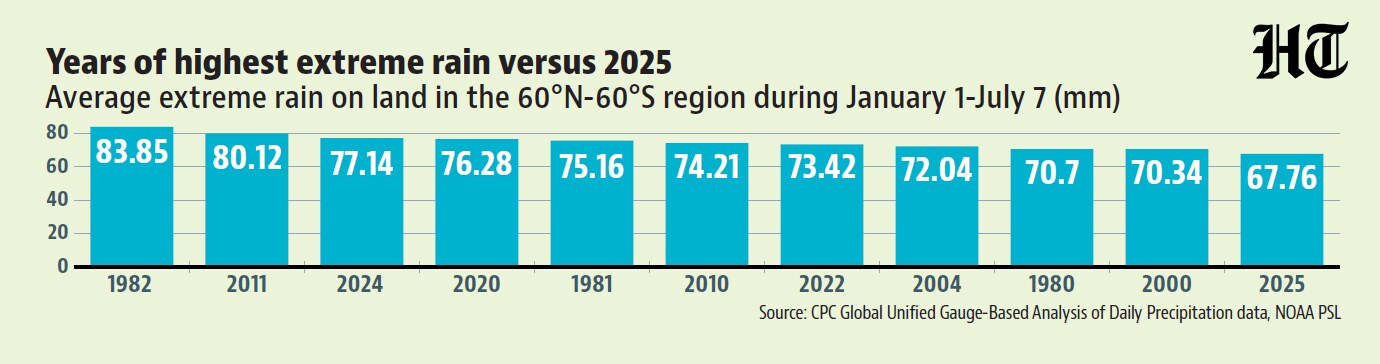
 Average global extreme rain is only 19th highest since 1979 so farThe Global Unified Gauge-Based Analysis of Daily Precipitation data from the Climate Prediction Center (CPC), an agency of the United States government, has daily rain data from January 1, 1979 to July 7 this year for 0.50 degree grids (areas bound by two latitudes and two longitudes 0.5 degrees apart). According to this data, average extreme rain this year is 67.8 mm for inhabited land areas (taken as the land bounded by the 60°N and 60°S latitudes in this analysis), 19th highest for the January 1-July 7 period in the 47 years from 1979 to 2025. To be sure, extreme rain in this analysis is not just intense rain. Daily rain would have to be higher than the 99th percentile of daily rain in the 1979-2023 period to be counted as extreme. In other words, days of extreme rain found in this analysis would be ranked in the top 1% rainiest days for a particular place in the 1979-2023 period. 2024 is ranked much higher than 2025 despite this strict criterion. January 1-July 7 rain for 2024 is ranked third highest since 1979.
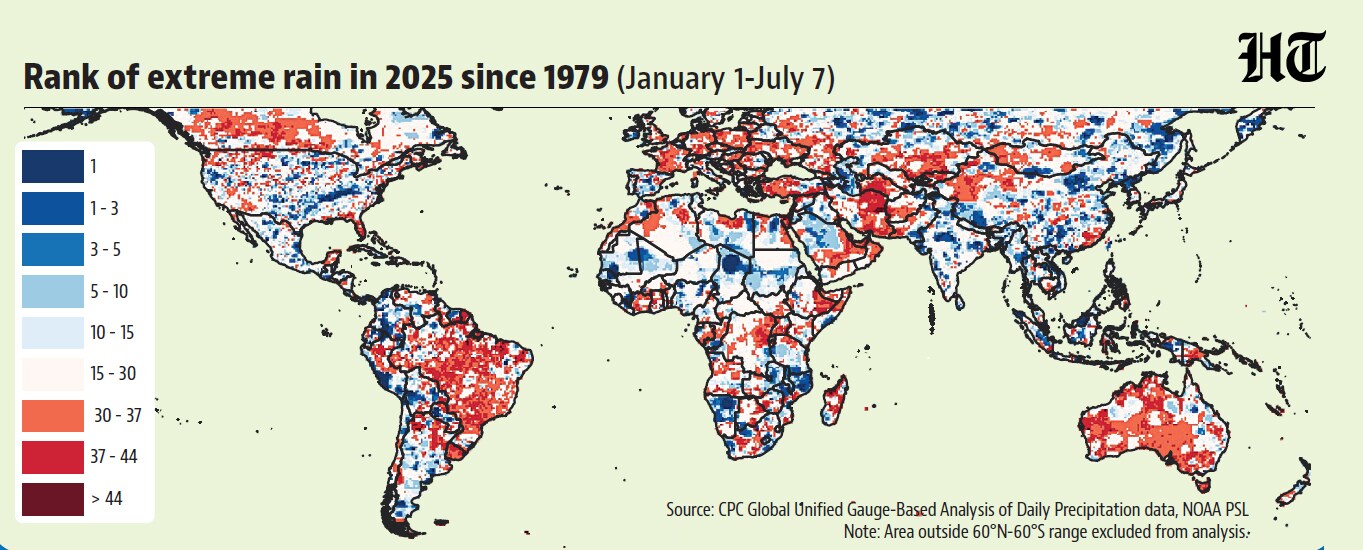
- However, extreme rain is ranked highest to fifth highest in 12% of the inhabited landWhile average extreme rain is not ranked high, individual places have indeed experienced rare amounts of extreme rain. Extreme rain this year is ranked highest to fifth highest for the January 1-July 7 period for 11.9% of the inhabited land area, and the highest for 2.5%. As the accompanying map shows, large parts of North and South America, Asia, and Africa have received extreme rain this year that is also ranked very high since 1979. While this is less the case in Europe, particularly its western parts, large parts of Greece and Spain, both countries that flooded earlier this year, received rare levels of extreme rain. Similarly, extreme rain in Australia, which covers most of the land in the continent of Oceania, is ranked high in only small parts. This may be the reason why coverage of extreme rain ranked highest to fifth highest is also low relative to the past. The 11.9% area covered by extreme rain ranked up to fifth highest since 1979, is only the 11th highest coverage since 1979. Extreme rain up to July 7 last year was ranked highest to fifth highest in 14.7% of the world, which would be ranked the fifth highest coverage since 1979.
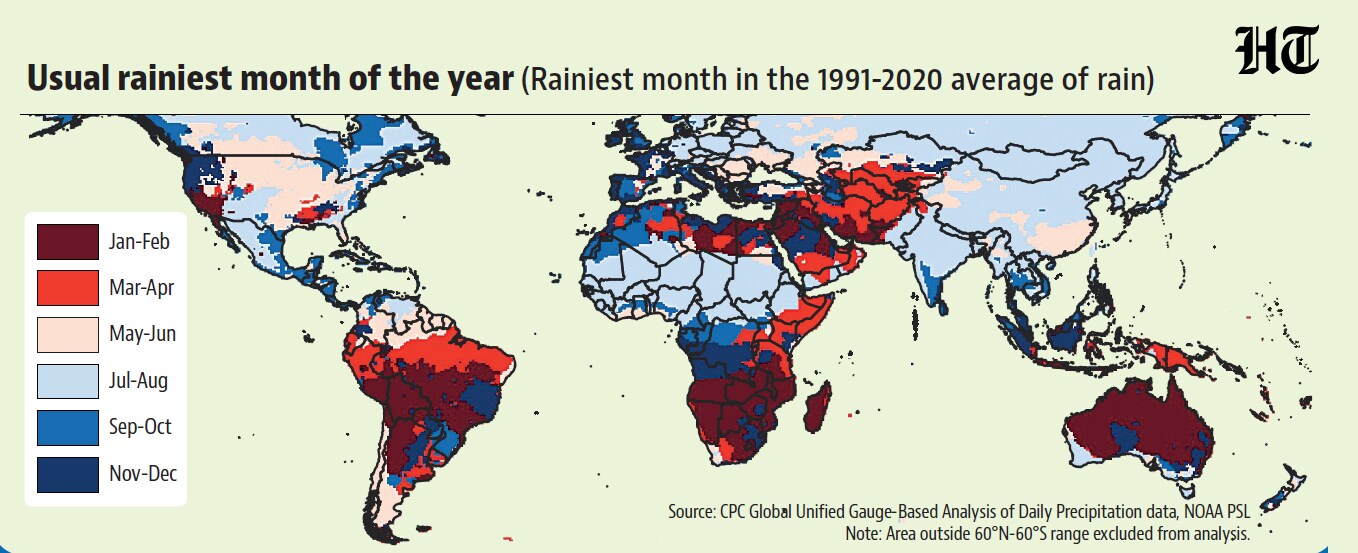
- The rainiest days of the year may still be some distance away for large parts of the worldWhile the trends described tell us about what has happened so far this year, there is little guarantee that these trends will hold as the year progresses. For example, since India’s rainiest months are usually July and August, the extreme rain trends in India can change later in the year. This is also the case with several other regions in the northern hemisphere, where the rainiest month falls in the second half of the year.
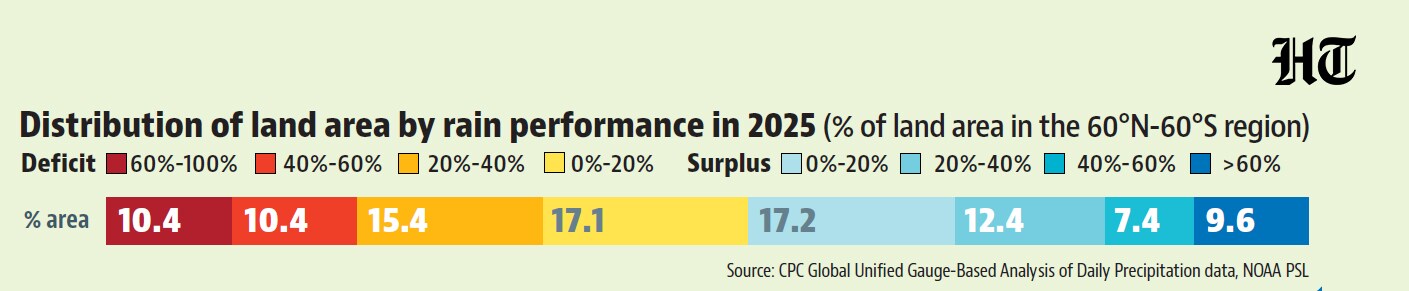
- While extreme rain may not be ranked high, there are extreme trends in rain overallWhile extremely wet weather has been experienced by a relatively small part of the world, this is not the case with extremely dry weather. Total rain this year is ranked the lowest since 1979 in 3.8% of the world. This is the second highest coverage of such highly ranked dryness. Dryness is also the more dominant trend this year with relation to the normal, taken as the average rain in the 1991-2020 period. 53.3% of the inhabited land has a deficit compared to normal and 36% of the world has a deficit of 20% or more. Clearly, less extreme rain this year than in the past does not mean extreme trends in rain do not exist.


Unlock a world of Benefits with HT! From insightful newsletters to real-time news alerts and a personalized news feed – it's all here, just a click away! -Login Now!


