
 E-Paper



Good, bad and ugly of world economy | Number Theory
.
Updated on: Jun 12, 2025, 10:01:41 IST

 Prefer HTon Google
Share via


Copy link

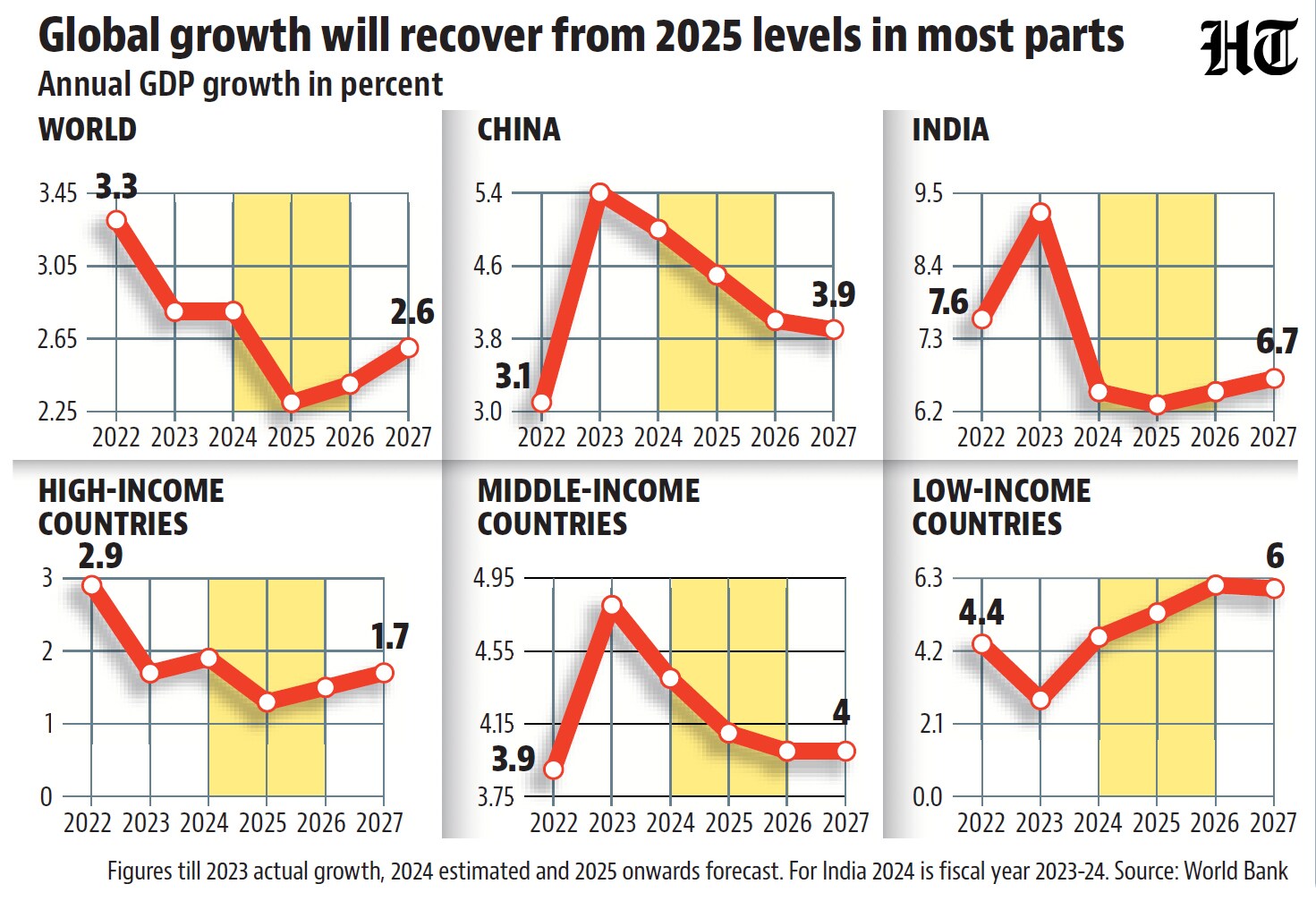
The World Bank released its flagship Global Economic Prospects (GEP) report on Tuesday. It shows that India will continue to be the fastest growing major economy in the world. This is pretty much the only good news about the economy from India’s perspective in the report which raises several red flags about the prospects of the global economy. Here are three charts which summarise key findings from the report.
Good, bad and ugly of the world economy
 Good: Growth is expected to improve for major country-groups post-2025This is the most important upside in the report despite the bleak economic environment for this year. Global GDP growth is expected to fall to 2.3% in 2025 from its 2.8% level in 2024. If one were to compare growth numbers for the world, high-income, middle-income, low-income countries and India and China, GDP growth is expected to fall between 2024 and 2025 in every country/group except low-income countries. A comparison with the January 2025 forecasts by the World Bank show that there has also been a downward revision to growth forecasts for both 2025 and 2026 for these countries. However, the 2026 growth numbers are likely to be higher than 2025 for all these countries/country-groups except China and middle-income countries. This means that there is at least something to look forward to next year compared to this one.
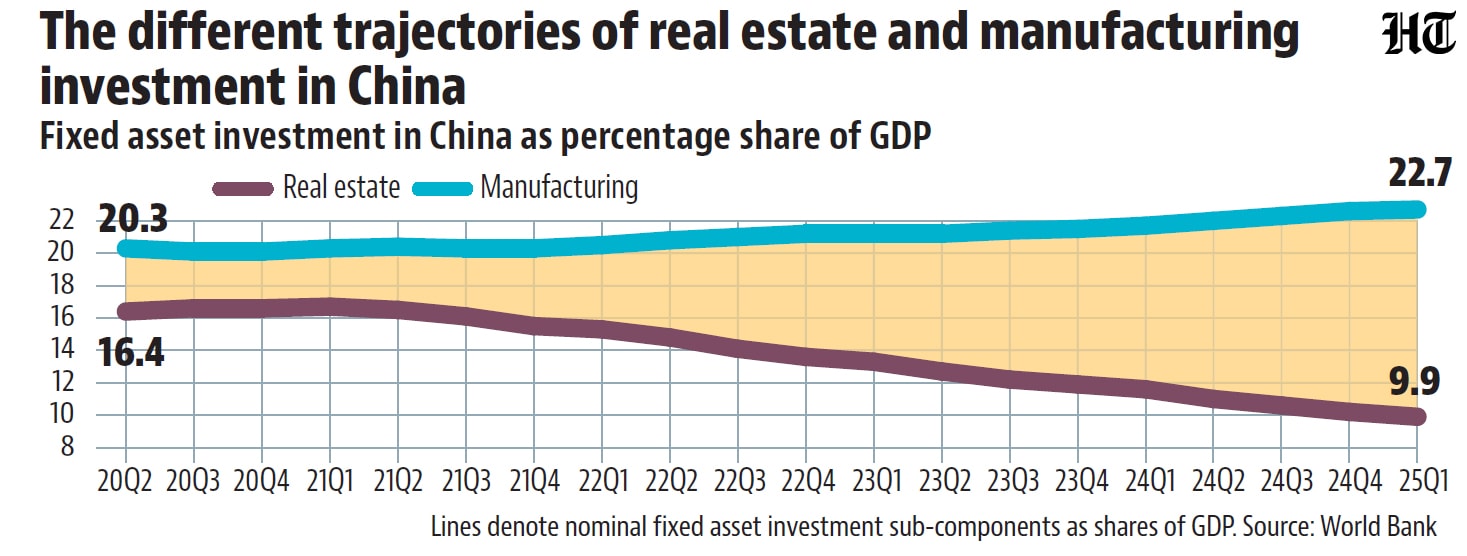
- Bad: China’s growth slowdown might not stop it from accumulating further excess capacity in global manufacturingChina’s rise as the world’s second largest economy by exporting to advanced economies, especially the US, is at the root of the current protectionist turn in the high-income countries. What has made matters complicated and concerning for the high-income countries is the fact that China isn’t just a cheap manufacturing outsourcing destination anymore, but is emerging as a frontrunner in the production of many high-tech, even cutting-edge goods. This progress has been possible because of a sustained push by the Chinese regime to promote high-tech manufacturing and R&D in the country. This has created a situation where China is sitting on a large excess capacity for manufacturing even as trade growth slows down in the world. Data from the latest GEP report shows that China continues to see a shift of investment from real estate to manufacturing, something which will only add to creation of excess capacity in China. This is not good news for the world, India included.
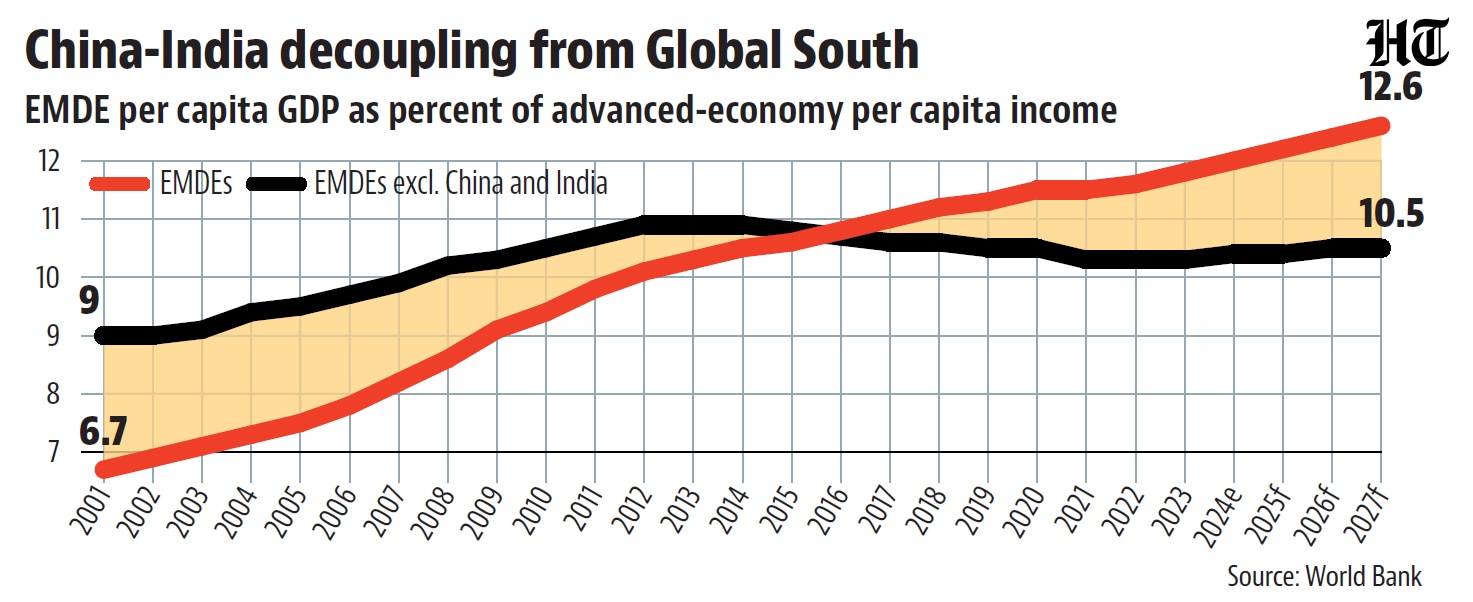
- Ugly: Growth in terms of income convergence is dead for EMDEs excluding China and IndiaThis is the most damning data in the World Bank report. The entire point of development economics is to ensure a catch-up of low-income countries with their high-income counterparts. World Bank data on Emerging Market and Developing Economies (EMDE) per capita GDP shows that it has increased from 6.7% of advanced economy per capita income levels to 12% by 2024 and is expected to reach 12.6% for 2027. However, if one were to take out India and China from the EMDE group, the income convergence trajectory becomes much less impressive. A similar trend can be seen in the reduction of global poverty as well. The fact that most of globalisation tailwinds were harvested by China and India in the recent past and the larger Global South has lost out on the globalisation gravy train even before protectionism kicked in the first world and is threatening to derail it. The loss of the Global South is not just an ethical issue. It also means that any international project to reform the global economic system and make it more egalitarian becomes more difficult to pursue at a time when the richest economies in the world are already turning their backs on the larger development project.


Unlock a world of Benefits with HT! From insightful newsletters to real-time news alerts and a personalized news feed – it's all here, just a click away! -Login Now!


