E-Paper



How did the collegium system change Supreme Court appointments? | Number Theory
This is the last of a three-part data series on SC judges. The first looked at family links or lack of it. The second looked at social and HC backgrounds.

 Prefer HTon Google


The second part of HT’s three-part series on Supreme Court judges discussed inequality, by social group and high courts of origin,. The concluding part of this series will look at the impact of the Collegium system on the appointment of Supreme Court judges. Appointment of Supreme Court judges was done by the executive until November 1993. This changed after the Supreme Court’s ruling in the Supreme Court Advocates-on-Record Association versus Union of India case decided that a group of senior-most Supreme Court judges would recommend the appointment of Supreme Court and High Court judges to the government. The Collegium consists of five and three members currently, including the CJI, for recommending judges to the Supreme Court and High Courts respectively.
To be sure, the government has refused some of these recommendations, and the Collegium has accepted its view. However, there continues to be friction between the executive and judiciary on the issue of judicial appointments. The first Narendra Modi government brought a law to annul the Collegium system, and the Supreme Court rejected it. These tensions make it worthwhile to see whether there is a discernible difference between the kind of appointments made before and after the Collegium system came into place.
This is the last of a three-part data journalism series on India’s Supreme Court judges. The first part looked at family links or lack of it among India’s Supreme Court judges. The second part looked at the social and high-court backgrounds of Supreme Court judges.
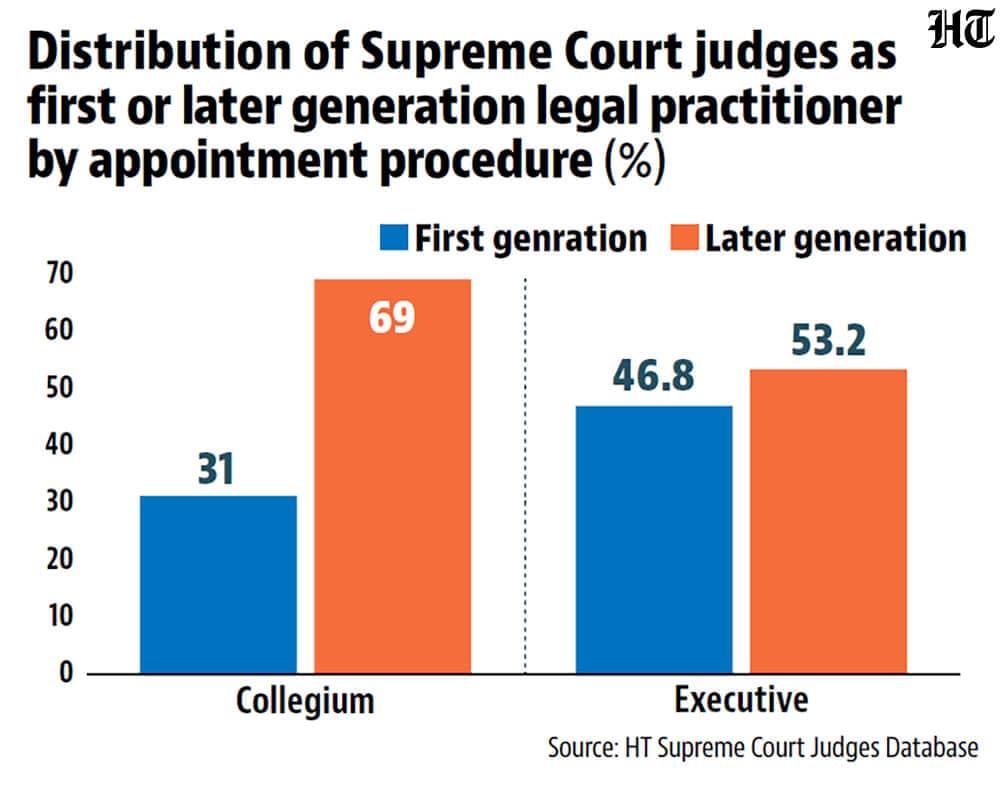
 Almost half of the judges appointed via the executive were first-generation lawyers as against less than a third for the collegiumOut of the 279 Supreme Court judges so far, 111 were appointed before the collegium system came into place. Almost half of the judges appointed before the Collegium system – 52 out of 111 – were first-generation legal practitioners, according to HT’s database. This number is significantly lower at less than one-third (52 out of the 168) for the judges appointed under the collegium system. Even a decade-wise disaggregation of the appointments under the executive and the collegium shows that the former did appoint a larger share of first-generation lawyer judges. Majority of all closely related Supreme Court judge pairs, as described in the first part of this series – have the elder judge preceding the collegium system and the younger judge after the collegium system came into place.
- The collegium system has only led to an incremental change in the judges' social compositionWhile there is reason to believe that the Collegium system has increased the probability of judicially connected persons being appointed Supreme Court judges, the social background of Supreme Court judges has not changed much between the pre- and post-Collegium system eras. To be sure, the Collegium system has a slightly better record in appointing judges from SC-ST-OBC groups and also women. Of a total of eight judges from the SC groups, five were appointed by the Collegium. The only judge from the ST community was appointed via Collegium. Of the 51 Supreme Court judges who went on to become CJIs, the Collegium appointed 21, and the remaining 30 were executive appointments. All the three of 51 CJIs (up to Justice Sanjiv Khanna, who retired on May 13) from SC and OBC groups were also appointed by the Collegium. This number increases to four of 52 with Justice Gavai’s appointment as CJI.
- The average tenure of judges and CJIs appointed during in 2010-2025 has been the lowest everData shows that the average tenure of judges and CJIs appointed during the period 2010-2025 has been lowest ever since 1950-64. The average tenure of judges and CJIs appointed during the period 2010-2025 has been 1793 and 390 days respectively; a judge spends significant time in the Supreme Court before becoming the CJI. The mean tenure of CJIs decreased from 841 days during 1950-64 to 390 days during the latest period ending in 2025. The average tenure of judges appointed via executive was 2132 days. This decreased to 1821 days for the collegium appointments, a 14.6% decrease. The average tenure of CJIs appointed during the executive was 653 days which decreased to 428 days for the collegium appointments, a decrease of more than a third.