
 E-Paper



How India's labour codes reconcile with labour market | Number Theory
.
Published on: Nov 24, 2025, 08:44:30 IST

 Prefer HTon Google
Share via


Copy link

The rollout of the four labour codes by the union government on Friday is one of the biggest factor market reforms in independent India. The new labour codes will simplify existing labour laws. Many experts also expect them to give a boost to India’s industrial landscape by allowing greater freedom to businesses in deciding the terms of employment of their workers. While some of the provisions in the new labour codes are being opposed by trade unions on the grounds that they dilute workers’ rights, any objective assessment of the debate requires a holistic assessment of the Indian labour market. Here is what the data shows.

How India's labour codes reconcile with labour market
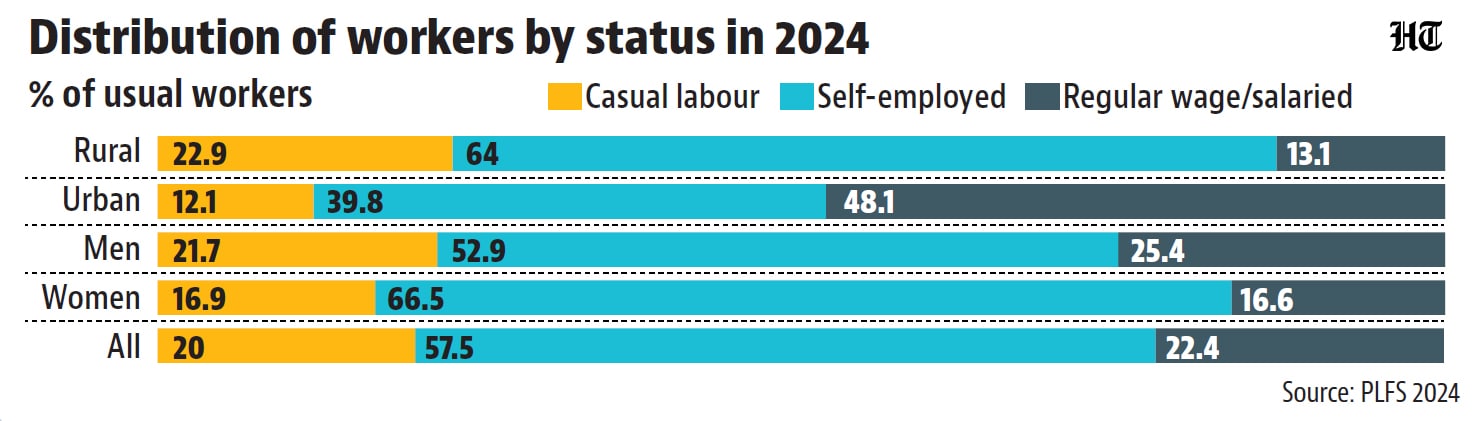
 Only one-fifth of Indian workers are salaried…The Periodic Labour Force Survey (PLFS) is the official source of labour market statistics in India. According to the latest PLFS report for the calendar year 2024, only 22.4% of Indian workers were salaried in India. An overwhelming 57.5% were self-employed and about 20% were casual workers. As is to be expected, bulk of the self-employment is in villages (agriculture) and salaried workers’ share is higher in urban areas (almost 50%). The share of salaried women workers is even lower in the country. The labour codes will primarily deal with salaried workers.
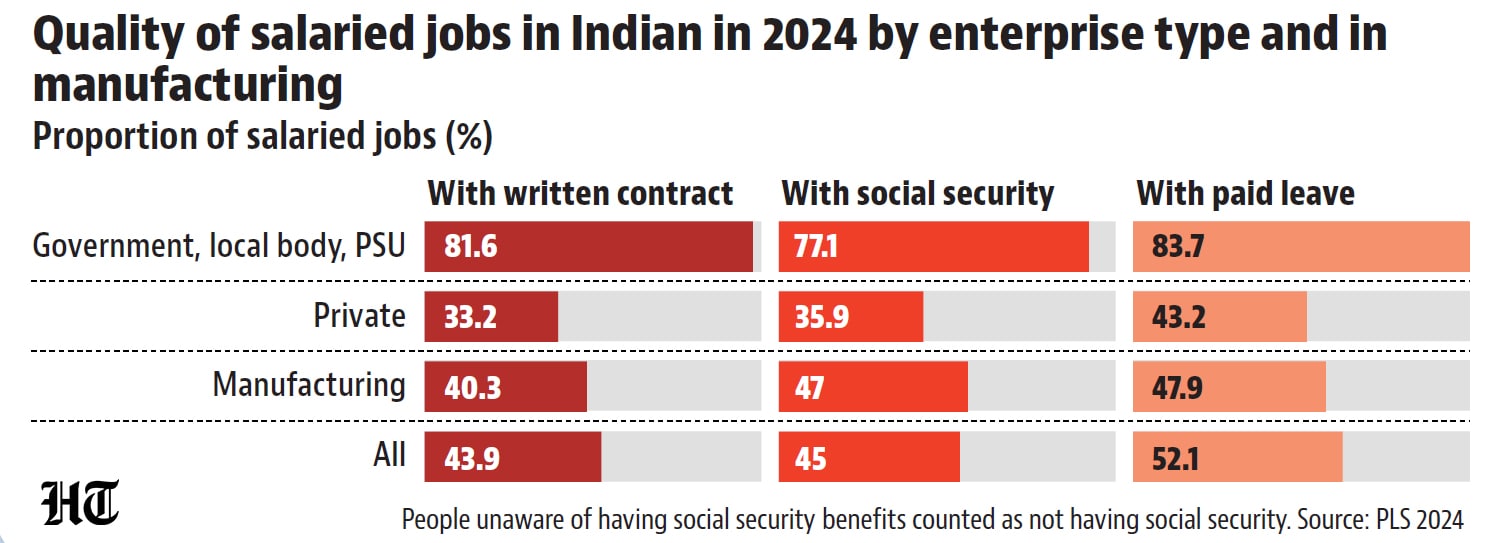
- …Just one-tenth are officially salaried, and even fewer are respectfully salariedNot all salaried workers in India are equal. PLFS data shows that less than half of them had a written contract, and the share of salaried workers with social security or paid leaves was also under 60%. If one took out the share of government workers, these numbers would fall further. Manufacturing, if one were to use PLFS data, is even worse, but it is better when one is only comparing privately employed salaried workers.
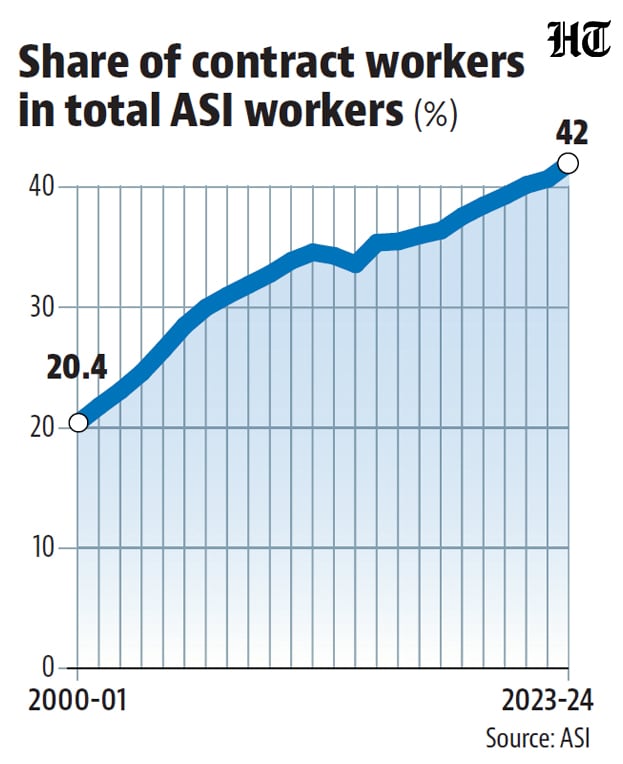
- Manufacturing has a larger share of salaried workers, the trend has been towards contract workersData from the Annual Survey of Industries (ASI) – it tracks of universe of registered manufacturing in India where labour laws perhaps matter the most – shows that the share of contract workers has been consistently rising in Indian industry. Contract workers now account for 42% of all workers in ASI, an increase of over 20 percentage points in the last two and a half decades. While some of this could be a result of factories trying to bring down costs, as contract workers often do not enjoy the fruits of collective bargaining like their permanent peers, part of it could also be a result of the freedom it offers them in dealing with cyclical fluctuations in work, something which the new labour codes seeks to address. The impact of the new labour codes on contract workers in the future will be interesting to observe.
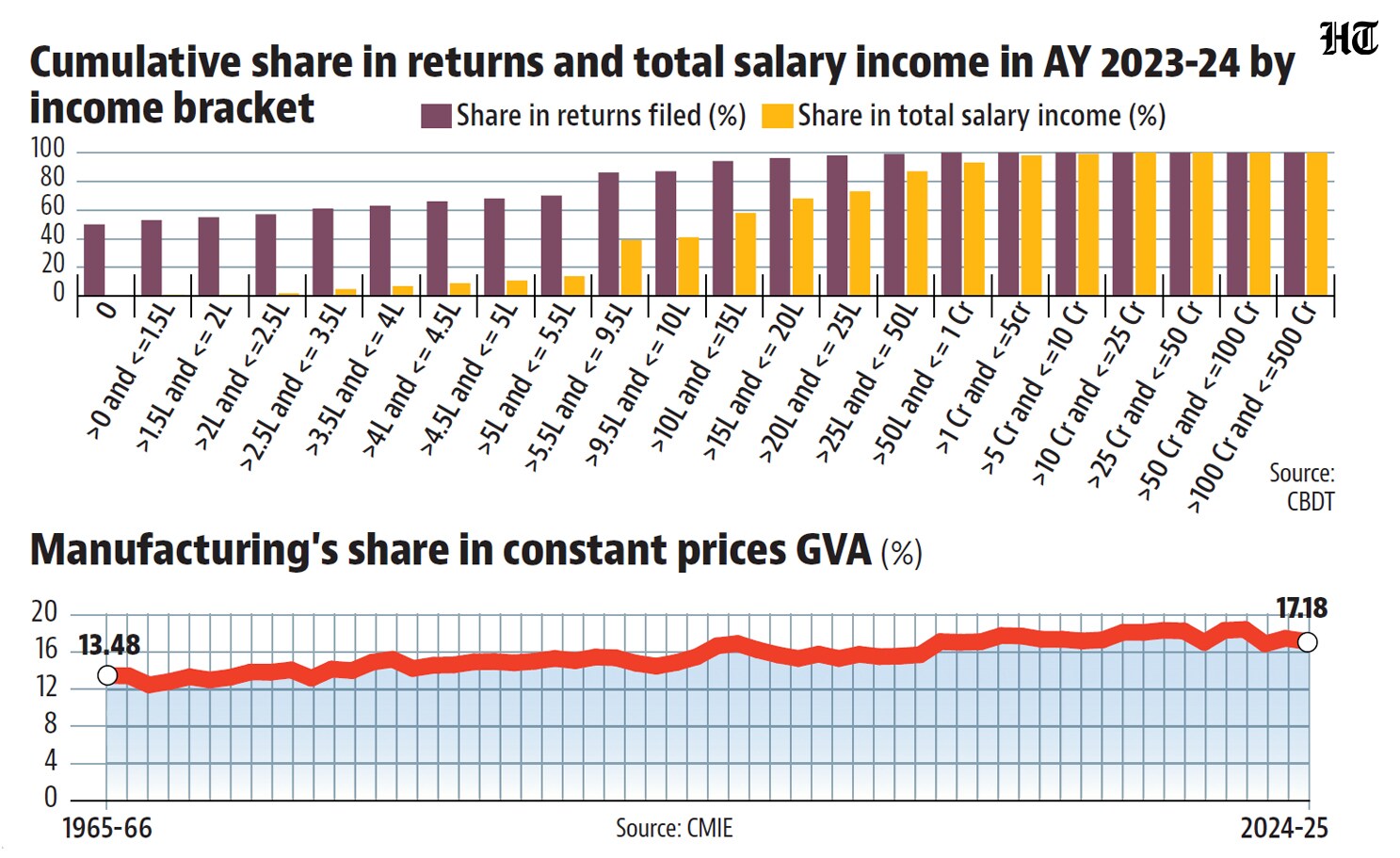
- Can the new codes expand India’s (unequal) salaried income universe?The statistics shown above pinpoint a basic asymmetry in Indian labour markets: the share of workers who enjoy basic rights is pretty small. Only capital can step in to expand the universe of salaried workers by new or bigger businesses and it has been arguing that existing labour regulations aimed to benefit a small minority of workers is a huge disincentive for it to make new investments. Ironically, these stifling regulations have actually hurt workers -- because they are unable to reap even these limited benefits due to trends such as greater contractualisation. The new labour codes, when seen in the backdrop of this, are a leap of faith -- premised on the expectation that businesses will now invest and hire more. There is another aspect. Within the universe of workers, the Indian economy is pretty unequal. The latest available income tax returns for Assessment Year 2023-24 (fiscal year 2022-23) show that about two-thirds of individual tax returns filed by salaried workers had a cumulative share of less than 10% in total reported salaried income. There isn’t much scope for further worsening of this inequality. The question is whether these new labour codes will give a boost to things such as the share of manufacturing in India’s Gross Value Added, which has largely been stagnant throughout the reform period.



Unlock a world of Benefits with HT! From insightful newsletters to real-time news alerts and a personalized news feed – it's all here, just a click away! -Login Now!


