
 E-Paper



How United and Chelsea bungled in player transfers | Number Theory
As the two marquee football clubs remain in churn, the latest moves also cast a light on how they have gone about buying and selling players
Updated on: Jan 10, 2026, 06:36:10 IST

 Prefer HTon Google
Share via


Copy link

Coach sackings are routine in the cutthroat world of club football. Still, the sackings of Enzo Maresca by Chelsea and Ruben Amorim by Manchester United in the first week of 2026 was stunning in the speed at which the die was cast and the cord was snapped. It was management making a statement, after the coaches dared question the lines of engagement between them—stated and unstated, logical or not. As the two marquee football clubs remain in churn, the latest moves also cast a light on how they have gone about buying and selling players
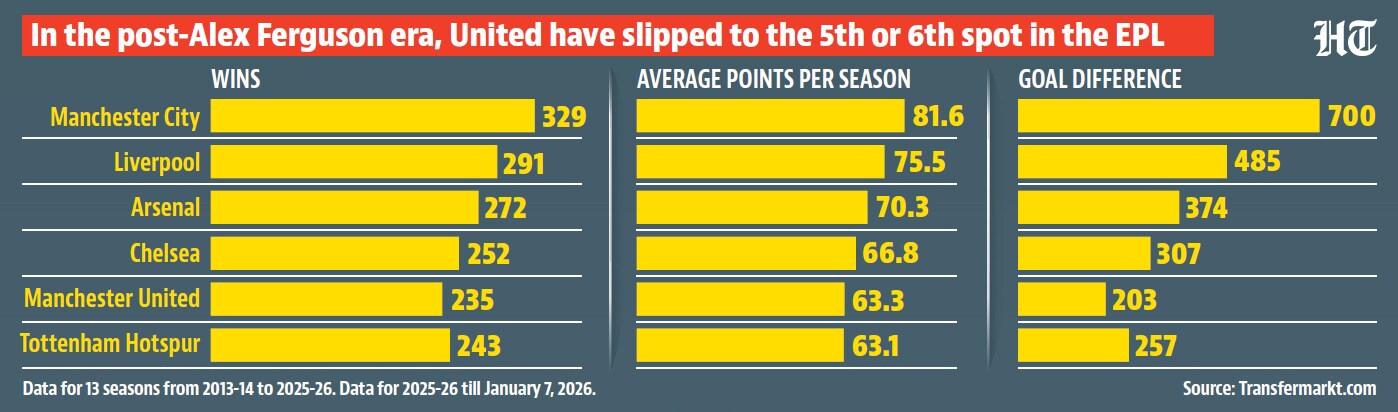
 Decade of downfallAlex Ferguson retired as manager of Manchester United after the 2012-13 season. In his 26 seasons, he secured 13 titles in the English Premier League (EPL) and two in the Champions League. Beyond the numbers, Ferguson turned United into a “theatre of dreams.” In the 13 seasons since Ferguson, United has cycled through 10 managers without success, creating an agonising narrative for fans. Meanwhile, the EPL hierarchy has shifted. The dominant force is now United’s cross-town rival, Manchester City, where Pep Guardiola has become the fixture United craves. City is followed by Liverpool and Arsenal. During these 13 seasons, among the top six EPL clubs, United has recorded the fewest wins—94 fewer than City—and the narrowest goal difference.
- High spending, low efficiencyIt is not as if the winning clubs have outspent Chelsea and United. During these 13 seasons, Chelsea spent 3.1 billion euros (approximately ₹279 billion) to buy players, the highest in the EPL. This is followed by Manchester City (2.4 billion euros or ₹216 billion) and Manchester United (2.3 billion euros or ₹207 billion). The telling difference is that United bought 205 players for its outlay, while City bought 287. This indicates that, on average, United paid significantly more per player than City. Of the 13 seasons, United was in the top three for spending in seven seasons, while Chelsea reached that bracket in 10. Other top clubs were also more effective sellers. In these 13 seasons, United incurred a net deficit—the difference between player sales and purchases—of 1.6 billion euros ( ₹144 billion), the highest in the EPL. The corresponding number for Liverpool was 763 million euros ( ₹68.6 billion).
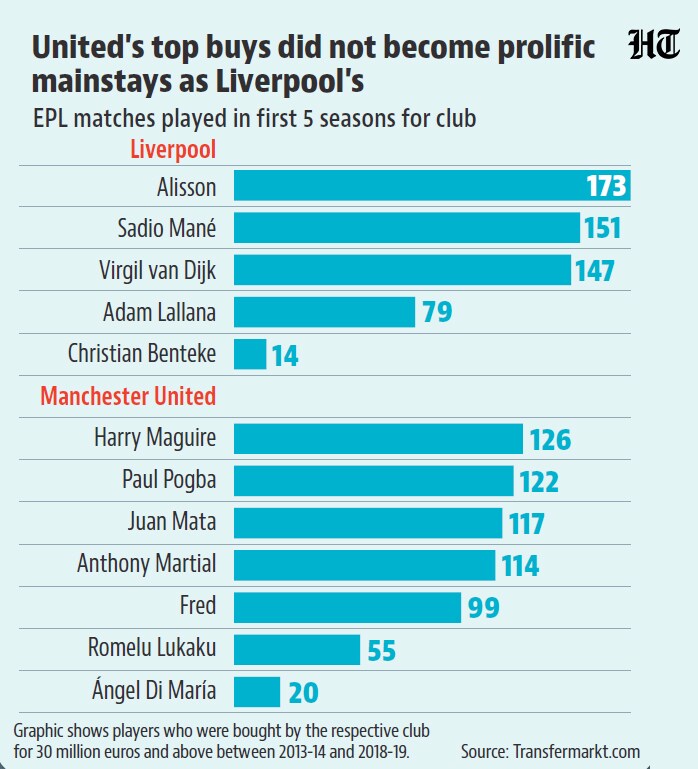
- Quality over quantityLiverpool succeeded where Manchester United failed by making its purchases count. When Liverpool spent big, it filled crucial gaps in its starting 11. Between 2013-14 and 2018-19, it bought five players for 30 million euros ( ₹2.7 billion) or more. Three of those five became cornerstones of the team: goalkeeper Alisson, defender Virgil van Dijk, and forward Sadio Mane. In their first five seasons, this trio featured in between 147 and 173 matches. Given there are 38 EPL matches a season, this represents a healthy turnout over 190 games. By comparison, none of the seven recruits in United’s “30 million-plus class” matched that performance in terms of turnout or results. Defender Harry Maguire leads this set with 126 games, but United has frequently sought to unload him.
- Spending constraintsLooking forward, United faces a dilemma regarding future transfers. Management is reluctant to spend big, and the squad lacks players who can be sold without incurring a loss. United’s current squad is the fourth-most expensive in European football based on purchase price; Chelsea’s is the most expensive. For both sides, many players were expensive at the time of purchase and their value has not appreciated. Of the top 10 clubs by purchase value, United is one of only two sitting on a value depreciation—a massive 32%. Chelsea is sitting on a near-unchanged value. By comparison, Real Madrid has seen a 47% increase in squad value and Arsenal 29%. For United and Chelsea, these figures limit options and make a rebuild difficult. (www.howindialives.com is a database and search engine for public data)
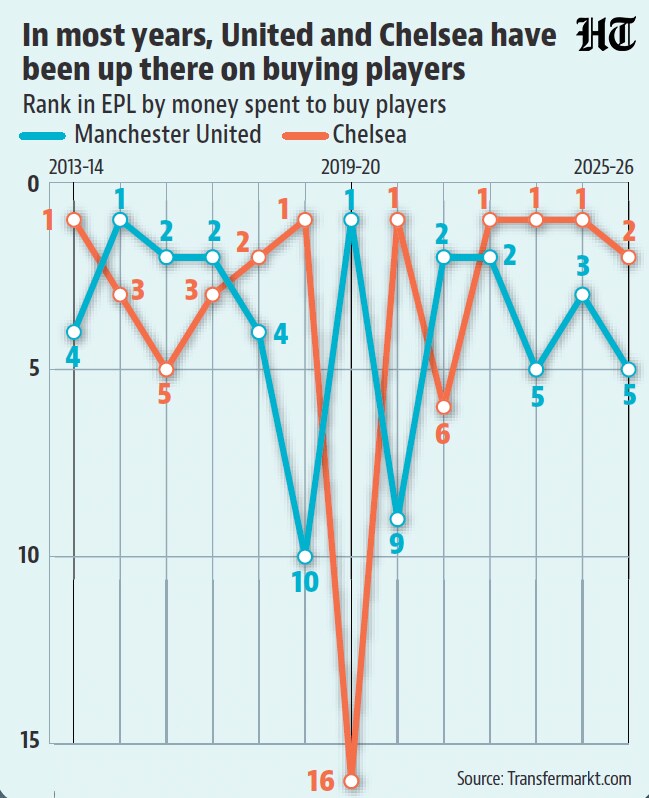
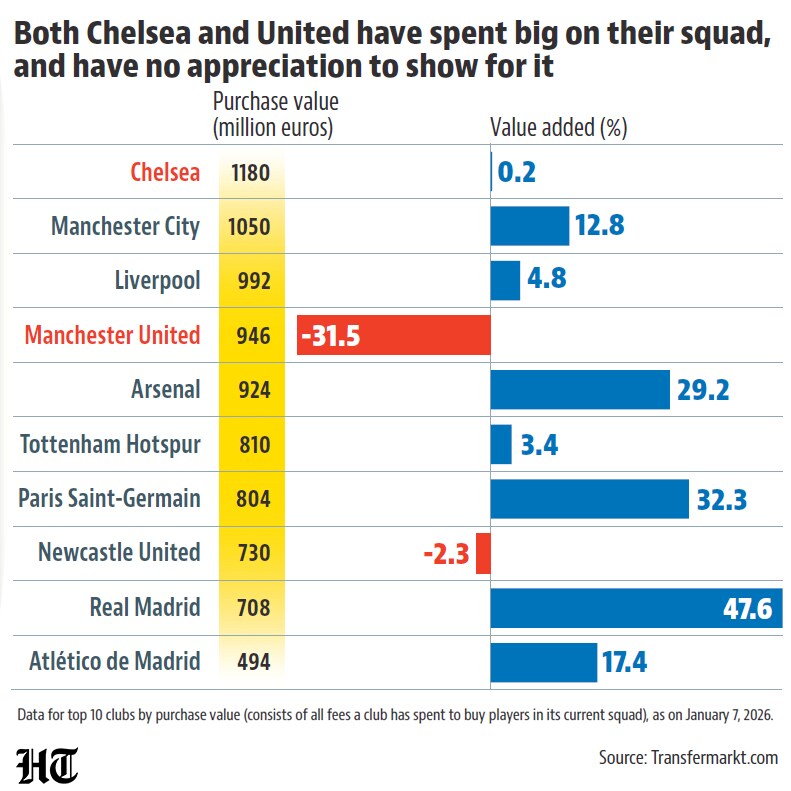
—an area that was a bone of contention for both coaches, and where neither club has distinguished itself over the past decade or so.

Unlock a world of Benefits with HT! From insightful newsletters to real-time news alerts and a personalized news feed – it's all here, just a click away! -Login Now!


