
 E-Paper



HT@100 | 1980-1989: A nation on the move
A PM is shot dead, streets run red with blood; hope returns, and HT gives voice to India’s new dreams

 Prefer HTon Google


The 1980s became a narrative of tragedy. The decade witnessed not just the assassination of a Prime Minister, but also widespread communal violence. The bloodstained peaks included the Nellie massacre in Assam in 1983 in which over 1,800 were killed, the anti-Sikh riots in 1984, the massacre of Muslims in places such as Hashimpura and Moradabad in Uttar Pradesh. It was marked by caste violence particularly in Bihar, between landed dominant “upper caste” farmers and landless Dalit farm workers. The decade also witnessed an ecological disaster in the Bhopal gas tragedy in December 1984, which killed over 3,700 people, and poisoned lives for future generations.
It was also a time of personal loss for Hindustan Times. On June 11, 1983, Ghanshyam Das Birla, who took over the reins of HT in 1926, and shaped and nurtured the paper for decades, passed away in London. HT’s page one headline was restrained, “GD Birla dies in London: Colossus of Modern Indian Industry”.
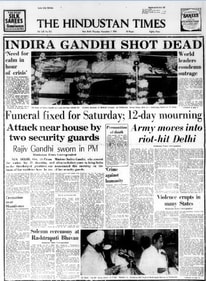
Indira Gandhi’s assassination on October 31, 1984 wounded India and shocked the world. HT’s top editorial that day “End of an era” stated: “There is horror, worldwide and universal, at the blood spilled in the Prime Minister’s residence on Wednesday morning, when Indira Gandhi was felled by assassins’ bullets. Seldom have we found a deed so abhorrent, so heinous and so outrageous. To lose a leader is sad in itself, but to lose a leader of Indira Gandhi’s stature and calibre is a calamity for the nation.”
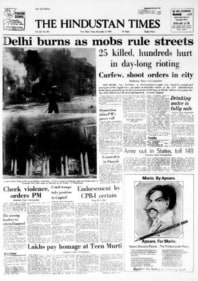
The next day the paper reported the brutal conflagration that followed: a headline read, “Delhi burns as mobs rule streets.” An editorial urged the people to “Stop this madness”. It was a scathing critique of the collapse of law and order in Delhi.
On November 8, 1984, a week after out-of-control mobs began to ravage parts of Delhi targeting Sikhs in a bloodthirsty display of rage at the assassination of Prime Minister Indira Gandhi by her bodyguards, HT published a front-page appeal authored by Krishna Kumar Birla, or KK, the paper’s chairman. Titled “Need of the Hour: Succour and Amity”, it read: “The management of The Hindustan Times has noted with great anguish the recent country-wide disturbances that erupted after the sad demise of the late Prime Minister Indira Gandhi, resulting in a large number of casualties.” It went on to remind the country of its common national identity, its ancient legacy of humanism, and advocated peace between Hindus and Sikhs. It detailed ways in which HT would help those languishing in the misery of relief camps. Official data claimed that over 3,300 people were killed in the anti-Sikh riots in the country, with most casualties in Delhi; the number of those scarred by mob violence was never fully counted.
In his autobiography, Brushes with History, KK recounted how Rajiv Gandhi, who had been appointed PM after his mother’s assassination, sought HT’s cooperation as soon as violence erupted in Delhi: one, to ensure that no articles would be published that could fan bitterness between communities; second, he requested the company to bring out a new, midday edition to “help restore peace and confidence by scotching rumours.” HT, which already had morning and evening editions, added a third edition.
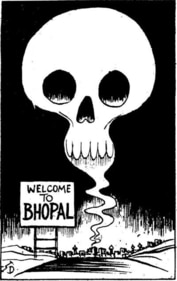
Rajiv Gandhi started his tenure as PM with another catastrophe: the Bhopal gas tragedy on December 3. Noted photojournalist N Thiagarajan’s moving pictures of grieving families, of burials, and crowded hospitals filled the pages of HT. On December 7, HT cartoonist Sudhir Dar’s heartrending strip showed smoke billowing to form a skull in the sky above a placard that read, “Welcome to Bhopal.”
Weeks later, India voted again, and the Congress under Rajiv Gandhi won more seats than ever in its past, an indication that the country was willing to trust Indira Gandhi’s son at a time of exceptional tragedy. “I too am young, and I too have a dream,” Rajiv Gandhi said as he took charge of a country that craved stability.
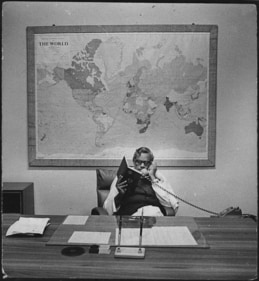
He reorganised the government, created the human resources development ministry with an emphasis on women, youth and child development programmes, revoked President’s Rule in Punjab, called for elections in Assam, and signed a peace treaty with the Mizo National Front. He introduced computers in government offices, and lowered the voting age to 18.
But the voters’ love affair with Rajiv didn’t last.
The Bofors scandal which broke out in 1987 stained the PM’s otherwise clean image, and despite the best efforts of the party and new-fangled instruments like an advertising agency (Rediffusion) as driver of the campaign, the Congress crumbled in the 1989 general elections.
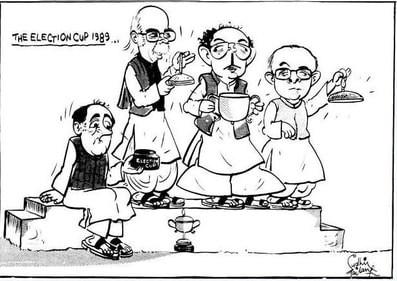
On November 28, 1989, as the results trickled in, HT’s edit “Verdict for coalition” read, “One thing seems to be clear from the election results. No party will be in a position to form a government at the Centre on its own, what the country is in for seems to be a hung parliament and a coalition government. While both the Congress-I and the Janata Dal are staking their claims, it is for the President to take an appropriate decision after studying the meaning of the mandate.”
The next day, Sudhir Tailang’s cartoon on page one captured the political situation with pithy wit. Captioned “The Election Cup 1989” it showed Rajiv Gandhi, LK Advani (of the BJP), VP Singh (Rajiv’s former finance minister who joined the Janata Dal in 1988), and Jyoti Basu (veteran Communist leader) each
Shobhana Bhartia joined HT in 1986, a time when the newspaper industry was desperate for the revolution that status quoists were unable to deliver. She transformed HT, professionalising the newsroom, preparing the newspaper for the vast post-liberalisation opportunities that would radically alter the very nature of the media and communication business. “India was changing. Needs, interests and aspirations were changing and evolving, and consumption was growing, presenting an opportunity for our industry to grow,” Bhartia said.
For KK, the newspaper remained a crusade that had played a role in nation-building; he maintained the philosophy of business he had inherited from his father, GD Birla, in 1957. Bhartia was equally loyal to this remarkable inheritance, but also understood that consumers had evolved, and technology advanced. HT had to keep in touch with change. Always ready to learn from her peers, she spent some time working across various departments of The Washington Post whose publisher, Katharine Graham, became a lifelong friend. “It was a relationship I knew I could always fall back on. Over the years, I would turn to her for advice. Later, in the 1990s, [Post] designer Michael Keegan spent time in the HT newsroom to help redesign the paper and its newer products to target younger readers,” she said.
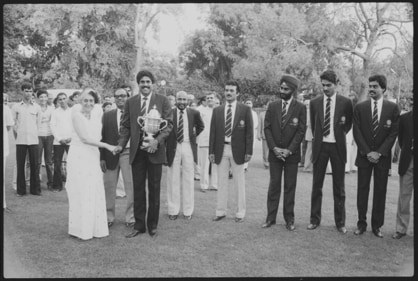
HT became the principal newspaper of a country that had learnt to dream. Dreams came in many forms, not least being the unexpected victory in the 1983 Cricket World Cup and news in 1984 that the first Indian (Rakesh Sharma) travelled to outer space.
In HT, Bhartia expanded the elasticity of the newspaper, both in the newsroom and business departments, reaching out to new audiences, and emphasising the importance of visual storytelling and forceful headlines.
Even as the middle class aspired to more material goods and greater stability, a new movement took root in urban India spearheaded by the BJP and its affiliate organisation, the Vishwa Hindu Parishad (VHP). The Ram Mandir movement had many beginnings: its roots can be traced to pre-colonial India, and certainly to 1949 when two idols were placed within the Babri Masjid prompting the government of the day to order it shut thereafter. However, it became a social and political movement in urban India in the 1980s.


