
 E-Paper



India's population is past its peak religious churn | Number Theory
.
Updated on: Aug 29, 2025, 10:25:06 IST

 Prefer HTon Google
Share via


Copy link

The first part of this series pointed out state-wise divergence in demographic trends in India and also highlighted that high growth states and districts are not necessarily the most populous ones or expected to become one. The second part will look at religion-wise demographics in the country.
India's population is past its peak religious churn
 Hindu-Muslim share in population has changed, but not drasticallyVarious census documents allow us to compare the religious break-up of India’s population from 1961 till 2011 census. 2011 is now 14 years back in time, but it is the government which decided to delay the census, which will start next year instead of 2021. The share of Hindus in India’s population was 83.5% in 1961. It has fallen to 79.8% in the 2011 census. Muslims have seen their share increase from 10.7% to 14.2%. The share of every other religious group has been largely constant. To be sure, in absolute terms, more (600 million) Hindus were added to India’s population during these 50 years compared to (125 million) Muslims. While we do have decadal religion-wise population share numbers for this period, the 1981 and 1991 numbers aren’t representative because the census was not conducted in Assam and Jammu and Kashmir in these two rounds. These two states (Jammu and Kashmir was a state in 2011) have the highest proportion of Muslims in their population in the country.
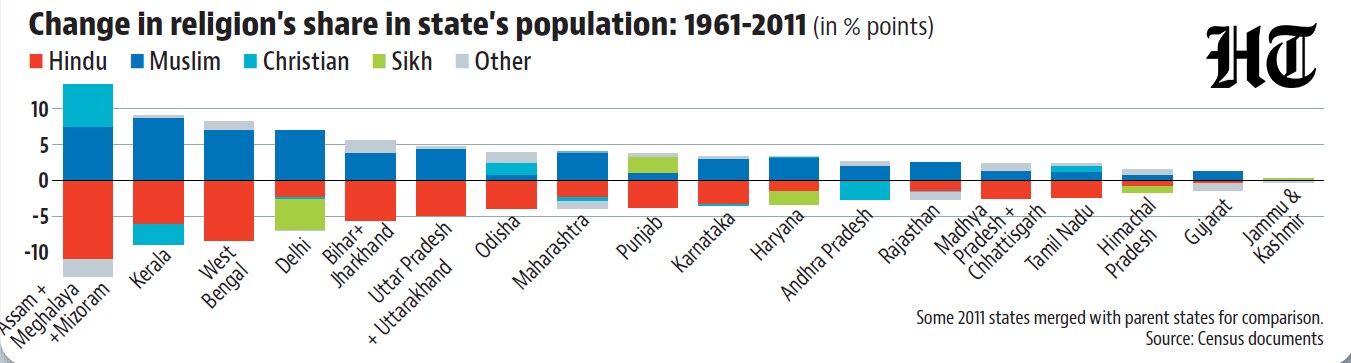
- There is a large state-wise variation in changing religious composition of populationStates such as Kerala and Assam show a much higher increase in share of Muslim population than others. On the other hand, Jammu and Kashmir, the only Muslim-majority state in 2011, did not see any big change in the share of Muslims or Hindus, according to the census numbers. To be sure, this could hide the intra-state migration from the valley to Jammu. As the accompanying chart shows, state-wise increase in the proportion of Muslims does not necessarily follow the border state logic with the exception of Assam, where migration has led to large-scale civic disorder and protests, on both religious and linguistic lines. State-level trends also show that the former state of Jammu and Kashmir, which was the only Muslim majority state in India, added more Muslims than Hindus in the 1961-2011 period in absolute terms, the only big state to do so. In the 2001-2011 period, this trend was additionally seen in Assam and Kerala.
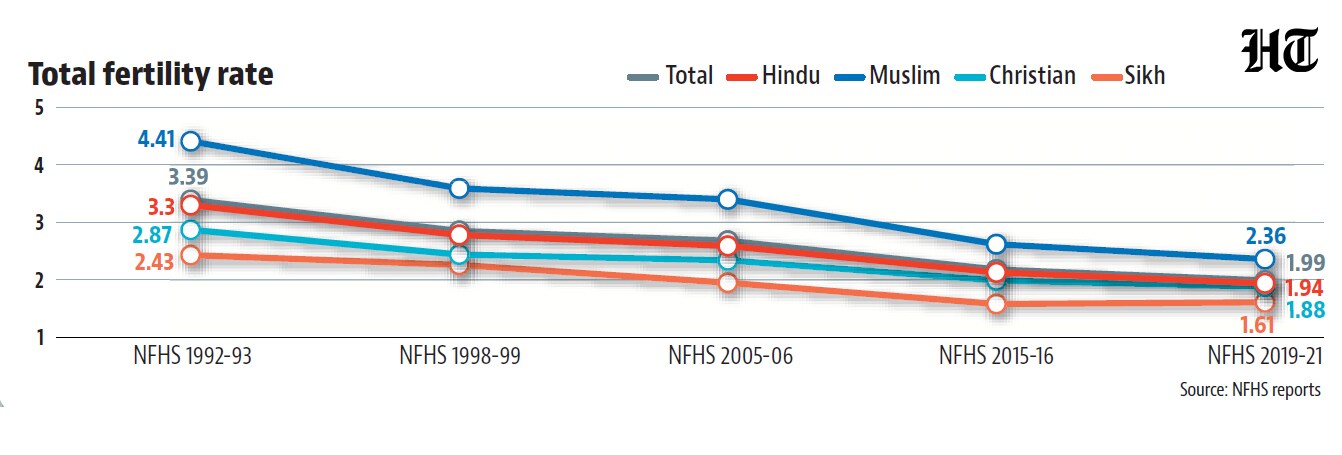
- But even Muslims are seeing a dip in their fertility rateThis is the most important statistic to keep in mind while discussing religion-wise demographics. While Muslim share in population has seen an increase , the pace of Muslim population growth is likely to come down. This can be seen from the rapidly falling total fertility rate (TFR) among Muslims. TFR is the average number of children a woman is expected to have in her lifetime. The ratio of TFR for Muslims and Hindus in the latest National Family and Health Survey round (2019-21) is the lowest since 1992-93, the earliest NFHS round. To be sure, while TFR is also determined by non-religious factors, as these pages had pointed out earlier, Muslim TFR was higher than other religious groups even after adjusting for other socio-economic indicators.
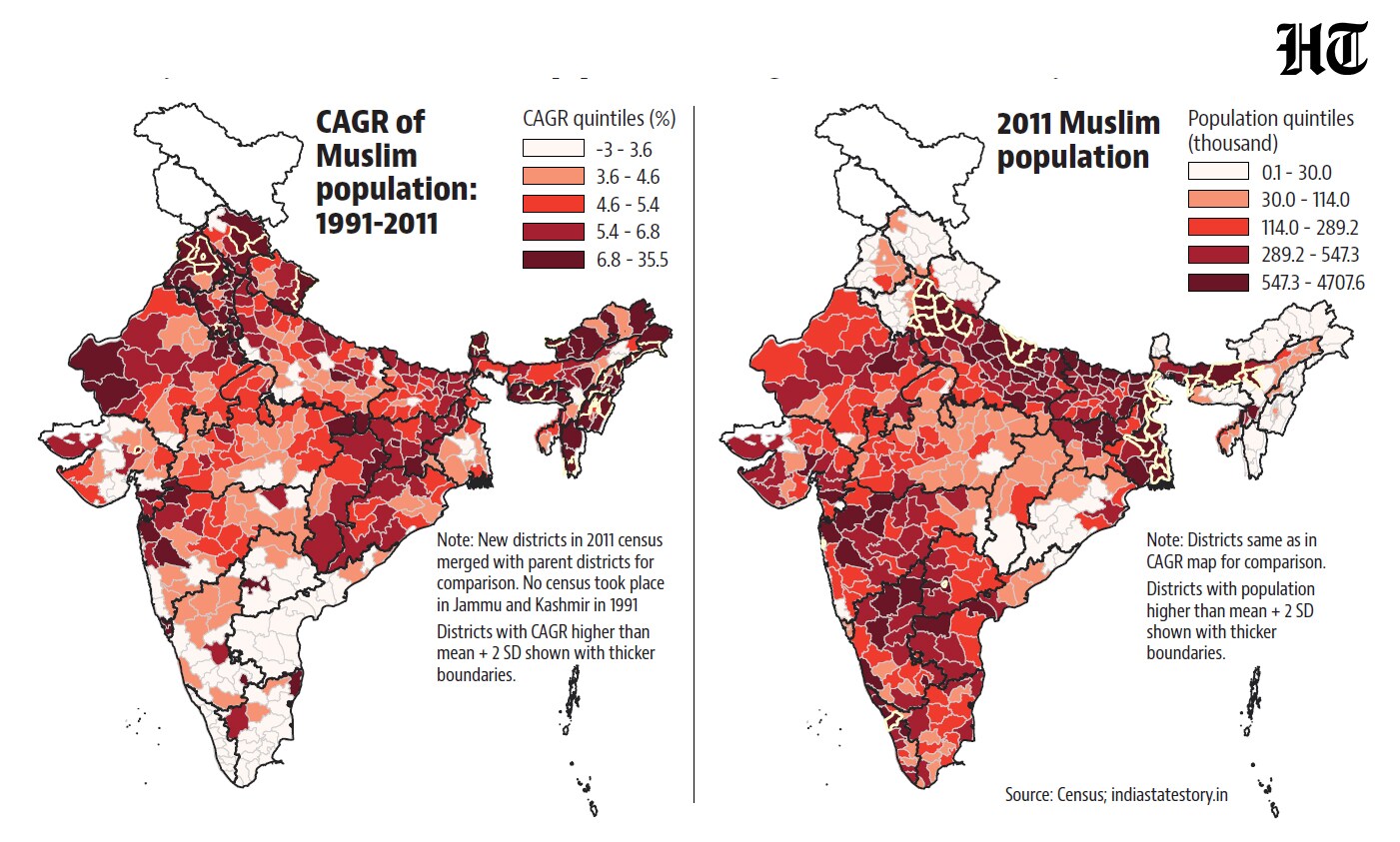
- Most districts with highest growth in Muslim population from 1991-2011 have a very low Muslim populationSince there is no back series for district population by religion, growth rate of Muslim population at the district level can be calculated only since 1991. However, as expected from the discussion in the first part of this series, the relation between Muslim population and growth rate is also weak. The median CAGR of Muslim population across 443 districts (new districts merged with parent districts for comparison) is 4.9%. The districts which are outliers on the higher side – we have taken mean plus two standard deviations to define these – in this distribution are also more likely to be districts where the Muslim population is among the lowest in the country.




Unlock a world of Benefits with HT! From insightful newsletters to real-time news alerts and a personalized news feed – it's all here, just a click away! -Login Now!


